


Page 817 - Cardiac Nursing
P. 817
98.
                          98.
                        3-7
                        3-7
                             qx
                                  0
                                  0
                               d
                                 3
                                                    Pa
                                                  M
                                                 A
                                                  M
                                                               ara
                                                       e 7
                     p78
                                                            Apt
                                                         93
                                   /
                                                 A
                                                 A
                                                 A
                                                 A
                                                 A
                                                 A
                                                 A
                                                 A
                                                 A
                                       2
                                        009
                                    0
                                     6
                                        009
                                             2:0
                                               7 A
                                            1
                                             2:0
            K34
                0-c
                  34_
            K34
         LWB K34 0-c 34_ p78 3-7 98. qx d  3 0 / 0 6 / / 2 009  1 2:0 7 A M  Pa g g e 7 93  Apt ara
         LWBK340-c34_p78p783-798.qxd  30/06/2009  12:07 AM  Page 793 Aptara
         LWB
                                                             C HAPTER  3 4 / Smoking Cessation and Relapse Prevention  793
                                                                       used in the clinical setting to help guide plans for a smoking cessa-
                      SPECIAL AREAS ON WHICH                           tion intervention. The two questions are (1) during the past
                      TO FOCUS                                         month, have you often been bothered by feeling down, depressed,
                                                                       or hopeless? and (2) during the past month, have you often been
                   Stress                                              bothered by having little interest or pleasure in doing things? If the
                                                                       patient answers “no” to both questions, the patient is unlikely to
                   Patients may often relapse to smoking during stressful times, es-  have major depression. If the patient answers “yes” to either ques-
                   pecially those involving emotional circumstances, such as argu-  tion, a follow-up clinical interview by a mental health professional
                   ments or a crisis situation with a spouse, family members, or  is recommended; alternatively, a referral to either the primary care
                   coworkers. 75  The frequency and severity ofdistressingdemands  provider or a psychiatrist is indicated. Bupropion SR should be
                   during everyday life have also been shown to be predictors oflater  considered the first-line pharmacotherapeutic agent used in pa-
                   relapse to smoking in both men and women.  106,107  Although  tients with current or past depression because it has been proven
                   some patients may need in-depth counseling to help them with  effective for both smoking cessation and depression therapy. 61
                   such problems, simple relaxation training may produce a sense of
                   increased control, which may in turn affect the patient’s confi-  Alcohol Use
                   dence to withstand the urge to smoke. Many patients can benefit
                   from the use of inexpensive relaxation audiotapes that use simple  Social situations that involve alcohol use are another predictor of
                   instructions on how to use muscle tension anddeep breathing ex-  relapse to smoking. 75  For this reason, nurses need to determine
                   ercises to achieve relaxation.                      whether the smoker attempting to quit consumes excessive alco-
                                                                       hol regularly. This information can be ascertained while taking a
                   Depression                                          smoking history by using the simple four-item CAGE question-
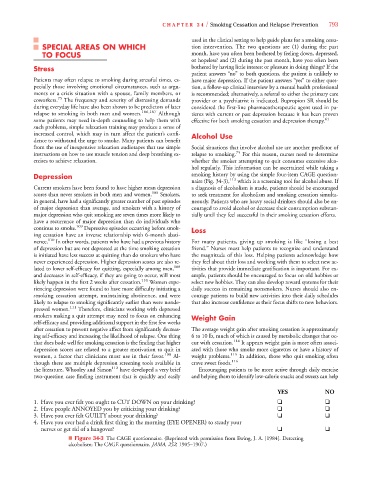
                                                                       naire (Fig. 34-3), 113  which is a screening tool for alcohol abuse. If
                   Current smokers have been found to have higher mean depression  a diagnosis of alcoholism is made, patients should be encouraged
                   scores than never smokers in both men and women. 108  Smokers,  to seek treatment for alcoholism and smoking cessation simulta-
                   in general, have had a significantly greater number of past episodes  neously. Patients who are heavy social drinkers should also be en-
                   of major depression than average, and smokers with a history of  couraged to avoid alcohol or decrease their consumption substan-
                   major depression who quit smoking are seven times more likely to  tially until they feel successful in their smoking cessation efforts.
                   have a recurrence of major depression than do individuals who
                   continue to smoke. 109  Depressive episodes occurring before smok-  Loss
                   ing cessation have an inverse relationship with 6-month absti-
                   nence. 110  In other words, patients who have had a previous history  For many patients,  giving up smoking is  like “losing a  best
                   ofdepression but are not depressed at the time smoking cessation  friend.” Nurses must help patients to recognize and understand
                   is initiatedhave less success at quitting than do smokers who have  the magnitude of this loss. Helping patients acknowledge how
                   never experienceddepression. Higher depression scores are also re-  they feel about their loss and working with them to select new ac-
                   lated to lower self-efficacy for quitting, especially among men, 108  tivities that provide immediate gratification is important. For ex-
                   anddecreases in self-efficacy, if they are going to occur, will most  ample, patients should be encouraged to focus on old hobbies or
                   likely happen in the first 2 weeks after cessation. 110  Women expe-  select new hobbies. They can also develop reward systems for their
                   riencing depression were found to have more difficulty initiating a  daily success in remaining nonsmokers. Nurses should also en-
                   smoking cessation attempt, maintaining abstinence, and were  courage patients to build new activities into their daily schedules
                   likely to relapse to smoking significantly earlier than were nonde-  that also increase confidence as their focus shifts to new behaviors.
                   pressed women. 111  Therefore, clinicians working with depressed
                   smokers making a quit attempt may need to focus on enhancing  Weight Gain
                   self-efficacy and providing additional support in the first few weeks
                   after cessation to prevent negative affect from significantly decreas-  The average weight gain after smoking cessation is approximately
                   ing self-efficacy and increasing the likelihood of relapse. One thing  6 to 10 lb, much of which is caused by metabolic changes that oc-
                   that does bode well for smoking cessation is the finding that higher  cur with cessation. 114  It appears weight gain is more often associ-
                   depression scores are related to a greater motivation to quit in  ated with those who smoke more cigarettes or have a history of
                   women, a factor that clinicians must use in their favor. 108  Al-  weight problems. 115  In addition, those who quit smoking often
                   though there are multiple depression screening tools available in  crave sweet foods. 116
                   the literature, Whooley and Simon 112  have developed a very brief  Encouraging patients to be more active through daily exercise
                   two-question case finding instrument that is quickly and easily  and helping them to identify low-calorie snacks and sweets can help
                                                                                                   YES            NO
                   1. Have you ever felt you ought to CUT DOWN on your drinking?                   ❑              ❑
                   2. Have people ANNOYED you by criticizing your drinking?                        ❑              ❑
                   3. Have you ever felt GUILTY about your drinking?                               ❑              ❑
                   4. Have you ever had a drink first thing in the morning (EYE OPENER) to steady your
                     nerves or get rid of a hangover?                                              ❑              ❑
                              ■ Figure 34-3 The CAGE questionnaire. (Reprinted with permission from Ewing, J. A. [1984]. Detecting
                                                                 2
                              alcoholism: The CAGE questionnaire. JAMA, 252, 1905–1907.)2

