


Page 886 - Cardiac Nursing
P. 886
9/2
                                  9/2
                                9/0
                               0
                                9/0
                                        0
                                        8:3
                                        0
                                    009
                                    009
                       1-8
                         75.
                       1-8
                    p86
                    p86
                           qxd
                               0
                           qxd
                         75.
                         75.
                                        8:3
                                                    62
                                                    62
                                                  e 8
                                                 g
                                                  e 8
                                                         ara
                                                         ara
                                                       Apt
                                                    62
                                                       Apt
                                             M
                                               P
                                             M
                                           6 A
                                           6 A
                                                a
                                                 g
                                                a
                                               P
                                               P
            K34
            K34
         L L LWB
         LWBK340-c38_38_p861-875.qxd  09/09/2009  08:36 AM  Page 862 Aptara
         LWB
                 38_
                 38_
               0-c
            K34
               0-c
                  862    PA R T  V / Health Promotion and Disease Prevention
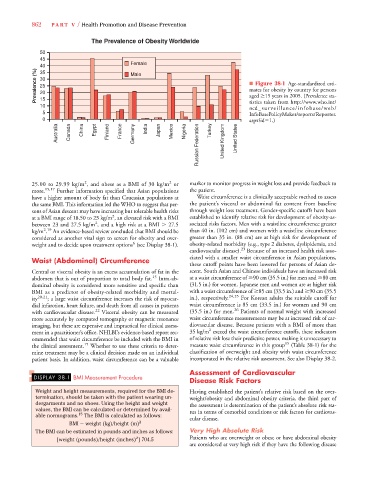
                                      The Prevalence of Obesity Worldwide
                     50
                     45
                                                   Female
                    Prevalence (%) 40              Male                                   ■ Figure 38-1 Age-standardized esti-
                     35
                     30
                     25
                                                                                          mates for obesity by country for persons
                     20
                     15
                                                                                          tistics taken from http://www.who.int/
                     10                                                                   aged  15 years in 2005. (Prevalence sta-
                                                                                          ncd_sur veillance/infobase/web/
                      5                                                                   InfoBasePolicyMaker/reports/Reporter.
                      0                                                                   aspx?id 1.)
                           Australia  Canada  China  Egypt  Finland  France  Germany  India  Japan  Mexico  Nigeria  Turkey  United States
                                                                         Russian Federation  United Kingdom
                                    2
                                                               2
                  25.00 to 29.99  kg/m , and obese as a BMI of 30 kg/m or  marker to monitor progress in weight loss and provide feedback to
                  more. 15,17  Further information specified that Asian populations  the patient.
                  have a higher amount of body fat than Caucasian populations at  Waist circumference is a clinically acceptable method to assess
                  the same BMI. This information led the WHO to suggest that per-  the  patient’s visceral or abdominal  fat content  from  baseline
                  sons of Asian descent may have increasing but tolerable health risks  through weight loss treatment. Gender-specific cutoffs have been
                                             2
                  at a BMI range of 18.50 to 23 kg/m , an elevated risk with a BMI  established to identify relative risk for development of obesity-as-
                                       2
                  between 23 and 27.5 kg/m , and a high risk at a BMI   27.5  sociated risks factors. Men with a waistline circumference greater
                      2 19
                  kg/m . An evidence-based review concluded that BMI should be  than 40 in. (102 cm) and women with a waistline circumference
                  considered as another vital sign to screen for obesity and over-  greater than 35 in. (88 cm) are at high risk for development of
                                                   6
                  weight and to decide upon treatment options (see Display 38-1).  obesity-related morbidity (e.g., type 2 diabetes, dyslipidemia, and
                                                                      cardiovascular disease). 23  Because of an increased health risk asso-
                                                                      ciated with a smaller waist circumference in Asian populations,
                  Waist (Abdominal) Circumference
                                                                      these cutoff points have been lowered for persons of Asian de-
                  Central or visceral obesity is an excess accumulation of fat in the  scent. South Asian and Chinese individuals have an increased risk
                  abdomen that is out of proportion to total body fat. 15  Intra-ab-  at a waist circumference of  90 cm (35.5 in.) for men and  80 cm
                  dominal obesity is considered more sensitive and specific than  (31.5 in.) for women. Japanese men and women are at higher risk
                  BMI as a predictor of obesity-related morbidity and mortal-  with a waist circumference of  85 cm (33.5 in.) and  90 cm (35.5
                  ityy 20,21 ; a large waist circumference increases the risk of myocar-  in.), respectively. 24,25  For Korean adults the suitable cutoff for
                  dial infarction, heart failure, and death from all causes in patients  waist circumference is 85 cm (33.5 in.) for women and 90 cm
                  with cardiovascular disease. 22  Visceral obesity can be measured  (35.5 in.) for men. 26  Patients of normal weight with increased
                  more accurately by computed tomography or magnetic resonance  waist circumference measurements may be at increased risk of car-
                  imaging, but these are expensive and impractical for clinical assess-  diovascular disease. Because patients with a BMI of more than
                                                                            2
                  ment in a practitioner’s office. NHLBI’s evidence-based report rec-  35 kg/m exceed the waist circumference cutoffs, these indicators
                  ommended that waist circumference be included with the BMI in  of relative risk lose their predictive power, making it unnecessary to
                  the clinical assessment. 15  Whether to use these criteria to deter-  measure waist circumference in this group 15  (Table 38-1) for the
                  mine treatment may be a clinical decision made on an individual  classification of overweight and obesity with waist circumference
                  patient basis. In addition, waist circumference can be a valuable  incorporated in the relative risk assessment. See also Display 38-2.
                                                                      Assessment of Cardiovascular
                   DISPLAY 38-1 BMI Measurement Procedure
                                                                      Disease Risk Factors
                    Weight and height measurements, required for the BMI de-  Having established the patient’s relative risk based on the over-
                    termination, should be taken with the patient wearing un-  weight/obesity and abdominal obesity criteria, the third part of
                    dergarments and no shoes. Using the height and weight  the assessment is determination of the patient’s absolute risk sta-
                    values, the BMI can be calculated or determined by avail-  tus in terms of comorbid conditions or risk factors for cardiovas-
                    able normograms. 15  The BMI is calculated as follows:
                                                                      cular disease.
                               BMI   weight (kg)/height (m) 2
                    The BMI can be estimated in pounds and inches as follows:  Very High Absolute Risk
                                                    2
                           [weight (pounds)/height (inches) ] 704.5   Patients who are overweight or obese or have abdominal obesity
                                                                      are considered at very high risk if they have the following disease

