


Page 888 - Cardiac Nursing
P. 888
LWBK340-c38_p861-875.qxd  09/09/2009  08:36 AM  Page 864 Aptara


                  864    PA R T  V / Health Promotion and Disease Prevention


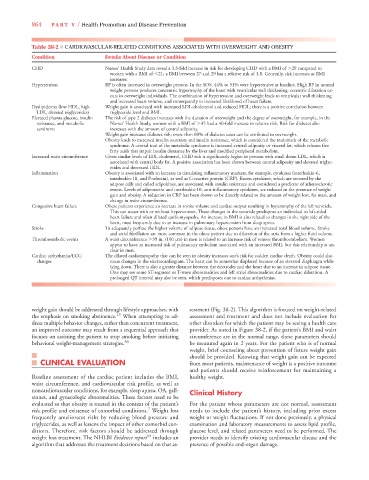
                  Table 38-2 ■ CARDIOVASCULAR-RELATED CONDITIONS ASSOCIATED WITH OVERWEIGHT AND OBESITY
                  Condition               Details About Disease or Condition
                  CHD                     Nurses’ Health Study data reveal a 3.3-fold increase in risk for developing CHD with a BMI of  29 compared to
                                            women with a BMI of  21; a BMI between 27 and 29 has a relative risk of 1.8. Generally, risk increases as BMI
                                            increases.
                  Hypertension            BP is often increased in overweight persons. In the SOS, 44% to 51% were hypertensive at baseline. High BP in normal
                                            weight persons produces concentric hypertrophy of the heart with ventricular wall thickening; eccentric dilatation oc-
                                            curs in overweight individuals. The combination of hypertension and overweight leads to ventricular wall thickening
                                            and increased heart volume, and consequently to increased likelihood of heart failure.
                  Dyslipidemia (low HDL, high   Weight gain is associated with increased LDL-cholesterol and reduced HDL; there is a positive correlation between
                    LDL, elevated triglycerides)  triglyceride level and BMI.
                  Elevated plasma glucose, insulin  The risk of type 2 diabetes increases with the duration of overweight and the degree of overweight, for example, in the
                    resistance, and metabolic  Nurses’ Health Study, women with a BMI of  35 had a 40-fold increase in relative risk. Risk for diabetes also
                    syndrome                increases with the amount of central adiposity.
                                          Weight gain increases diabetes risk; more than 60% of diabetes cases can be attributed to overweight.
                                          Obesity leads to increased insulin secretion and insulin resistance, which is considered the trademark of the metabolic
                                            syndrome. A central trait of the metabolic syndrome is increased central adiposity or visceral fat, which releases free
                                            fatty acids that impair insulin clearance by the liver and modified peripheral metabolism.
                  Increased waist circumference  Given similar levels of LDL cholesterol, CHD risk is significantly higher in persons with small dense LDL, which is
                                            associated with central body fat. A positive association has been shown between central adiposity and elevated triglyc-
                                            erides and decreased HDL.
                  Inflammation             Obesity is associated with an increase in circulating inflammatory markers, for example, cytokines (interleukin-6,
                                            interleukin-18, and P-selectin), as well as C-reactive protein (CRP). Excess cytokines, which are secreted by the
                                            adipose cells and called adipokines, are associated with insulin resistance and considered a predictor of atherosclerotic
                                            events. Levels of adiponectin and interleukin-10, anti-inflammatory cytokines, are reduced in the presence of weight
                                            gain and obesity. A reduction in CRP has been shown to be directly related to the amount of weight lost, fat mass, and
                                            change in waist circumference.
                  Congestive heart failure  Obese patients experience an increase in stroke volume and cardiac output resulting in hypertrophy of the left ventricle.
                                            This can occur with or without hypertension. These changes in the ventricle predispose an individual to left-sided
                                            heart failure and often dilated cardiomyopathy. An increase in BMI is also related to changes in the right side of the
                                            heart, most frequently due to an increase in pulmonary hypertension from sleep apnea.
                  Stroke                  To adequately perfuse the higher volume of adipose tissue, obese persons have an increased total blood volume. Stroke
                                            and atrial fibrillation are more common in the obese patient due to dilatation of the atria from a higher fluid volume.
                  Thromboembolic events   A waist circumference  39 in. (100 cm) in men is related to an increase risk of venous thromboembolism. Women
                                            appear to have an increased risk of pulmonary embolism associated with an increased BMI, but this relationship is un-
                                            clear in men.
                  Cardiac arrhythmias/ECG  The dilated cardiomyopathy that can be seen in obesity increases one’s risk for sudden cardiac death. Obesity could also
                    changes                 cause changes in the electrocardiogram. The heart can be somewhat displaced because of an elevated diaphragm while
                                            lying down. There is also a greater distance between the electrodes and the heart due to an increase in adipose tissue.
                                            One may see some ST-segment or T-wave abnormalities and left atrial abnormalities due to cardiac dilatation. A
                                            prolonged QT interval may also be seen, which predisposes one to cardiac arrhythmias.


                  weight gain should be addressed through lifestyle approaches, with  sessment (Fig. 38-2). This algorithm is focused on weight-related
                  the emphasis on smoking abstinence. 15  When attempting to ad-  assessment and treatment and does not include evaluation for
                  dress multiple behavior changes, rather than concurrent treatment,  other disorders for which the patient may be seeing a health care
                  an improved outcome may result from a sequential approach that  provider. As noted in Figure 38-2, if the patient’s BMI and waist
                  focuses on assisting the patient to stop smoking before initiating  circumference are in the normal range, these parameters should
                  behavioral weight-management strategies. 36         be measured again in 2 years. For the patient who is of normal
                                                                      weight, brief counseling about prevention of future weight gain
                                                                      should be provided. Knowing that weight gain can be expected
                     CLINICAL EVALUATION                              from most patients, maintenance of weight is a positive outcome
                                                                      and patients should receive reinforcement for maintaining a
                  Baseline assessment of the cardiac patient includes the BMI,  healthy weight.
                  waist circumference, and cardiovascular risk profile, as well as
                  noncardiovascular conditions, for example, sleep apnea, OA, gall-  Clinical History
                  stones, and gynecologic abnormalities. These factors need to be
                  evaluated so that obesity is treated in the context of the patient’s  For the patient whose parameters are not normal, assessment
                                                        7
                  risk profile and existence of comorbid conditions. Weight loss  needs to include the patient’s  history, including prior excess
                  frequently ameliorates risks  by reducing  blood pressure and  weight or weight fluctuations. If not done previously, a physical
                  triglycerides, as well as lessens the impact of other comorbid con-  examination and laboratory measurements to assess lipid profile,
                  ditions. Therefore, risk  factors should  be addressed through  glucose level, and related parameters need to be performed. The
                  weight loss treatment. The NHLBI Evidence report 15  includes an  provider needs to identify existing cardiovascular disease and the
                  algorithm that addresses the treatment decisions based on that as-  presence of possible end-organ damage.

