


Page 891 - Cardiac Nursing
P. 891
LWBK340-c38_p861-875.qxd  09/09/2009  08:36 AM  Page 867 Aptara


                                                      C HAP TE R  38 / Obesity: An Overview of Assessment and Treatment  867

                   Goal of Treatment                                   Dietary Therapy
                                                                       During weight loss treatment, the strongest determinant of the
                   The goal of weight loss is not to achieve some cosmetic standard  rate and amount of weight loss that will occur is the extent of the
                   of attractiveness, but rather to reduce morbidity and increase mo-  negative energy balance. 58  A key component of dietary therapy is
                   bility and quality of life. The recommended initial weight loss  a reduction in total caloric intake by 500 to 1,000 kcal/day, re-
                            6
                   goal is 10%; however, improvement in obesity-related risk factors  sulting in the patient consuming 800 to 1,500 kcal/day. This is re-
                   for CHD can be observed with as little as a 5% loss of initial  ferred to as a low-calorie diet and has been shown to reduce
                   weight. If a weight loss of  10% is not maintained, reductions in  weight by 8% over 6 months. A deficit of 500 kcal/day results in
                   total and LDL-cholesterol revert toward baseline. 7,53  The rate of  a weight loss of 1 lb/week (1 lb is the equivalent of 3,500 kcal).
                   loss should be approximately 0.5 to 1 lb/week for the moderately  Depending on the patient’s baseline weight and the amount of
                   obese and 1 to 2 lb/week in the severely obese. 54  weight loss desired, the patient may follow a diet ranging from
                     It is important to discuss treatment strategies and goals with  1,000 to 1,200 kcal for women and 1,200 to 1,800 kcal for
                   the patient because these have to be arrived at through mutual de-  men. 55  Programs using the lifestyle approach include nutritional
                   cision making, and there could be a discrepancy between the  education. 59  The focus of the instruction includes the energy
                   provider’s and the patient’s goals. 55  An example would be a 55-  value of food (e.g., fat contains 9 cal/g compared to protein and
                   year-old woman who has lower body obesity and no additional  carbohydrates, which contain 4 cal/g), how to read labels, the
                   risk factors but may wish to lose a certain amount of weight that  three types of fat and the recommended distribution of these in
                   may be unrealistic. This patient may achieve the loss and feel bet-  the diet, methods to reduce fat and increase fiber and complex
                   ter about her appearance, but if she is unable to sustain this loss,  carbohydrate intake, and how to prepare food to reduce the addi-
                   she will regain and feel like a failure. This person may benefit from  tion of calories. Patients also are instructed on recipe modification
                   guidance for a lower weight loss goal and exercise or a plan for sta-  and ordering from a restaurant menu; some programs include
                   bility of current weight. However, if this same woman had central  field trips to supermarkets to teach the participants how grocery
                   adiposity or presence of risk factors, she should be counseled for  shopping should be done.
                   achieving a 10% weight reduction. Another scenario might in-  An important component of dietary therapy is addressing both
                   volve an individual without additional risk factors, but a desire to  fat and caloric restriction. In general, a 20% to 30% fat diet is rec-
                   achieve a body weight that is significantly below her current  ommended and the patient is provided a daily fat gram goal along
                   weight and one she has not had since she was in her 20s. The  with the calorie goal. The recommended diet composition is con-
                                                                                     59
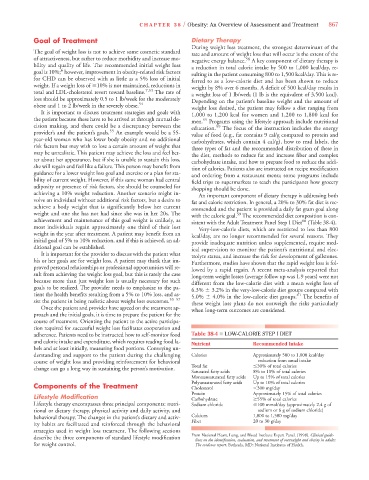
                   achievement and maintenance of this goal weight is unlikely, as  sistent with the Adult Treatment Panel Step I Diet (Table 38-4).
                                                                                                           60
                   most individuals regain approximately one third of their lost  Very-low-calorie diets, which are restricted to less than 800
                   weight in the year after treatment. A patient may benefit from an  kcal/day, are no longer recommended for several reasons. They
                   initial goal of 5% to 10% reduction, and if this is achieved, an ad-  provide inadequate nutrition unless supplemented, require med-
                   ditional goal can be established.                   ical supervision to monitor the patient’s nutritional and elec-
                     It is important for the provider to discuss with the patient what  trolyte status, and increase the risk for development of gallstones.
                   his or her goals are for weight loss. A patient may think that im-  Furthermore, studies have shown that the rapid weight loss is fol-
                   proved personal relationships or professional opportunities will re-  lowed by a rapid regain. A recent meta-analysis reported that
                   sult from achieving the weight loss goal, but this is rarely the case  long-term weight losses (average follow up was 1.9 years) were not
                   because more than just weight loss is usually necessary for such  different from the low-calorie diet with a mean weight loss of
                   goals to be realized. The provider needs to emphasize to the pa-  6.3%   3.2% in the very-low-calorie diet groups compared with
                   tient the health benefits resulting from a 5% to 10% loss, and as-  5.0%   4.0% in the low-calorie diet groups. 61  The benefits of
                   sist the patient in being realistic about weight loss outcomes. 55–57  these weight loss plans do not outweigh the risks particularly
                     Once the patient and provider have agreed on the treatment ap-  when long-term outcomes are considered.
                   proach and the initial goals, it is time to prepare the patient for the
                   course of treatment. Orienting the patient to the active participa-
                   tion required for successful weight loss facilitates cooperation and
                   adherence. Patients need to be instructed how to self-monitor food  Table 38-4 ■ LOW-CALORIE STEP I DIET
                   and caloric intake and expenditure, which requires reading food la-  Nutrient  Recommended Intake
                   bels and at least initially, measuring food portions. Conveying un-
                   derstanding and support to the patient during the challenging  Calories  Approximately 500 to 1,000 kcal/day
                   course of weight loss and providing reinforcement for behavioral         reduction from usual intake
                   change can go a long way in sustaining the person’s motivation.  Total fat   30% of total calories
                                                                       Saturated fatty acids  8% to 10% of total calories
                                                                       Monounsaturated fatty acids  Up to 15% of total calories
                                                                       Polyunsaturated fatty acids  Up to 10% of total calories
                   Components of the Treatment                         Cholesterol          300 mg/day
                                                                       Protein             Approximately 15% of total calories
                   Lifestyle Modification                               Carbohydrate         55% of total calories
                   Lifestyle therapy encompasses three principal components: nutri-  Sodium chloride   100 mmol/day (approximately 2.4 g of
                   tional or dietary therapy, physical activity and daily activity, and     sodium or 6 g of sodium chloride)
                   behavioral therapy. The changes in the patient’s dietary and activ-  Calcium  1,000 to 1,500 mg/day
                   ity habits are facilitated and reinforced through the behavioral  Fiber  20 to 30 g/day
                   strategies used in weight loss treatment. The following sections
                                                                       From National Heart, Lung, and Blood Institute Expert Panel. (1998). Clinical guide-
                   describe the three components of standard lifestyle modification
                                                                        lines on the identification, evaluation, and treatment of overweight and obesity in adults:
                   for weight control.                                  The evidence report. Bethesda, MD: National Institutes of Health.

