


Page 890 - Cardiac Nursing
P. 890
LWBK340-c38_p861-875.qxd  09/09/2009  08:36 AM  Page 866 Aptara


                  866    PA R T  V / Health Promotion and Disease Prevention

                  Patient Motivation                                  day-to-day life and increased access to high-fat, high-calorie con-
                                                                      venience food in larger portion sizes are common. 49  In addition,
                  Before considering treatment options, the patient’s motivation for  ethnic minorities might be particularly affected by the living envi-
                  engaging in weight loss treatment needs to be assessed. Embark-  ronment. For example, neighborhoods in New Orleans with 80%
                  ing on a weight loss and maintenance program requires a com-  Black residents had 2.4 fast-food restaurants per square mile com-
                  mitment to a change in lifestyle and an investment of resources by  pared to 1.5 fast-food restaurants per square mile in communities
                  the patient and the provider. Moreover, the change is not for a  with only 20% Black individuals. Black neighborhoods had access
                  limited time, but rather lifelong. Factors to consider in the initial  to six more fast-food restaurants than did mostly White neighbor-
                  assessment include the patient’s attitude toward weight loss, prior  hoods when comparing communities of similar size. Recent find-
                                                                                                           50
                  treatment failures and successes, support system, comprehension  ings revealed that persons who live in areas with a higher number
                  of risk posed by weight status, readiness to initiate lifestyle  of fast-food restaurants had a higher BMI compared with persons
                  changes, 40  self-efficacy for achieving weight loss, 41  time commit-  who live in areas with a higher number of full-service restaurants. 51
                  ment, barriers to behavior change, 42  and financial issues if the
                  treatment is not covered by insurance. Adverse medical events
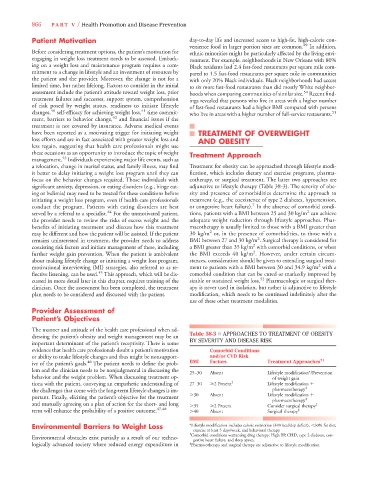
                  have been reported as a motivating trigger for initiating weight  TREATMENT OF OVERWEIGHT
                  loss efforts and are in fact associated with greater weight loss and  AND OBESITY
                  less regain, suggesting that health care professionals might use
                  these occasions as an opportunity to introduce the topic of weight  Treatment Approach
                            43
                  management. Individuals experiencing major life events, such as
                  a relocation, change in marital status, and family illness, may find  Treatment for obesity can be approached through lifestyle modi-
                  it better to delay initiating a weight loss program until they can  fication, which includes dietary and exercise programs, pharma-
                  focus on the behavior changes required. Those individuals with  cotherapy, or surgical treatment. The latter two approaches are
                  significant anxiety, depression, or eating disorders (e.g., binge eat-  adjunctive to lifestyle therapy (Table 38-3). The severity of obe-
                  ing or bulimia) may need to be treated for these conditions before  sity and presence of comorbidities determine the approach to
                  initiating a weight loss program, even if health care professionals  treatment (e.g., the coexistence of type 2 diabetes, hypertension,
                                                                                           7
                  conduct the program. Patients with eating disorders are best  or congestive heart failure). In the absence of comorbid condi-
                                                                                                            2
                  served by a referral to a specialist. 44  For the unmotivated patient,  tions, patients with a BMI between 25 and 30 kg/m can achieve
                  the provider needs to review the risks of excess weight and the  adequate weight reduction through lifestyle approaches. Phar-
                  benefits of initiating treatment and discuss how this treatment  macotherapy is usually limited to those with a BMI greater than
                                                                             2
                  may be different and how the patient will be assisted. If the patient  30 kg/m or, in the presence of comorbidities, to those with a
                                                                                            2
                  remains uninterested in treatment, the provider needs to address  BMI between 27 and 30 kg/m . Surgical therapy is considered for
                                                                                           2
                  coexisting risk factors and initiate management of these, including  a BMI greater than 35 kg/m with comorbid conditions, or when
                                                                                           2
                  further weight gain prevention. When the patient is ambivalent  the BMI exceeds 40 kg/m . However, under certain circum-
                  about making lifestyle change or initiating a weight loss program,  stances, consideration should be given to extending surgical treat-
                                                                                                                2
                  motivational interviewing (MI) strategies, also referred to as re-  ment to patients with a BMI between 30 and 34.9 kg/m with a
                                        45
                  flective listening, can be used. This approach, which will be dis-  comorbid condition that can be cured or markedly improved by
                  cussed in more detail later in this chapter, requires training of the  sizable or sustained weight loss. 52  Pharmacologic or surgical ther-
                  clinician. Once the assessment has been completed, the treatment  apy is never used in isolation, but rather is adjunctive to lifestyle
                  plan needs to be considered and discussed with the patient.  modification, which needs to be continued indefinitely after the
                                                                      use of these other treatment modalities.
                  Provider Assessment of
                  Patient’s Objectives
                  The manner and attitude of the health care professional when ad-
                  dressing the patient’s obesity and weight management may be an  Table 38-3 ■ APPROACHES TO TREATMENT OF OBESITY
                  important determinant of the patient’s receptivity. There is some  BY SEVERITY AND DISEASE RISK
                  evidence that health care professionals doubt a patient’s motivation  Comorbid Conditions
                  or ability to make lifestyle changes and thus might be nonsupport-  and/or CVD Risk
                  ive of the patient’s goals. 46  The patient needs to define the prob-  BMI  Factors  Treatment Approaches 74
                  lem and the clinician needs to be nonjudgmental in discussing the  25–30  Absent  Lifestyle modification*/Prevention
                  behavior and the weight problem. When discussing treatment op-                 of weight gain
                  tions with the patient, conveying an empathetic understanding of  27–30   2 Present †  Lifestyle modification
                  the challenges that come with the long-term lifestyle changes is im-           pharmacotherapy ‡
                  portant. Finally, eliciting the patient’s objective for the treatment   30  Absent  Lifestyle modification
                                                                                                            ‡
                                                                                                 pharmacotherapy
                  and mutually agreeing on a plan of action for the short- and long   35   2 Present  Consider surgical therapy ‡
                  term will enhance the probability of a positive outcome. 47,48   40  Absent  Surgical therapy ‡
                  Environmental Barriers to Weight Loss               *Lifestyle modification includes caloric restriction (400 kcal/day deficit),  30% fat diet,
                                                                       exercise at least 5 days/week, and behavioral therapy.
                                                                      † Comorbid conditions warranting drug therapy: High BP, CHD, type 2 diabetes, con-
                  Environmental obstacles exist partially as a result of our techno-
                                                                       gestive heart failure, and sleep apnea.
                  logically advanced society where reduced energy expenditure in  ‡ Pharmacotherapy and surgical therapy are adjunctive to lifestyle modification.

