


Page 161 - untitled
P. 161
AAAC72  21/5/05  10:59 AM  Page 160
           72 The spinal cord


                                                                                               C2
                                                                                               C3
                                                                                               C4
                                                 C2
                                                                                               C5
                                        C2                                                     C6
                                    C3            C3                                           C7
                                                                                               C8
                                   C4         T3    C4                                         T1
                                  T2    T3    T4                                               T2
                                        T4    T5
                                              T6
                                        T5    T7
                                        T6    T8        T2
                                        T7    T9
                                              T10
                                        T8    T11          C5
                             C5  T1     T9    T12                                              L1
                                       T10    L1                                               L2
                                                        T1
                                        T11                                                    L3
                        C6             T12    S1                 C6                            L4
                        C7          L1        S3       L2         C7                           L5
                                                                                               S1
                                              S4                                               S2
                           C8                 S5          C8                                   S3
                                                                                               S4
                                    L2                                                         S5


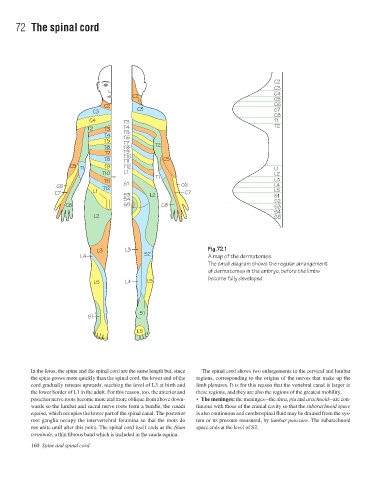
                                     L3        L3                         Fig.72.1
                                L4                   S2                   A map of the dermatomes.
                                                                          The small diagram shows the regular arrangement
                                                                          of dermatomes in the embryo, before the limbs
                                                                          become fully developed
                                    L5         L4     L5


                                                   S1
                                  S1

                                                  L5


                In the fetus, the spine and the spinal cord are the same length but, since  The spinal cord shows two enlargements in the cervical and lumbar
                the spine grows more quickly than the spinal cord, the lower end of the  regions, corresponding to the origins of the nerves that make up the
                cord gradually retreats upwards, reaching the level of L3 at birth and  limb plexuses. It is for this reason that the vertebral canal is larger in
                the lower border of L1 in the adult. For this reason, too, the anterior and  these regions, and they are also the regions of the greatest mobility.
                posterior nerve roots become more and more oblique from above down-  • The meninges: the meningesathe dura, pia and arachnoidaare con-
                wards so the lumbar and sacral nerve roots form a bundle, the cauda  tinuous with those of the cranial cavity so that the subarachnoid space
                equina, which occupies the lower part of the spinal canal. The posterior  is also continuous and cerebrospinal fluid may be drained from the sys-
                root ganglia occupy the intervertebral foramina so that the roots do   tem or its pressure measured, by lumbar puncture. The subarachnoid
                not unite until after this point. The spinal cord itself ends as the filum  space ends at the level of S2.
                terminale, a thin fibrous band which is included in the cauda equina.
                160 Spine and spinal cord

