


Page 156 - untitled
P. 156
AAAC69  21/5/05  11:00 AM  Page 155
                                                        Iris
                  Cornea
                  Aqueous
                                                        Conjunctiva
                                                                                                              Anterior
                                                                     Sinus venosus sclerae
                  humour
                                                                                                              chamber
                                                                     Conjunctiva                              Cornea
                                                                                                              Iris
                                                                     Circular and
                                                                                                              Posterior
                                                                     radiating
                                                                                                              chamber
                                                                     ciliary muscles
                  Choroid                               Retina                                                Lens
                                                                     Sclera
                  Sclera
                                                        Vitreous     Choroid                    Suspensory
                                                        body                                    ligament
                                                        Fovea
                  Optic nerve                           centralis
                  Sheath of                             Central      Fig.69.4
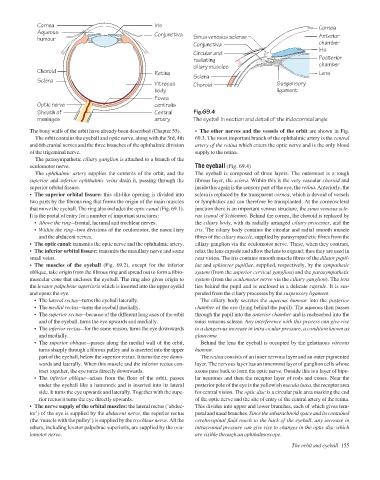
                  meninges                              artery       The eyeball in section and detail of the iridocorneal angle
               The bony walls of the orbit have already been described (Chapter 55).  • The other nerves and the vessels of the orbit are shown in Fig.
                 The orbit contains the eyeball and optic nerve, along with the 3rd, 4th  69.3. The most important branch of the ophthalmic artery is the central
               and 6th cranial nerves and the three branches of the ophthalmic division  artery of the retina which enters the optic nerve and is the only blood
               of the trigeminal nerve.                              supply to the retina.
                 The parasympathetic ciliary ganglion is attached to a branch of the
               oculomotor nerve.                                     The eyeball (Fig. 69.4)
                 The ophthalmic artery supplies the contents of the orbit, and the  The eyeball is composed of three layers. The outermost is a tough
               superior and inferior ophthalmic veins drain it, passing through the  fibrous layer, the sclera. Within this is the very vascular choroid and
               superior orbital fissure.                              inside this again is the sensory part of the eye, the retina. Anteriorly, the
               • The superior orbital fissure: this slit-like opening is divided into  sclera is replaced by the transparent cornea, which is devoid of vessels
               two parts by the fibrous ring that forms the origin of the main muscles  or lymphatics and can therefore be transplanted. At the corneoscleral
               that move the eyeball. The ring also includes the optic canal (Fig. 69.1).  junction there is an important venous structure, the sinus venosus scle-
               It is the portal of entry for a number of important structures:  rae (canal of Schlemm). Behind the cornea, the choroid is replaced by
                 • Above the ringafrontal, lacrimal and trochlear nerves.  the ciliary body, with its radially arranged ciliary processes, and the
                 • Within the ringatwo divisions of the oculomotor, the nasociliary  iris. The ciliary body contains the circular and radial smooth muscle
                  and the abducent nerves.                           fibres of the ciliary muscle, supplied by parasympathetic fibres from the
               • The optic canal: transmits the optic nerve and the ophthalmic artery.  ciliary ganglion via the oculomotor nerve. These, when they contract,
               • The inferior orbital fissure: transmits the maxillary nerve and some  relax the lens capsule and allow the lens to expand; thus they are used in
               small veins.                                          near vision. The iris contains smooth muscle fibres of the dilator pupil-
               • The muscles of the eyeball (Fig. 69.2), except for the inferior  lae and sphincter pupillae, supplied, respectively, by the sympathetic
               oblique, take origin from the fibrous ring and spread out to form a fibro-  system (from the superior cervical ganglion) and the parasympathetic
               muscular cone that encloses the eyeball. The ring also gives origin to  system (from the oculomotor nerve via the ciliary ganglion). The lens
               the levator palpebrae superioris which is inserted into the upper eyelid  lies behind the pupil and is enclosed in a delicate capsule. It is sus-
               and opens the eye.                                    pended from the ciliary processes by the suspensory ligament.
                 • The lateral rectusaturns the eyeball laterally.     The ciliary body secretes the  aqueous humour into the  posterior
                 • The medial rectusaturns the eyeball medially.     chamber of the eye (lying behind the pupil). The aqueous then passes
                 • The superior rectusabecause of the different long axes of the orbit  through the pupil into the anterior chamber and is reabsorbed into the
                  and of the eyeball, turns the eye upwards and medially.  sinus venosus sclerae. Any interference with this process can give rise
                 • The inferior rectusafor the same reason, turns the eye downwards  to a dangerous increase in intra-ocular pressure, a condition known as
                  and medially.                                      glaucoma.
                 • The superior obliqueapasses along the medial wall of the orbit,  Behind the lens the eyeball is occupied by the gelatinous vitreous
                  turns sharply through a fibrous pulley and is inserted into the upper  humour.
                  part of the eyeball, below the superior rectus. It turns the eye down-  The retina consists of an inner nervous layer and an outer pigmented
                  wards and laterally. When this muscle and the inferior rectus con-  layer. The nervous layer has an innermost layer of ganglion cells whose
                  tract together, the eye turns directly downwards.  axons pass back to form the optic nerve. Outside this is a layer of bipo-
                 • The inferior obliqueaarises from the floor of the orbit, passes  lar neurones and then the receptor layer of rods and cones. Near the
                  under the eyeball like a hammock and is inserted into its lateral  posterior pole of the eye is the yellowish macula lutea, the receptor area
                  side. It turns the eye upwards and laterally. Together with the supe-  for central vision. The optic disc is a circular pale area marking the end
                  rior rectus it turns the eye directly upwards.     of the optic nerve and the site of entry of the central artery of the retina.
               • The nerve supply of the orbital muscles: the lateral rectus (‘abduc-  This divides into upper and lower branches, each of which gives tem-
               tor’) of the eye is supplied by the abducent nerve, the superior rectus  poral and nasal branches. Since the subarachnoid space and its contained
               (the ‘muscle with the pulley’) is supplied by the trochlear nerve. All the  cerebrospinal fluid reach to the back of the eyeball, any increase in
               others, including levator palpebrae superioris, are supplied by the ocu-  intracranial pressure can give rise to changes in the optic disc which
               lomotor nerve.                                        are visible through an ophthalmoscope.
                                                                                                     The orbit and eyeball 155

