


Page 65 - untitled
P. 65
AAAC27  21/5/05  10:45 AM  Page 64
                                                  Olecranon
                                                                  Trochlear
                                                                  notch
                                                                  Head
                          Coronoid
                                                                  of
                          process
                                                                  radius
                                                                  Supinator
                          Radial
                                                                  crest
                          tuberosity
                                                                  Tuberosity
                                                                  of the
                                                                  ulna
                       Attachment
                       of
                       pronator
                       teres
                       Interosseous
                       borders
                                                                  Dorsal
                                                                  tubercle
                                                                  Head
                       Ulna styloid                               of ulna
                                                                                      Fig.27.6
                       Fig.27.5      Radial styloid                                   X-ray of a  fracture of the lower end
                       The left radius and ulna in (a) supination and (b) pronation   of the radius (Colles' fracture)


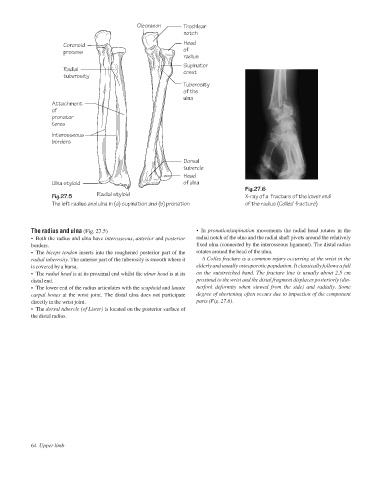
                The radius and ulna (Fig. 27.5)                       • In  pronation/supination movements the radial head rotates in the
                • Both the radius and ulna have interosseous, anterior and posterior  radial notch of the ulna and the radial shaft pivots around the relatively
                borders.                                              fixed ulna (connected by the interosseous ligament). The distal radius
                • The biceps tendon inserts into the roughened posterior part of the  rotates around the head of the ulna.
                radial tuberosity. The anterior part of the tuberosity is smooth where it  A Colles fracture is a common injury occurring at the wrist in the
                is covered by a bursa.                                elderly and usually osteoporotic population. It classically follows a fall
                •The radial head is at its proximal end whilst the ulnar head is at its  on the outstretched hand. The fracture line is usually about 2.5 cm
                distal end.                                           proximal to the wrist and the distal fragment displaces posteriorly (din-
                • The lower end of the radius articulates with the scaphoid and lunate  nerfork deformity when viewed from the side) and radially. Some
                carpal bones at the wrist joint. The distal ulna does not participate  degree of shortening often occurs due to impaction of the component
                directly in the wrist joint.                          parts (Fig. 27.6).
                • The dorsal tubercle (of Lister) is located on the posterior surface of
                the distal radius.


                64 Upper limb

