


Page 66 - untitled
P. 66
AAAC27  21/5/05  10:45 AM  Page 65
                                     Lunate
                                     Triquetral                          Tubercle of scaphoid
                                                                         Trapezium
                                     Pisiform
                                                                         Trapezoid
                                                                         Capitate
                                     Hook of hamate


                                                                                Pisiform
                                                                                Triquetral
                                                                                Lunate


                                                                       Flexor retinaculum
                                                                      Scaphoid

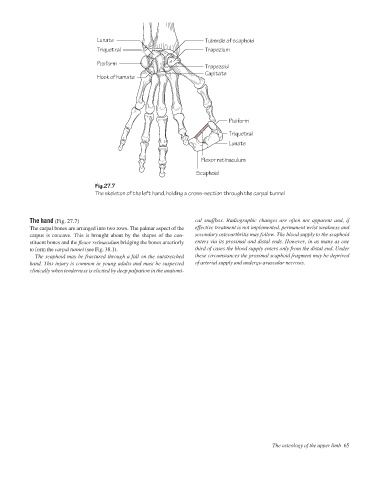
                                     Fig.27.7
                                     The skeleton of the left hand, holding a cross-section through the carpal tunnel


               The hand (Fig. 27.7)                                  cal snuffbox. Radiographic changes are often not apparent and, if
               The carpal bones are arranged into two rows. The palmar aspect of the  effective treatment is not implemented, permanent wrist weakness and
               carpus is concave. This is brought about by the shapes of the con-  secondary osteoarthritis may follow. The blood supply to the scaphoid
               stituent bones and the flexor retinaculum bridging the bones anteriorly  enters via its proximal and distal ends. However, in as many as one
               to form the carpal tunnel (see Fig. 38.1).            third of cases the blood supply enters only from the distal end. Under
                 The scaphoid may be fractured through a fall on the outstretched  these circumstances the proximal scaphoid fragment may be deprived
               hand. This injury is common in young adults and must be suspected  of arterial supply and undergo avascular necrosis.
               clinically when tenderness is elicited by deep palpation in the anatomi-


                                                                                               The osteology of the upper limb 65

