


Page 176 - Color Atlas Of Pathophysiology (S Silbernagl Et Al, Thieme 2000)
P. 176
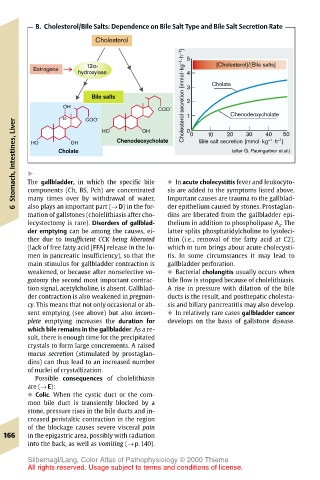
B.  Cholesterol/Bile Salts: Dependence on Bile Salt Type and Bile Salt Secretion Rate
                      Cholesterol


                     12α-                  5      [Cholesterol]/[Bile salts]
         Estrogens  hydroxylase            4

                      Bile salts          Cholesterol secretion [mmol·kg –1 ·h –1 ]  3 2  Cholate
               OH                    COO –  1        Chenodeoxycholate
    Liver  HO  12  OH  COO –  HO  Chenodeoxycholate  0 0  Bile salt secretion [mmol·kg ·h ] 50
                                 OH
                                                10
                                                    20
                                                        30
                                                             40
    Stomach, Intestines,  "  Cholate   ! In acute cholecystitis fever and leukocyto-
                                                             –1
                                                               –1
                                                     (after G. Paumgartner et al.)
       The gallbladder, in which the specific bile
       many times over by withdrawal of water,
                                       Important causes are trauma to the gallblad-
       also plays an important part (→ D) in the for-
                                       der epithelium caused by stones. Prostaglan-
    6  components (Ch, BS, Pch) are concentrated  sis are added to the symptoms listed above.
       mation of gallstones (cholelithiasis after cho-  dins are liberated from the gallbladder epi-
       lecystectomy is rare). Disorders of gallblad-  thelium in addition to phospholipase A 2 . The
       der emptying can be among the causes, ei-  latter splits phosphatidylcholine to lysoleci-
       ther due to insufficient CCK being liberated  thin (i.e., removal of the fatty acid at C2),
       (lack of free fatty acid [FFA] release in the lu-  which in turn brings about acute cholecysti-
       men in pancreatic insufficiency), so that the  tis. In some circumstances it may lead to
       main stimulus for gallbladder contraction is  gallbladder perforation.
       weakened, or because after nonselective va-  ! Bacterial cholangitis usually occurs when
       gotomy the second most important contrac-  bile flow is stopped because of cholelithiasis.
       tion signal, acetylcholine, is absent. Gallblad-  A rise in pressure with dilation of the bile
       der contraction is also weakened in pregnan-  ducts is the result, and posthepatic cholesta-
       cy. This means that not only occasional or ab-  sis and biliary pancreatitis may also develop.
       sent emptying (see above) but also incom-  ! In relatively rare cases gallbladder cancer
       plete emptying increases the duration for  develops on the basis of gallstone disease.
       which bile remains in the gallbladder. As a re-
       sult, there is enough time for the precipitated
       crystals to form large concrements. A raised
       mucus secretion (stimulated by prostaglan-
       dins) can thus lead to an increased number
       of nuclei of crystallization.
         Possible consequences of cholelithiasis
       are (→ E):
       ! Colic. When the cystic duct or the com-
       mon bile duct is transiently blocked by a
       stone, pressure rises in the bile ducts and in-
       creased peristaltic contraction in the region
       of the blockage causes severe visceral pain
  166  in the epigastric area, possibly with radiation
       into the back, as well as vomiting (→ p.140).
       Silbernagl/Lang, Color Atlas of Pathophysiology © 2000 Thieme
       All rights reserved. Usage subject to terms and conditions of license.

