


Page 256 - Color Atlas Of Pathophysiology (S Silbernagl Et Al, Thieme 2000)
P. 256
Abnormalities of Lipoprotein Metabolism
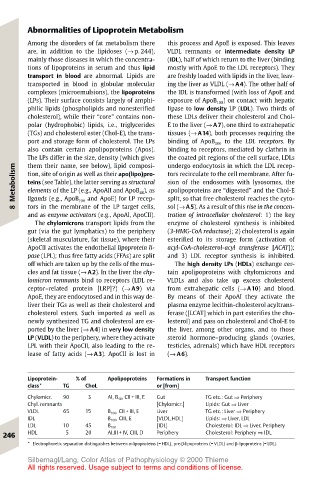
       Among the disorders of fat metabolism there  this process and ApoE is exposed. This leaves
       are, in addition to the lipidoses (→ p. 244),  VLDL remnants or intermediate density LP
       mainly those diseases in which the concentra-  (IDL), half of which return to the liver (binding
       tions of lipoproteins in serum and thus lipid  mostly with ApoE to the LDL receptors). They
       transport in blood are abnormal. Lipids are  are freshly loaded with lipids in the liver, leav-
       transported in blood in globular molecular  ing the liver as VLDL (→ A4). The other half of
       complexes (microemulsions), the lipoproteins  the IDL is transformed (with loss of ApoE and
       (LPs). Their surface consists largely of amphi-  exposure of ApoB 100 ) on contact with hepatic
       philic lipids (phospholipids and nonesterified  lipase to low density LP (LDL). Two thirds of
       cholesterol), while their “core” contains non-  these LDLs deliver their cholesterol and Chol-
       polar (hydrophobic) lipids, i.e., triglycerides  E to the liver (→ A7), one third to extrahepatic
       (TGs) and cholesterol ester (Chol-E), the trans-  tissues (→ A14), both processes requiring the
       port and storage form of cholesterol. The LPs  binding of ApoB 100 to the LDL receptors. By
       also contain certain apolipoproteins (Apos).  binding to receptors, mediated by clathrin in
       The LPs differ in the size, density (which gives  the coated pit regions of the cell surface, LDLs
       them their name, see below), lipid composi-
                                       undergo endocytosis in which the LDL recep-
    Metabolism  tion, site of origin as well as their apo(lipo)pro-  tors recirculate to the cell membrane. After fu-
       teins (see Table), the latter serving as structural
                                       sion of the endosomes with lysosomes, the
                                       apolipoproteins are “digested” and the Chol-E
       elements of the LP (e.g., ApoAII and ApoB 48 ), as
                                       sol (→ A5). As a result of this rise in the concen-
       tors in the membrane of the LP target cells,
    8  ligands (e.g., ApoB 100 and ApoE) for LP recep-  split, so that free cholesterol reaches the cyto-
       and as enzyme activators (e.g., ApoAI, ApoCII).  tration of intracellular cholesterol: 1) the key
         The chylomicrons transport lipids from the  enzyme of cholesterol synthesis is inhibited
       gut (via the gut lymphatics) to the periphery  (3-HMG-CoA reductase); 2) cholesterol is again
       (skeletal musculature, fat tissue), where their  esterified to its storage form (activation of
       ApoCII activates the endothelial lipoprotein li-  acyl-CoA-cholesterol-acyl transferase [ACAT]);
       pase (LPL); thus free fatty acids (FFAs) are split  and 3) LDL receptor synthesis is inhibited.
       off which are taken up by the cells of the mus-  The high density LPs (HDLs) exchange cer-
       cles and fat tissue (→ A2). In the liver the chy-  tain apolipoproteins with chylomicrons and
       lomicron remnants bind to receptors (LDL re-  VLDLs and also take up excess cholesterol
       ceptor–related protein [LRP]?) (→ A9) via  from extrahepatic cells (→ A10) and blood.
       ApoE, they are endocytosed and in this way de-  By means of their ApoAI they activate the
       liver their TGs as well as their cholesterol and  plasma enzyme lecithin-cholesterol acyltrans-
       cholesterol esters. Such imported as well as  ferase ([LCAT] which in part esterifies the cho-
       newly synthesized TG and cholesterol are ex-  lesterol) and pass on cholesterol and Chol-E to
       ported by the liver (→ A4) in very low density  the liver, among other organs, and to those
       LP (VLDL) to the periphery, where they activate  steroid hormone–producing glands (ovaries,
       LPL with their ApoCII, also leading to the re-  testicles, adrenals) which have HDL receptors
       lease of fatty acids (→ A3). ApoCII is lost in  (→ A6).

       Lipoprotein-  % of  Apolipoproteins  Formations in  Transport function
       class*  TG   ChoL            or [from]
       Chylomicr.  90  3  AI, B 48 , CII + III, E  Gut  TG etc.: Gut ⇒ Periphery
       Chyl. remnants               [Chylomicr.]  Lipids: Gut ⇒ Liver
       VLDL    65   15   B 100 , CII + III, E  Liver  TG etc.: Liver ⇒ Periphery
       IDL               B 100 , CIII, E  [VLDL,HDL]  Lipids: ⇒ Liver, LDL
       LDL     10   45   B 100      [IDL]      Cholesterol: IDL ⇒ Liver, Periphery
  246  HDL      5   20   AI,III + IV, CIII, D  Periphery  Cholesterol: Periphery ⇒ IDL
       * Electrophoretic separation distinguishes between α-lipoproteins (= HDL), pre-β-lipoproteins (= VLDL) and β-lipoproteins (= LDL).
       Silbernagl/Lang, Color Atlas of Pathophysiology © 2000 Thieme
       All rights reserved. Usage subject to terms and conditions of license.

