


Page 95 - Encyclopedia of Nursing Research
P. 95
62  n  CLInICAL JUDGMEnT


           interview and observe nurses with varying                Table 1
           degrees  of  clinical  expertise.  In  the  inter-  Four Phases of the Tanner CJM
   C       view process, nurses were asked to describe
           outstanding  clinical  situations  from  their   CJM Aspect  Description
           practice. Benner found that a holistic grasp   noticing  Perceiving the situation based
           of clinical situations is a necessary precur-        on clinical knowledge, clinical
                                                                experience, and knowing the patient
           sor  to  expert  clinical  judgment  (Benner,   Interpreting  Developing a deep understanding of
           1984).  Subsequent  research  supports  these        the situation
           findings and discriminates  between differ-  Responding  Intervening based on clinical
           ences in clinical judgment among clinicians          reasoning
           with varying levels of experience (Corcoran,   Reflecting   Reading the patient response to
           1986). In a 6-year interpretive study of nurs-       interventions and making
                                                                  adjustments to care based on that
           ing  practice,  Benner  et  al.  (1996)  identified      response; ongoing deliberation of
           five  interrelated  aspects  of  clinical  judg-     practice to secure lessons learned
           ment:  (1)  disposition  toward  what  is  good   From Tanner, 2006.
           and right, (2) extensive practical knowledge,
           (3)  emotional  responses  to  the  context  of  a
           clinical situation, (4) intuition, and (5) role of   Using  the  CJM  as  a  conceptual  frame-
           narrative in understanding a patient’s story,   work, Lasater (2007) developed the Clinical
           meanings, intents and concerns. The authors   Judgment  Rubric  to  provide  a  means  to
           suggested that these aspects play a signifi-  describe and quantify levels of performance
           cant  role  in  clinical  judgment  and  deserve   in clinical judgment. neilson further devel-
           equal  consideration  along  with  the  aspects   oped  this  work  though  development  of  the
           arising  from  the  “rationalistic”  perspective   CJM  study  guide  that  uses  the  phases  of
           of clinical judgment.                    Tanner’s  model  to  assist  students  in  appli-
              on the basis of a critical review of liter-  cation  of  the  model  to  assigned  patients  in
           ature published through 2004, Tanner (2006)   clinical practice (nielsen, Stragnell, & Jester,
           proposed  an  alternative  model  of  clinical   2007). Together, the Clinical Judgment Rubric
           judgment.  The  Tanner  Clinical  Judgment   and  the  study  guide  provide  an  evaluation
           Model  (CJM)  represents  the  complexity  of   framework  to  assist  faculty  and  preceptors
           the construct including its interrelation with   in recognizing and evaluating clinical judg-
           the nurses’ background, the situational con-  ment skills in more novice nurses. In addi-
           text,  and  the  degree  to  which  knowing  the   tion, these tools provide guiding principles
           patient influences interpretation of findings,   and  a  standardized  language  for  offering
           response,  and  reflection  on  that  response   feedback to students as they work to develop
           (Tanner, 2006). The CJM proposes a nonlinear   clinical judgment skills.
           process  that  characterizes  the  clinical  judg-  Although early research on clinical judg-
           ment skills used by expert nurses. However,   ment identified two divergent but legitimate
           the  model  supports  the  diagnosis  of  break-  perspectives  of  rationalistic  and  phenome-
           down in clinical judgment with novice nurses   nological approaches, the more recent work
           by faculty members and preceptors. The CJM   (Lasater,  2007;  neilson  2007;  Tanner,  2006)
           also supports self-diagnosis of lapses in clin-  indicates signs of convergence. The challenge
           ical  judgment  by  more  experienced  nurses   for future research is continued integration
           through self-reflection on practice. The CJM   of these perspectives to apply what is known
           includes four distinct yet iterative phases: (1)   and to study the impact of integrated models
           noticing, (2) interpreting, (3) responding, and   on clinical reasoning and patient outcomes.
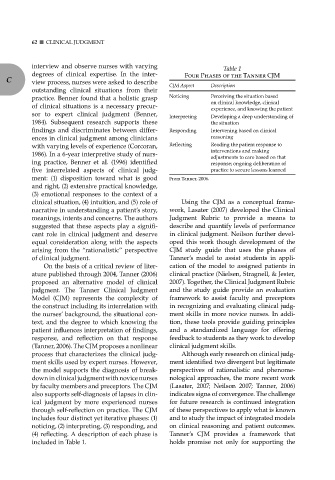
           (4) reflecting. A description of each phase is   Tanner’s  CJM  provides  a  framework  that
           included in Table 1.                     holds  promise  not  only  for  supporting  the

