


Page 148 - ACCCN's Critical Care Nursing
P. 148
Essential Nursing Care of the Critically Ill Patient  125

                                                                  prophylaxis and pressure injury prevention, along with a
               Practice tip                                       thorough assessment of physical care needs and a subse-
                                                                  quent  plan  of  management.  Consideration  of  factors
               If ceasing nutrition during the patient transport, make sure that   such as limb function, which may ultimately reduce the
               the  patient  is  not  at  risk  of  hypoglycaemia  from  concurrent   deficits  in  physical  function  often  experienced  at  least
               insulin therapy.                                   transiently by critically ill patients, is another component
                                                                  of essential nursing care of the critically ill patient. Recov-
                                                                  ery  for  patients  to  normal  functioning  after  a  critical
                                                                  illness is dependent upon a multitude of factors, and is
                                                                  a dynamic process over time, however, much of the essen-
             The need for monitoring relates to both the patient and   tial nursing care given to critically ill patients assists in
             equipment, and is identified in Table 6.16. 158  Some moni-  both  reducing  deficits  associated  with  their  episode  of
             toring  should  be  continuous,  such  as  cardiac,  oxygen   illness  and  reducing  the  time  taken  to  achieve  normal
             saturation, capnography if the patient is intubated, and   functioning.
             arterial, pulmonary artery and intracranial monitoring if
             the respective devices are in situ. Intermittent monitoring   Good personal hygiene is at the heart of essential nursing
             of central venous pressure CVP, non-invasive blood pres-  care,  and  many  other  aspects  of  essential  care  (e.g.  eye
             sure and respiratory rate should be undertaken as indi-  care and oral care) are closely related. Personal hygiene
             cated by the patient’s condition. 158,166            is often attended to when patients are repositioned, and
                                                                  whenever they are moved the nurse has an opportunity
             A  complete  record  should  be  kept  of  all  details  of  the   to assess patients, particularly their dependent pressure
             patient’s  condition,  personnel  involved,  clinical  events,   areas.
             observations  and  therapy  given  during  transport.  The
             transporting team should hand over directly to the receiv-  Bowel  and  urinary  catheter  care  are  vital  but  often
             ing team providing continuing care for the patient, 163,167    neglected areas of care. When patients are critically ill, the
             or should remain during the intervention/procedure to   development of preventable complications such as con-
             manage the patient’s care.                           stipation and urinary tract infection may have significant
                                                                  consequences for them.
             SUMMARY                                              All critically ill patients are at risk of infection, and essen-
                                                                  tial nursing care requires effective application of surveil-
             In the management of critically ill patients there is always
             an  initial  focus  on  assessing  and  treating  the  patient’s   lance,  prevention  and  control  measures  that  should  be
             most  life-threatening  and  immediate  problems.  Early   applied equally to all patients. This principle is embed-
             attention should then be given to the implementation of   ded in the recommended use of standard precautions.
             preventative therapies such as venous thromboembolism   Critically ill patients are often transferred to other depart-
                                                                  ments for further investigation or specific interventions.
                                                                  All transfers pose a potential risk to patients, particularly
                                                                  if  they  are  unstable.  Essential  nursing  care  of  patients
                                                                  during  transfer  is  based  on  thorough  assessment  and
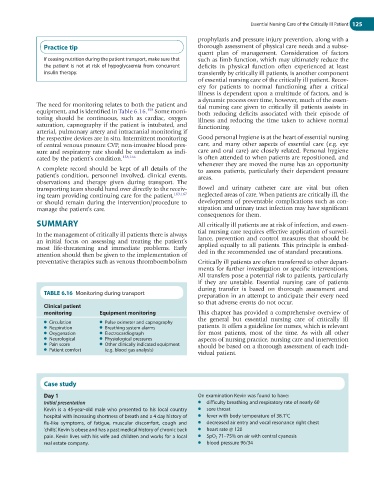
               TABLE 6.16  Monitoring during transport            preparation in an attempt to anticipate their every need
                                                                  so that adverse events do not occur.
               Clinical patient
               monitoring         Equipment monitoring            This chapter has provided a comprehensive overview of
                                                                  the  general  but  essential  nursing  care  of  critically  ill
               ●  Circulation     ●  Pulse oximeter and capnography
               ●  Respiration     ●  Breathing system alarms      patients. It offers a guideline for nurses, which is relevant
               ●  Oxygenation     ●  Electrocardiograph           for  most  patients,  most  of  the  time.  As  with  all  other
               ●  Neurological    ●  Physiological pressures      aspects of nursing practice, nursing care and intervention
               ●  Pain score      ●  Other clinically indicated equipment   should be based on a thorough assessment of each indi-
               ●  Patient comfort  (e.g. blood gas analysis)
                                                                  vidual patient.


               Case study

               Day 1                                              On examination Kevin was found to have:
               Initial presentation                               ●  difficulty breathing and respiratory rate of nearly 60
               Kevin  is  a  45-year-old  male  who  presented  to  his  local  country   ●  sore throat
               hospital with increasing shortness of breath and a 4 day history of   ●  fever with body temperature of 38.1°C
               flu-like  symptoms,  of  fatigue,  muscular  discomfort,  cough  and   ●  decreased air entry and vocal resonance right chest
               ‘chills’. Kevin is obese and has a past medical history of chronic back   ●  heart rate @ 120
               pain. Kevin lives with his wife and children and works for a local   ●  SpO 2  71–75% on air with central cyanosis
               real estate company.                               ●  blood pressure 96/34

