


Page 145 - ACCCN's Critical Care Nursing
P. 145
122  P R I N C I P L E S   A N D   P R A C T I C E   O F   C R I T I C A L   C A R E


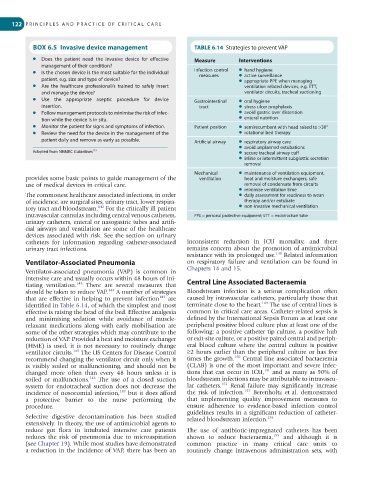
            BOX 6.5  Invasive device management                  TABLE 6.14  Strategies to prevent VAP
            ●  Does  the  patient  need  the  invasive  device  for  effective   Measure  Interventions
               management of their condition?
            ●  Is the chosen device is the most suitable for the individual   Infection control   ●  hand hygiene
                                                                  measures
                                                                               ●  active surveillance
               patient, e.g. size and type of device?                          ●  appropriate PPE when managing
            ●  Are  the  healthcare  professional/s  trained  to  safely  insert   ventilation related devices, e.g. ETT,
               and manage the device?                                            ventilator circuits, tracheal suctioning
            ●  Use  the  appropriate  aseptic  procedure  for  device   Gastrointestinal   ●  oral hygiene
               insertion.                                         tract        ●  stress ulcer prophylaxis
            ●  Follow management protocols to minimise the risk of infec-      ●  avoid gastric over distention
               tion while the device is in situ.                               ●  enteral nutrition
            ●  Monitor the patient for signs and symptoms of infection.  Patient position  ●  semirecumbent with head raised to >30°
            ●  Review the need for the device in the management of the         ●  rotational bed therapy
               patient daily and remove as early as possible.    Artificial airway  ●  respiratory airway care
                                                                               ●  avoid unplanned extubations
            Adapted from NHMRC Guidelines 119                                  ●  secure tracheal airway cuff
                                                                               ●  inline or intermittent subglottic secretion
                                                                                 removal
                                                                 Mechanical    ●  maintenance of ventilation equipment,
         provides some basic points to guide management of the    ventilation    heat and moisture exchangers, safe
         use of medical devices in critical care.                                removal of condensate from circuits
                                                                               ●  minimise ventilation time
         The commonest healthcare associated infections, in order              ●  daily assessment for readiness to wean
         of incidence, are surgical sites, urinary tract, lower respira-         therapy and/or extubate
         tory tract and bloodstream. 142  For the critically ill patient       ●  non-invasive mechanical ventilation
         intravascular cannulas including central venous catheters,   PPE = personal protective equipment; ETT = endotrachael tube
         urinary catheters, enteral or nasogastric tubes and artifi-
         cial airways and ventilation are some of the healthcare
         devices associated with risk. See the section on urinary
         catheters  for  information  regarding  catheter-associated   inconsistent  reduction  in  ICU  mortality,  and  there
         urinary tract infections.                            remains concern about the promotion of antimicrobial
                                                              resistance with its prolonged use.  Related information
                                                                                           148
         Ventilator-Associated Pneumonia                      on  respiratory  failure  and  ventilation  can  be  found  in
         Ventilator-associated  pneumonia  (VAP)  is  common  in   Chapters 14 and 15.
         intensive care and usually occurs within 48 hours of ini-
         tiating  ventilation. 143   There  are  several  measures  that   Central Line Associated Bacteraemia
         should be taken to reduce VAP. 144  A number of strategies   Bloodstream  infection  is  a  serious  complication  often
         that  are  effective  in  helping  to  prevent  infection 143   are   caused by intravascular catheters, particularly those that
         identified in Table 6.14, of which the simplest and most   terminate close to the heart. 149  The use of central lines is
         effective is raising the head of the bed. Effective analgesia   common in critical care areas. Catheter-related sepsis is
         and  minimising  sedation  while  avoidance  of  muscle-  defined by the International Sepsis Forum as at least one
         relaxant  medications  along  with  early  mobilisation  are   peripheral positive blood culture plus at least one of the
         some of the other strategies which may contribute to the   following: a positive catheter tip culture, a positive hub
         reduction of VAP. Provided a heat and moisture exchanger   or exit-site culture, or a positive paired central and periph-
         (HME)  is  used,  it  is  not  necessary  to  routinely  change   eral  blood  culture  where  the  central  culture  is  positive
         ventilator circuits. 145  The US Centers for Disease Control   ≥2 hours earlier than the peripheral culture or has five
                                                                              150
         recommend changing the ventilator circuit only when it   times the growth.  Central line associated bactaeremia
         is  visibly  soiled  or  malfunctioning,  and  should  not  be   (CLAB) is one of the most important and severe infec-
                                                                                       151
         changed  more  often  than  every  48  hours  unless  it  is   tions that can occur in ICU,  and as many as 90% of
         soiled  or  malfunctions. 146   The  use  of  a  closed  suction   bloodstream infections may be attributable to intravascu-
         system  for  endotracheal  suction  does  not  decrease  the   lar  catheters. 152   Renal  failure  may  significantly  increase
                                                                                 153
         incidence of nosocomial infection, 147  but it does afford   the  risk  of  infection.   Berenholtz  et al.  demonstrated
         a  protective  barrier  to  the  nurse  performing  the   that  implementing  quality  improvement  measures  to
         procedure.                                           ensure  adherence  to  evidence-based  infection  control
                                                              guidelines results in a significant reduction of catheter-
         Selective  digestive  decontamination  has  been  studied   related bloodstream infection. 154
         extensively. In theory, the use of antimicrobial agents to
         reduce  gut  flora  in  intubated  intensive  care  patients   The  use  of  antibiotic-impregnated  catheters  has  been
         reduces  the  risk  of  pneumonia  due  to  microaspiration   shown  to  reduce  bacteraemia, 155   and  although  it  is
         (see Chapter 19). While most studies have demonstrated   common  practice  in  many  critical  care  units  to
         a reduction in the incidence of VAP, there has been an   routinely  change  intravenous  administration  sets,  with

