


Page 143 - ACCCN's Critical Care Nursing
P. 143
120  P R I N C I P L E S   A N D   P R A C T I C E   O F   C R I T I C A L   C A R E

         nosocomial infection, with feedback to critical care staff,
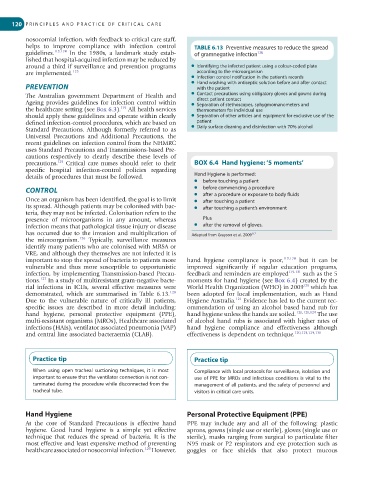
         helps  to  improve  compliance  with  infection  control   TABLE 6.13  Preventive measures to reduce the spread
         guidelines. 119,124   In  the  1980s,  a  landmark  study  estab-  of gramnegative infection 128
         lished that hospital-acquired infection may be reduced by
         around a third if surveillance and prevention programs   ●  Identifying the infected patient using a colour-coded plate
         are implemented. 125                                    according to the microorganism
                                                                ●  Infection control notification in the patient’s records
                                                                ●  Hand washing with antiseptic solution before and after contact
         PREVENTION                                              with the patient
         The  Australian  government  Department  of  Health  and   ●  Contact precautions using obligatory gloves and gowns during
                                                                 direct patient contact
         Ageing  provides  guidelines  for  infection  control  within   ●  Separation of stethoscopes, sphygmomanometers and
                                         119
         the healthcare setting (see Box 6.3).  All health services   thermometers for individual use
         should apply these guidelines and operate within clearly   ●  Separation of other articles and equipment for exclusive use of the
         defined infection-control procedures, which are based on   patient
         Standard  Precautions.  Although  formerly  referred  to  as   ●  Daily surface cleaning and disinfection with 70% alcohol
         Universal  Precautions  and  Additional  Precautions,  the
         recent guidelines on infection control from the NHMRC
         uses Standard Precautions and Transmissions-based Pre-
         cautions  respectively  to  clearly  describe  these  levels  of
                    119
         precautions.   Critical  care  nurses  should  refer  to  their   BOX 6.4  Hand hygiene: ‘5 moments’
         specific  hospital  infection-control  policies  regarding
         details of procedures that must be followed.            Hand Hygiene is performed:
                                                                 ●  before touching a patient
         CONTROL                                                 ●  before commencing a procedure
                                                                 ●  after a procedure or exposure to body fluids
         Once an organism has been identified, the goal is to limit   ●  after touching a patient
         its spread. Although patients may be colonised with bac-  ●  after touching a patient’s environment
         teria, they may not be infected. Colonisation refers to the
         presence  of  microorganisms  in  any  amount,  whereas   Plus
         infection means that pathological tissue injury or disease   ●  after the removal of gloves.
         has occurred due to the invasion and multiplication of   Adapted from Grayson et al. 2009 117
         the  microorganism. 126   Typically,  surveillance  measures
         identify many patients who are colonised with MRSA or
         VRE, and although they themselves are not infected it is
         important to stop the spread of bacteria to patients more   hand  hygiene  compliance  is  poor, 119,120   but  it  can  be
         vulnerable  and  thus  more  susceptible  to  opportunistic   improved  significantly  if  regular  education  programs,
         infection, by implementing Transmission-based Precau-  feedback and reminders are employed 119-121  such as the 5
         tions. 127  In a study of multiresistant gram-negative bacte-  moments for hand hygiene (see Box 6.4) created by the
                                                                                                    120
         rial  infections  in  ICUs,  several  effective  measures  were   World Health Organization (WHO) in 2009  which has
                                                         128
         demonstrated,  which  are  summarised  in  Table  6.13.    been  adopted  for  local  implementation,  such  as  Hand
                                                                              121
         Due  to  the  vulnerable  nature  of  critically  ill  patients,   Hygiene Australia.  Evidence has led to the current rec-
         specific  issues  are  described  in  more  detail  including:   ommendation  of  using  an  alcohol  based  hand  rub  for
         hand  hygiene,  personal  protective  equipment  (PPE),   hand hygiene unless the hands are soiled. 120,121,129  The use
         multi-resistant organisms (MROs), Healthcare associated   of alcohol hand rubs is associated with higher rates of
         infections (HAIs), ventilator associated pneumonia (VAP)   hand  hygiene  compliance  and  effectiveness  although
         and central line associated bacteraemia (CLAB).      effectiveness is dependent on technique. 120,121,129,130


            Practice tip                                         Practice tip

            When  using  open  tracheal  suctioning  techniques,  it  is  most   Compliance with local protocols for surveillance, isolation and
            important to ensure that the ventilator connection is not con-  use of PPE for MROs and infectious conditions is vital to the
            taminated during the procedure while disconnected from the   management of all patients, and the safety of personnel and
            tracheal tube.                                       visitors in critical care units.


         Hand Hygiene                                         Personal Protective Equipment (PPE)
         At  the  core  of  Standard  Precautions  is  effective  hand   PPE  may  include  any  and  all  of  the  following:  plastic
         hygiene.  Good  hand  hygiene  is  a  simple  yet  effective   aprons, gowns (single use or sterile), gloves (single use or
         technique  that  reduces  the  spread  of  bacteria.  It  is  the   sterile), masks ranging from surgical to particulate filter
         most effective and least expensive method of preventing   N95 mask or P2 respirators and eye protection such as
                                                120
         healthcare associated or nosocomial infection.  However,   goggles  or  face  shields  that  also  protect  mucous

