


Page 261 - ACCCN's Critical Care Nursing
P. 261
238  P R I N C I P L E S   A N D   P R A C T I C E   O F   C R I T I C A L   C A R E


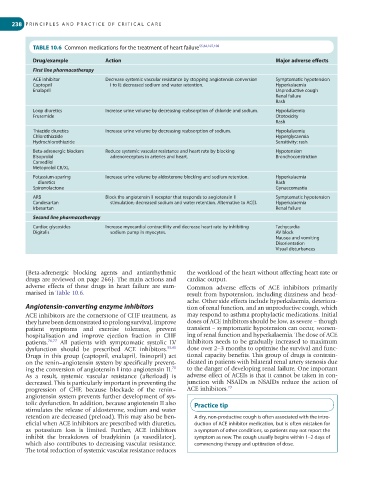
            TABLE 10.6  Common medications for the treatment of heart failure 55,64,107,108

            Drug/example            Action                                                 Major adverse effects
            First line pharmacotherapy
            ACE inhibitor           Decrease systemic vascular resistance by stopping angiotensin conversion   Symptomatic hypotension
            Captopril                I to II; decreased sodium and water retention.        Hyperkalaemia
            Enalapril                                                                      Unproductive cough
                                                                                           Renal failure
                                                                                           Rash
            Loop diuretics          Increase urine volume by decreasing reabsorption of chloride and sodium.  Hypokalaemia
            Frusemide                                                                      Ototoxicity
                                                                                           Rash
            Thiazide diuretics      Increase urine volume by decreasing reabsorption of sodium.  Hypokalaemia
            Chlorothiazide                                                                 Hyperglycaemia
            Hydrochlorothiazide                                                            Sensitivity: rash
            Beta-adrenergic blockers  Reduce systemic vascular resistance and heart rate by blocking   Hypotension
            Bisoprolol               adrenoreceptors in arteries and heart.                Bronchoconstriction
            Carvedilol
            Metoprolol CR/XL
            Potassium-sparing       Increase urine volume by aldosterone blocking and sodium retention.  Hyperkalaemia
             diuretics                                                                     Rash
            Spironolactone                                                                 Gynaecomastia
            ARB                     Block the angiotensin II receptor that responds to angiotensin II   Symptomatic hypotension
            Candesartan              stimulation; decreased sodium and water retention. Alternative to ACEI.  Hyperkalaemia
            Irbesartan                                                                     Renal failure
            Second line pharmacotherapy
            Cardiac glycosides      Increase myocardial contractility and decrease heart rate by inhibiting   Tachycardia
            Digitalis                sodium pump in myocytes.                              AV block
                                                                                           Nausea and vomiting
                                                                                           Disorientation
                                                                                           Visual disturbances


         (Beta-adrenergic  blocking  agents  and  antiarrhythmic   the workload of the heart without affecting heart rate or
         drugs are reviewed on page 266). The main actions and   cardiac output.
         adverse  effects  of  these  drugs  in  heart  failure  are  sum-  Common  adverse  effects  of  ACE  inhibitors  primarily
         marised in Table 10.6.                               result from hypotension, including dizziness and head-
                                                              ache. Other side effects include hyperkalaemia, deteriora-
         Angiotensin-converting enzyme inhibitors             tion of renal function, and an unproductive cough, which
         ACE inhibitors are the cornerstone of CHF treatment, as   may respond to asthma prophylactic medications. Initial
         they have been demonstrated to prolong survival, improve   doses of ACE inhibitors should be low, as severe – though
         patient  symptoms  and  exercise  tolerance,  prevent     transient – symptomatic hypotension can occur, worsen-
         hospitalisation  and  improve  ejection  fraction  in  CHF   ing of renal function and hyperkalaemia. The dose of ACE
         patients. 76,77   All  patients  with  symptomatic  systolic  LV   inhibitors needs to be gradually increased to maximum
         dysfunction  should  be  prescribed  ACE  inhibitors. 55,61    dose over 2–3 months to optimise the survival and func-
         Drugs in this group (captopril, enalapril, lisinopril) act   tional capacity benefits. This group of drugs is contrain-
         on the renin–angiotensin system by specifically prevent-  dicated in patients with bilateral renal artery stenosis due
                                                         78
         ing the conversion of angiotensin I into angiotensin II.    to the danger of developing renal failure. One important
         As  a  result,  systemic  vascular  resistance  (afterload)  is   adverse effect of ACEIs is that it cannot be taken in con-
         decreased. This is particularly important in preventing the   junction  with  NSAIDs  as  NSAIDs  reduce  the  action  of
         progression  of  CHF,  because  blockade  of  the  renin–  ACE inhibitors. 79
         angiotensin system prevents further development of sys-
         tolic dysfunction. In addition, because angiotensin II also   Practice tip
         stimulates the release of aldosterone, sodium and water
         retention are decreased (preload). This may also be ben-  A dry, non-productive cough is often associated with the intro-
         eficial when ACE inhibitors are prescribed with diuretics,   duction of ACE inhibitor medication, but is often mistaken for
         as  potassium  loss  is  limited.  Further,  ACE  inhibitors   a symptom of other conditions, so patients may not report the
         inhibit  the  breakdown  of  bradykinin  (a  vasodilator),   symptom as new. The cough usually begins within 1–2 days of
         which also contributes to decreasing vascular resistance.   commencing therapy and uptitration of dose.
         The total reduction of systemic vascular resistance reduces

