


Page 315 - ACCCN's Critical Care Nursing
P. 315
292  P R I N C I P L E S   A N D   P R A C T I C E   O F   C R I T I C A L   C A R E


                                                                           Fused cusps
                                     Cusp                                                        Cusp


                                     Orifice                                  Orifice

                         Normal valve        Normal valve       Stenosed valve    Regurgitant valve
                            (open)             (closed)            (open)             (closed)      B
                      A


                                                      Stenosed
                                                      mitral
                                                      valve

                                                             Mitral
                                                             valve does
                                                             not close
                                                             properly

                              C                                     D


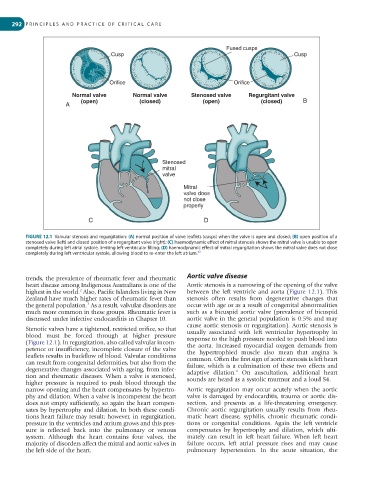
         FIGURE 12.1  Valvular stenosis and regurgitation: (A) normal position of valve leaflets (cusps) when the valve is open and closed; (B) open position of a
         stenosed valve (left) and closed position of a regurgitant valve (right); (C) haemodynamic effect of mitral stenosis shows the mitral valve is unable to open
         completely during left atrial systole, limiting left ventricular filling; (D) haemodynamic effect of mitral regurgitation shows the mitral valve does not close
         completely during left ventricular systole, allowing blood to re-enter the left atrium.
                                                                  43


         trends, the prevalence of rheumatic fever and rheumatic   Aortic valve disease
         heart disease among Indigenous Australians is one of the   Aortic stenosis is a narrowing of the opening of the valve
         highest in the world.  Also, Pacific Islanders living in New   between the left ventricle and aorta (Figure 12.1). This
                           2
         Zealand have much higher rates of rheumatic fever than   stenosis  often  results  from  degenerative  changes  that
         the general population.  As a result, valvular disorders are   occur with age or as a result of congenital abnormalities
                              3
         much more common in these groups. Rheumatic fever is   such  as  a  bicuspid  aortic  valve  (prevalence  of  bicuspid
         discussed under infective endocarditis in Chapter 10.  aortic valve in the general population is 0.5% and may
                                                              cause aortic stenosis or regurgitation). Aortic stenosis is
         Stenotic valves have a tightened, restricted orifice, so that   usually  associated  with  left  ventricular  hypertrophy  in
         blood  must  be  forced  through  at  higher  pressure     response to the high pressure needed to push blood into
         (Figure 12.1). In regurgitation, also called valvular incom-  the  aorta.  Increased  myocardial  oxygen  demands  from
         petence or insufficiency, incomplete closure of the valve   the  hypertrophied  muscle  also  mean  that  angina  is
         leaflets results in backflow of blood. Valvular conditions   common. Often the first sign of aortic stenosis is left heart
         can result from congenital deformities, but also from the   failure, which is a culmination of these two effects and
         degenerative changes associated with ageing, from infec-  adaptive  dilation.   On  auscultation,  additional  heart
                                                                              4
         tion and rheumatic diseases. When a valve is stenosed,   sounds are heard as a systolic murmur and a loud S4.
         higher  pressure  is  required  to  push  blood  through  the
         narrow opening and the heart compensates by hypertro-  Aortic  regurgitation  may  occur  acutely  when  the  aortic
         phy and dilation. When a valve is incompetent the heart   valve is damaged by endocarditis, trauma or aortic dis-
         does not empty sufficiently, so again the heart compen-  section,  and  presents  as  a  life-threatening  emergency.
         sates by hypertrophy and dilation. In both these condi-  Chronic  aortic  regurgitation  usually  results  from  rheu-
         tions heart failure may result; however, in regurgitation,   matic  heart  disease,  syphilis,  chronic  rheumatic  condi-
         pressure in the ventricles and atrium grows and this pres-  tions  or  congenital  conditions.  Again  the  left  ventricle
         sure  is  reflected  back  into  the  pulmonary  or  venous   compensates  by  hypertrophy  and  dilation,  which  ulti-
         system.  Although  the  heart  contains  four  valves,  the   mately  can  result  in  left  heart  failure.  When  left  heart
         majority of disorders affect the mitral and aortic valves in   failure  occurs,  left  atrial  pressure  rises  and  may  cause
         the left side of the heart.                          pulmonary  hypertension.  In  the  acute  situation,  the

