


Page 318 - ACCCN's Critical Care Nursing
P. 318
Cardiac Surgery and Transplantation  295


                                                       A                             B


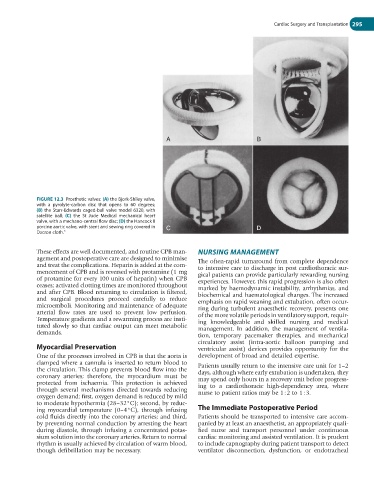
             FIGURE 12.3  Prosthetic valves: (A) the Bjork-Shiley valve,
             with  a  pyrolyte-carbon  disc  that  opens  to  60  degrees;
             (B) the Starr-Edwards caged-ball valve model 6320, with
             satellite  ball;  (C)  the  St  Jude  Medical  mechanical  heart
             valve, with a mechano-central flow disc; (D) the Hancock II
             porcine aortic valve, with stent and sewing ring covered in   C         D
             Dacron cloth.   5


             These effects are well documented, and routine CPB man-  NURSING MANAGEMENT
             agement and postoperative care are designed to minimise   The often-rapid turnaround from complete dependence
             and treat the complications. Heparin is added at the com-  to intensive care to discharge in post cardiothoracic sur-
             mencement of CPB and is reversed with protamine (1 mg   gical patients can provide particularly rewarding nursing
             of protamine for every 100 units of heparin) when CPB   experiences. However, this rapid progression is also often
             ceases; activated clotting times are monitored throughout   marked by haemodynamic instability, arrhythmias, and
             and after CPB. Blood returning to circulation is filtered,   biochemical and haematological changes. The increased
             and  surgical  procedures  proceed  carefully  to  reduce   emphasis on rapid weaning and extubation, often occur-
             microemboli. Monitoring and maintenance of adequate   ring during turbulent anaesthetic recovery, presents one
             arterial  flow  rates  are  used  to  prevent  low  perfusion.     of the more volatile periods in ventilatory support, requir-
             Temperature gradients and a rewarming process are insti-  ing  knowledgeable  and  skilled  nursing  and  medical
             tuted slowly so that cardiac output can meet metabolic   management.  In  addition,  the  management  of  ventila-
             demands.
                                                                  tion,  temporary  pacemaker  therapies,  and  mechanical
                                                                  cir culatory  assist  (intra-aortic  balloon  pumping  and
             Myocardial Preservation                              ventricular  assist)  devices  provides  opportunity  for  the
             One of the processes involved in CPB is that the aorta is   development of broad and detailed expertise.
             clamped where a cannula is inserted to return blood to   Patients usually return to the intensive care unit for 1–2
             the circulation. This clamp prevents blood flow into the   days, although where early extubation is undertaken, they
             coronary  arteries;  therefore,  the  myocardium  must  be   may spend only hours in a recovery unit before progress-
             protected  from  ischaemia.  This  protection  is  achieved   ing  to  a  cardiothoracic  high-dependency  area,  where
             through  several  mechanisms  directed  towards  reducing   nurse to patient ratios may be 1 : 2 to 1 : 3.
             oxygen demand: first, oxygen demand is reduced by mild
             to moderate hypothermia (28–32°C); second, by reduc-
             ing  myocardial  temperature  (0–4°C),  through  infusing   The Immediate Postoperative Period
             cold fluids directly into the coronary arteries; and third,   Patients should be transported to intensive care accom-
             by preventing normal conduction by arresting the heart   panied by at least an anaesthetist, an appropriately quali-
             during diastole, through infusing a concentrated potas-  fied  nurse  and  transport  personnel  under  continuous
             sium solution into the coronary arteries. Return to normal   cardiac monitoring and assisted ventilation. It is prudent
             rhythm is usually achieved by circulation of warm blood,   to include capnography during patient transport to detect
             though defibrillation may be necessary.              ventilator  disconnection,  dysfunction,  or  endotracheal

