


Page 316 - ACCCN's Critical Care Nursing
P. 316
Cardiac Surgery and Transplantation  293

             patient  presents  with  collapse,  severe  hypotension  and
                      4
             dyspnoea.   Patients  with  chronic  regurgitation  may
             remain  asymptomatic  for  years,  finally  presenting  with
             signs  of  left  heart  failure.  On  auscultation,  a  diastolic
             murmur can be heard.
                                                                                              Left subclavian
             Mitral valve disease                                                                 artery

             Mitral valve stenosis often occurs as a result of rheumatic
             heart disease and less often from systemic lupus erythro-                           Internal mammary
                                                                                                 (internal thoracic) artery
             matosus.  These  diseases  cause  damage  to  the  leaflets
             and chordae tendineae, so that during healing the scars
             contract  and  seal,  restricting  the  aperture.  Left  atrial
             pressure  rises  with  resultant  pulmonary  hypertension.
             In chronic conditions, this pressure may also affect the
                           5
             right  ven tricle.   Lung  compliance  is  also  reduced,
             causing  dyspnoea.  On  auscultation  a  low-pitched
             diastolic murmur and an opening snap can be heard.
             Mitral  valve  regurgitation  results  when  the  mitral  valve                        Anterior descending
             and chordae tendineae are damaged, often due to myo-                                   branch of the left
                                                                                                    coronary artery
             cardial infarction, rheumatic disease and infectious endo-
             carditis.  Backflow  into  the  left  atrium  during  systole
             creates  elevated  atrial  and  pulmonary  pressures,  and
                                        5
             pulmonary oedema can result.  On auscultation, a third
             heart sound and a pansystolic murmur can be heard.
             Ischaemic Heart Disease
                                                                                       Site of graft
             The pathophysiology and implications of ischaemic heart
                                                                                                         5
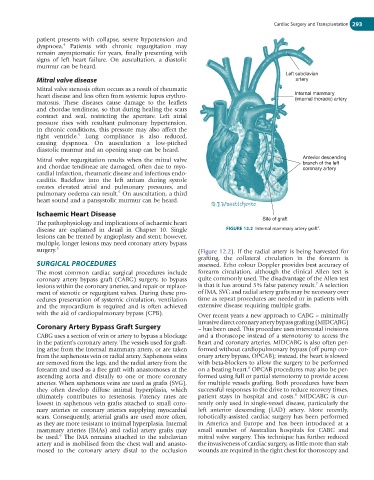
             disease  are  explained  in  detail  in  Chapter  10.  Single   FIGURE 12.2  Internal mammary artery graft .
             lesions can be treated by angioplasty and stent; however,
             multiple, longer lesions may need coronary artery bypass
             surgery. 5                                           (Figure 12.2). If the radial artery is being harvested for
                                                                  grafting,  the  collateral  circulation  in  the  forearm  is
             SURGICAL PROCEDURES                                  assessed. Echo colour Doppler provides best accuracy of
             The  most  common  cardiac  surgical  procedures  include   forearm  circulation,  although  the  clinical  Allen  test  is
             coronary  artery  bypass  graft  (CABG)  surgery,  to  bypass   quite commonly used. The disadvantage of the Allen test
                                                                                                        7
             lesions within the coronary arteries, and repair or replace-  is that it has around 5% false patency result.  A selection
             ment of stenotic or regurgitant valves. During these pro-  of IMA, SVG and radial artery grafts may be necessary over
             cedures preservation of systemic circulation, ventilation   time as repeat procedures are needed or in patients with
             and  the  myocardium  is  required  and  is  often  achieved   extensive disease requiring multiple grafts.
             with the aid of cardiopulmonary bypass (CPB).        Over recent years a new approach to CABG – minimally
                                                                  invasive direct coronary artery bypass grafting (MIDCABG)
             Coronary Artery Bypass Graft Surgery                 – has been used. This procedure uses intercostal incisions
             CABG uses a section of vein or artery to bypass a blockage   and a thorascope instead of a sternotomy to access the
             in the patient’s coronary artery. The vessels used for graft-  heart and coronary arteries. MIDCABG is also often per-
             ing arise from the internal mammary artery, or are taken   formed without cardiopulmonary bypass (off pump cor-
             from the saphenous vein or radial artery. Saphenous veins   onary artery bypass, OPCAB); instead, the heart is slowed
             are removed from the legs, and the radial artery from the   with beta-blockers to allow the surgery to be performed
                                                                                  8
             forearm and used as a free graft with anastomoses at the   on a beating heart.  OPCAB procedures may also be per-
             ascending  aorta  and  distally  to  one  or  more  coronary   formed using full or partial sternotomy to provide access
             arteries. When saphenous veins are used as grafts (SVG),   for multiple vessels grafting. Both procedures have been
             they  often  develop  diffuse  intimal  hyperplasia,  which   successful responses to the drive to reduce recovery times,
                                                                                                 8
             ultimately  contributes  to  restenosis.  Patency  rates  are   patient  stays  in  hospital  and  costs.   MIDCABG  is  cur-
             lowest in saphenous vein grafts attached to small coro-  rently only used in single-vessel disease, particularly the
             nary  arteries  or  coronary  arteries  supplying  myocardial   left  anterior  descending  (LAD)  artery.  More  recently,
             scars. Consequently, arterial grafts are used more often,   robotically-assisted  cardiac  surgery  has  been  performed
             as they are more resistant to intimal hyperplasia. Internal   in  America  and  Europe  and  has  been  introduced  at  a
             mammary  arteries  (IMAs)  and  radial  artery  grafts  may     small  number  of  Australian  hospitals  for  CABG  and
                    6
             be  used.   The  IMA  remains  attached  to  the  subclavian   mitral valve surgery. This technique has further reduced
             artery and is mobilised from the chest wall and anasto-  the invasiveness of cardiac surgery, as little more than stab
             mosed  to  the  coronary  artery  distal  to  the  occlusion     wounds are required in the right chest for thoroscopy and

