


Page 341 - ACCCN's Critical Care Nursing
P. 341
318  P R I N C I P L E S   A N D   P R A C T I C E   O F   C R I T I C A L   C A R E


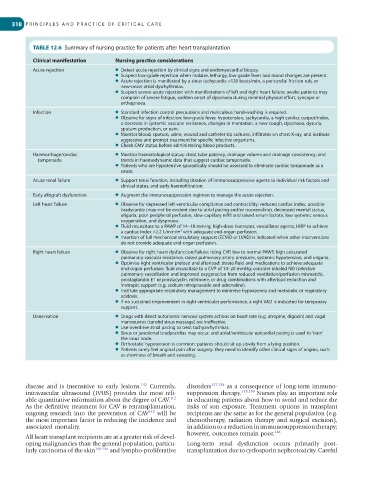
            TABLE 12.6  Summary of nursing practice for patients after heart transplantation

            Clinical manifestation     Nursing practice considerations
            Acute rejection            ●  Detect acute rejection by clinical signs and endomyocardial biopsy.
                                       ●  Suspect low-grade rejection when malaise, lethargy, low-grade fever and mood changes are present.
                                       ●  Acute rejection is manifested by a sinus tachycardia >120 beats/min, a pericardial friction rub, or
                                         new-onset atrial dysrhythmias.
                                       ●  Suspect severe acute rejection with manifestations of left and right heart failure; awake patients may
                                         complain of severe fatigue, sudden onset of dyspnoea during minimal physical effort, syncope or
                                         orthopnoea.
            Infection                  ●  Standard infection control precautions and meticulous hand-washing is required.
                                       ●  Observe for signs of infection: low-grade fever, hypotension, tachycardia, a high cardiac output/index,
                                         a decrease in systemic vascular resistance, changes in mentation, a new cough, dyspnoea, dysuria,
                                         sputum production, or pain.
                                       ●  Monitor blood, sputum, urine, wound and catheter-tip cultures, infiltrates on chest X-ray, and institute
                                         aggressive and prompt treatment for specific infective organisms.
                                       ●  Check CMV status before administering blood products.
            Haemorrhage/cardiac        ●  Monitor haematological status; chest tube patency, drainage volume and drainage consistency; and
             tamponade                   trends in haemodynamic data that suggest cardiac tamponade.
                                       ●  Patients who are hypotensive sporadically should be assessed to eliminate cardiac tamponade as a
                                         cause.
            Acute renal failure        ●  Support renal function, including titration of immunosuppressive agents to individual risk factors and
                                         clinical status, and early haemofiltration.
            Early allograft dysfunction  ●  Augment the immunosuppression regimen to manage the acute rejection.
            Left heart failure         ●  Observe for depressed left ventricular compliance and contractility: reduced cardiac index, possible
                                         bradycardia (may not be evident due to atrial pacing and/or isoprenaline), decreased mental status,
                                         oliguria, poor peripheral perfusion, slow capillary refill and raised serum lactate, low systemic venous
                                         oxygenation, and dyspnoea.
                                       ●  Fluid resuscitate to a PAWP of 14–18 mmHg, high-dose inotropes, vasodilator agents, IABP to achieve
                                                            2
                                         a cardiac index >2.2 L/min/m  with adequate end-organ perfusion.
                                       ●  Insertion of full mechanical circulatory support (ECMO or LVAD) is indicated when other interventions
                                         do not provide adequate end-organ perfusion.
            Right heart failure        ●  Observe for right heart dysfunction/failure: rising CVP, low to normal PAWP, high calculated
                                         pulmonary vascular resistance, raised pulmonary artery pressures, systemic hypotension, and oliguria.
                                       ●  Optimise right ventricular preload and afterload: titrate fluid and medications to achieve adequate
                                         end-organ perfusion; fluid resuscitate to a CVP of 14–20 mmHg; consider inhaled NO (selective
                                         pulmonary vasodilation and improved oxygenation from reduced ventilation/perfusion mismatch),
                                         prostaglandin E1 or prostacyclin, milrinone, or drug combinations with afterload reduction and
                                         inotropic support (e.g. sodium nitroprusside and adrenaline).
                                       ●  Institute appropriate respiratory management to minimise hypoxaemia and metabolic or respiratory
                                         acidosis.
                                       ●  If no sustained improvement in right ventricular performance, a right VAD is indicated for temporary
                                         support.
            Denervation                ●  Drugs with direct autonomic nervous system actions on heart rate (e.g. atropine, digoxin) and vagal
                                         manoeuvres (carotid sinus massage) are ineffective.
                                       ●  Use overdrive atrial pacing to treat tachyarrhythmias.
                                       ●  Sinus or junctional bradycardias may occur, and atrial/ventricular epicardial pacing is used to ‘train’
                                         the sinus node.
                                       ●  Orthostatic hypotension is common: patients should sit up slowly from a lying position.
                                       ●  Patients rarely feel anginal pain after surgery: they need to identify other clinical signs of angina, such
                                         as shortness of breath and sweating.


         disease  and  is  insensitive  to  early  lesions.   Currently,   disorders 147,148  as a consequence of long-term immuno-
                                               142
         intravascular ultrasound (IVUS) provides the most reli-  suppression therapy. 149,150  Nurses play an important role
                                                         112
         able quantitative information about the degree of CAV.    in educating patients about how to avoid and reduce the
         As the definitive treatment for CAV is retransplantation,   risks  of  sun  exposure.  Treatment  options  in  transplant
                                                  143
         ongoing research into the prevention of CAV  will be   recipients are the same as for the general population (e.g.
         the most important factor in reducing the incidence and   chemotherapy, radiation therapy and surgical excision),
         associated mortality.                                in addition to a reduction in immunosuppression therapy;
                                                              however, outcomes remain poor. 146
         All heart transplant recipients are at a greater risk of devel-
         oping malignancies than the general population, particu-  Long-term  renal  dysfunction  occurs  primarily  post-
         larly carcinoma of the skin 144-146  and lympho-proliferative   transplantation due to cyclosporin nephrotoxicity. Careful

