


Page 336 - ACCCN's Critical Care Nursing
P. 336
Cardiac Surgery and Transplantation  313

             Hyperacute Rejection                                 rejection (grade 1) is rarely treated, and only 20–40% of
             Hyperacute rejection is now a rare form of humoral rejec-  mild  cases  progress  to  moderate  rejection  (grade  3A),
                                                                                          95,98
             tion  that  occurs  minutes  to  hours  after  transplantation   usually requiring treatment.   Grades 3B and 4 rejection
             and results from ABO blood group incompatibility or the   are  always  treated,  as  they  represent  myocyte  necrosis.
                                                             92
             recipient having preformed, donor-specific antibodies.    Cellular rejection is usually treated with higher doses of
             ABO blood group and panel reactive screening of anti-  corticosteroids, such as ‘pulse’ doses of methylpredniso-
             human  lymphocyte  antigen  (anti-HLA)  antibodies    lone  (1–3 g  IV  over  3  days),  and  antilymphocyte  anti-
             preoperatively  minimises  the  possibility  of  hyperacute   body agents (ATG, ATGAM or OKT3). Humoral rejection
             rejection, particularly in health care systems where blood   is treated with plasmapheresis, high-dose corticosteroids,
             that  has  been  prospectively  cross-matched  is  routinely   cyclosphosphamide  therapy  and  antilymphocyte  anti-
                                                                              99,100
             used.  If  it  occurs,  hyperacute  rejection  leads  to  organ   body  therapy.    It  may  be  judicious  to  review  the
             failure and rapid activation of the complement cascade,   patient’s  medications  during  periods  of  rejection  to
             producing  severe  damage  to  endothelial  cells,  platelet   ensure  that  drugs  capable  of  reducing  cyclosporin  or
             activation, initiation of the clotting cascade, and extensive   tacrolimus serum levels such as certain anticonvulsants
             microvascular  thrombosis.   There  is  no  effective  treat-  and antibiotics have not been taken. In addition to aug-
                                    78
             ment  for  hyperacute  rejection  apart  from  mechanical     mentation  of  immunosuppression  therapy,  fluid,  phar-
             circulatory support or interim retransplantation.    macological  and  mechanical  therapeutic  interventions
                                                                  are instituted to support cardiac function, depending on
                                                                  the degree of ventricular dysfunction.
             Acute Rejection                                      Immunosuppression Therapy
             Acute  rejection  can  be  classified  as  either  cellular  or
                     93
             humoral.   Cellular  rejection  involves  T-cell  infiltration   In this section, a brief discussion of immunosuppression
             of  the  allograft.  Cellular  rejection  occurs  much  more   therapies  and  associated  nursing  implications  is  pro-
             commonly than humoral rejection, but both may occur   vided.  To  prevent  rejection  of  the  transplanted  organ,
                           94
             simultaneously.  Humoral or microvascular rejection is   recipients  receive  a  triple-therapy  regimen  of  immuno-
             thought to be primarily mediated by antibodies. Humoral   suppression agents for the remainder of their life. Triple-
             rejection  may  occur  due  to  the  presence  of  a  positive   therapy usually consists of corticosteroids (prednisolone
             donor-specific  cross-match,  or  in  a  sensitised  recipient   or prednisone), a calcineurin antagonist (cyclosporine or
             with preformed anti-HLA antibodies. 95               tacrolimus  [FK506])  and  an  antiproliferative  cytotoxic
                                                                  agent (mycophenolate mofetil, azathioprine or sirolimus/
             Percutaneous transvenous endomyocardial biopsy is con-  rapamycin). 101,102  For heart patients, sirolimus or rapamy-
                                                             96
             sidered the gold standard for detecting cardiac rejection.    cin may become the cytotoxic drug of choice following
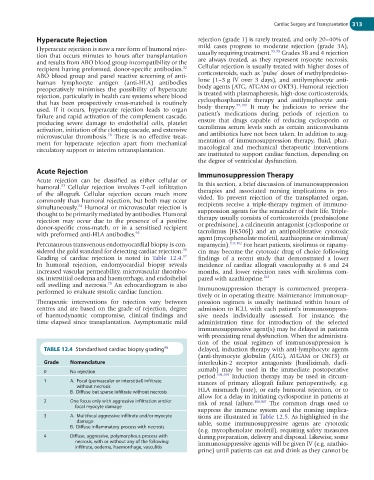
             Grading  of  cardiac  rejection  is  noted  in  Table  12.4.    findings  of  a  recent  study  that  demonstrated  a  lower
                                                             97
             In  humoral  rejection,  endomyocardial  biopsy  reveals   incidence of cardiac allograft vasculopathy at 6 and 24
             increased vascular permeability, microvascular thrombo-  months,  and  lower  rejection  rates  with  sirolimus  com-
             sis, interstitial oedema and haemorrhage, and endothelial   pared with azathioprine. 103
                                    78
             cell  swelling  and  necrosis.   An  echocardiogram  is  also
             performed to evaluate systolic cardiac function.     Immunosuppression  therapy  is  commenced  preopera-
                                                                  tively or in operating theatre. Maintenance immunosup-
             Therapeutic  interventions  for  rejection  vary  between   pression  regimen  is  usually  instituted  within  hours  of
             centres and are based on the grade of rejection, degree     admission to ICU, with each patient’s immunosuppres-
             of  haemodynamic  compromise,  clinical  findings  and   sive  needs  individually  assessed.  For  instance,  the
             time elapsed since transplantation. Asymptomatic mild   administration  time  for  introduction  of  the  selected
                                                                  immunosuppressive agent(s) may be delayed in patients
                                                                  with preexisting renal dysfunction. When the administra-
                                                                  tion  of  the  usual  regimen  of  immunosuppression  is
               TABLE 12.4  Standardised cardiac biopsy grading 98  delayed, induction therapy with anti-lymphocyte agents
                                                                  (anti-thymocyte  globulin  (ATG),  ATGAM  or  OKT3)  or
               Grade    Nomenclature                              interleukin-2  receptor  antagonists  (basiliximab,  dacli-
               0        No rejection                              zumab)  may  be  used  in  the  immediate  postoperative
                                                                  period. 104,105   Induction  therapy  may  be  used  in  circum-
               1        A.  Focal (perivascular or interstitial) infiltrate    stances  of  primary  allograft  failure  perioperatively,  e.g.
                          without necrosis
                        B.  Diffuse but sparse infiltrate without necrosis  HLA mismatch (rare), or early humoral rejection, or to
                                                                  allow for a delay in initiating cyclosporine in patients at
               2        One focus only with aggressive infiltration and/or   risk  of  renal  failure. 106,107   The  common  drugs  used  to
                          focal myocyte damage
                                                                  suppress  the  immune  system  and  the  nursing  implica-
               3        A.  Multifocal aggressive infiltrate and/or myocyte   tions are illustrated in Table 12.5. As highlighted in the
                          damage                                  table,  some  immunosuppressive  agents  are  cytotoxic
                        B.  Diffuse inflammatory process with necrosis
                                                                  (e.g. mycophenolate mofetil), requiring safety measures
               4        Diffuse, aggressive, polymorphous process with   during preparation, delivery and disposal. Likewise, some
                          necrosis, with or without any of the following:   immunosuppressive agents will be given IV (e.g. azathio-
                          infiltrate, oedema, haemorrhage, vasculitis
                                                                  prine) until patients can eat and drink as they cannot be

