


Page 337 - ACCCN's Critical Care Nursing
P. 337
314  P R I N C I P L E S   A N D   P R A C T I C E   O F   C R I T I C A L   C A R E


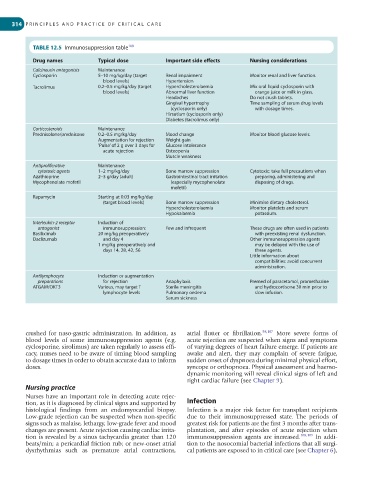
            TABLE 12.5  Immunosuppression table 108

            Drug names           Typical dose          Important side effects      Nursing considerations
            Calcineurin antagonists  Maintenance
            Cyclosporin          5–10 mg/kg/day (target   Renal impairment         Monitor renal and liver function.
                                   blood levels)       Hypertension
            Tacrolimus           0.2–0.5 mg/kg/day (target   Hypercholesterolaemia  Mix oral liquid cyclosporin with
                                   blood levels)       Abnormal liver function      orange juice or milk in glass.
                                                       Headaches                   Do not crush tablets.
                                                       Gingival hypertrophy        Time sampling of serum drug levels
                                                         (cyclosporin only)         with dosage times.
                                                       Hirsutism (cyclosporin only)
                                                       Diabetes (tacrolimus only)
            Corticosteroids      Maintenance
            Prednisolone/prednisone  0.2–0.5 mg/kg/day  Mood change                Monitor blood glucose levels.
                                 Augmentation for rejection  Weight gain
                                 ‘Pulse’ of 2 g over 3 days for   Glucose intolerance
                                   acute rejection     Osteopenia
                                                       Muscle weakness
            Antiproliferative    Maintenance
             cytotoxic agents    1–2 mg/kg/day         Bone marrow suppression     Cytotoxic: take full precautions when
            Azathioprine         2–3 g/day (adult)     Gastrointestinal tract irritation   preparing, administering and
            Mycophenolate mofetil                        (especially mycophenolate   disposing of drugs.
                                                         mofetil)
            Rapamycin            Starting at 0.03 mg/kg/day
                                   (target blood levels)  Bone marrow suppression  Minimise dietary cholesterol.
                                                       Hypercholesterolaemia       Monitor platelets and serum
                                                       Hypokalaemia                 potassium.
            Interleukin-2 receptor   Induction of
             antagonist            immunosuppression:  Few and infrequent          These drugs are often used in patients
            Basiliximab          20 mg/kg preoperatively                            with preexisting renal dysfunction.
            Daclizumab             and day 4                                       Other immunosuppression agents
                                 1 mg/kg preoperatively and                         may be delayed with the use of
                                   days 14, 28, 42, 56                              these agents.
                                                                                   Little information about
                                                                                    compatibilities: avoid concurrent
                                                                                    administration.
            Antilymphocyte       Induction or augmentation
             preparations          for rejection       Anaphylaxis                 Premed of paracetamol, promethazine
            ATGAM/OKT3           Various, may target T   Sterile meningitis         and hydrocortisone 30 min prior to
                                   lymphocyte levels   Pulmonary oedema             slow infusion.
                                                       Serum sickness


         crushed for naso-gastric administration. In addition, as   atrial  flutter  or  fibrillation. 98,107   More  severe  forms  of
         blood  levels  of  some  immunosuppression  agents  (e.g.   acute rejection are suspected when signs and symptoms
         cyclosporine, sirolimus) are taken regularly to assess effi-  of varying degrees of heart failure emerge. If patients are
         cacy, nurses need to be aware of timing blood sampling   awake  and  alert,  they  may  complain  of  severe  fatigue,
         to dosage times in order to obtain accurate data to inform   sudden onset of dyspnoea during minimal physical effort,
         doses.                                               syncope or orthopnoea. Physical assessment and haemo-
                                                              dynamic monitoring will reveal clinical signs of left and
                                                              right cardiac failure (see Chapter 9).
         Nursing practice
         Nurses have an important role in detecting acute rejec-
         tion, as it is diagnosed by clinical signs and supported by   Infection
         histological  findings  from  an  endomyocardial  biopsy.   Infection is a major risk factor for transplant recipients
         Low-grade rejection can be suspected when non-specific   due  to  their  immunosuppressed  state.  The  periods  of
         signs such as malaise, lethargy, low-grade fever and mood   greatest risk for patients are the first 3 months after trans-
         changes are present. Acute rejection causing cardiac irrita-  plantation,  and  after  episodes  of  acute  rejection  when
         tion is revealed by a sinus tachycardia greater than 120   immunosuppression  agents  are  increased. 108,109   In  addi-
         beats/min; a pericardial friction rub; or new-onset atrial   tion to the nosocomial bacterial infections that all surgi-
         dysrhythmias  such  as  premature  atrial  contractions,    cal patients are exposed to in critical care (see Chapter 6),

