


Page 349 - ACCCN's Critical Care Nursing
P. 349
326  P R I N C I P L E S   A N D   P R A C T I C E   O F   C R I T I C A L   C A R E


                Thyroid cartilage                             bronchi.  Further  divisions  within  these  conducting
                Cricoid cartilage                             airways end with the terminal bronchioles, the smallest
                    Trachea                 Upper lobe        airways without alveoli. These conducting airways do not
                 Clavicle                   of left lung
           Upper lobe                                         participate in gas exchange but form the anatomical dead
                                                                                         7
          of right lung                                       space (approximately 150 mL).
         Scapula             1          1                     Larger  airways  have  a  greater  proportion  of  supporting
                                                              cartilage, ciliated epithelium, goblet and serous cells and
                             2           2                    hence  a  mucous  layer.  As  the  airways  become  smaller,
                                                              cartilage  becomes  irregularly  dispersed,  the  number  of
                            3            3
                                                              goblet cells and amount of mucus decreases until, at the
        Sternum             4             4                   alveolar  level,  there  is  only  a  single  layer  of  squamous
                                                              epithelial cells. Alveolar macrophages are present in these
                           5               5                  epithelial cells, and phagocytose any small particles that
                         6                   6                may  enter  the  alveolar  area.  Smooth  muscle  surrounds
                                                    Lower lobe  and supports the bronchioles, enabling airway diameter
          Middle lobe   7                    7      of left lung  change and subsequent changes in airway resistance to
          Lower lobe   8                      8               gas flow. 8
                      9                        9
         Rib cartilages
                      10                       10             THORAX/LUNGS
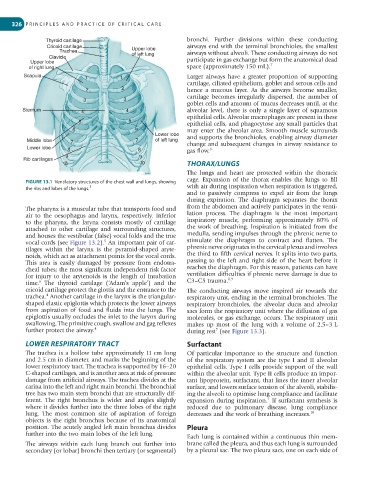
                                                              The  lungs  and  heart  are  protected  within  the  thoracic
         FIGURE 13.1  Ventilatory structures of the chest wall and lungs, showing   cage.  Expansion  of  the  thorax  enables  the  lungs  to  fill
                              1
         the ribs and lobes of the lungs.                     with air during inspiration when respiration is triggered,
                                                              and  to  passively  compress  to  expel  air  from  the  lungs
                                                              during  expiration.  The  diaphragm  separates  the  thorax
         The pharynx is a muscular tube that transports food and   from the abdomen and actively participates in the venti-
         air  to  the  oesophagus  and  larynx,  respectively.  Inferior     lation  process.  The  diaphragm  is  the  most  important
         to  the  pharynx,  the  larynx  consists  mostly  of  cartilage   inspiratory  muscle,  performing  approximately  80%  of
         attached  to  other  cartilage  and  surrounding  structures,   the work of breathing. Inspiration is initiated from the
         and houses the vestibular (false) vocal folds and the true   medulla, sending impulses through the phrenic nerve to
                                   5
         vocal cords (see Figure 13.2).  An important pair of car-  stimulate  the  diaphragm  to  contract  and  flatten.  The
         tilages  within  the  larynx  is  the  pyramid-shaped  aryte-  phrenic nerve originates in the cervical plexus and involves
         noids, which act as attachment points for the vocal cords.   the third to fifth cervical nerves. It splits into two parts,
         This  area  is  easily  damaged  by  pressure  from  endotra-  passing  to  the  left  and  right  side  of  the  heart  before  it
         cheal tubes; the most significant independent risk factor   reaches the diaphragm. For this reason, patients can have
         for  injury  to  the  arytenoids  is  the  length  of  intubation   ventilation difficulties if phrenic nerve damage is due to
                                                                            8,9
              6
         time.   The  thyroid  cartilage  (‘Adam’s  apple’)  and  the   C3–C5 trauma.
         cricoid cartilage protect the glottis and the entrance to the   The  conducting  airways  move  inspired  air  towards  the
                4
         trachea.  Another cartilage in the larynx is the triangular-  respiratory unit, ending in the terminal bronchioles. The
         shaped elastic epiglottis which protects the lower airways   respiratory  bronchioles,  the  alveolar  ducts  and  alveolar
         from  aspiration  of  food  and  fluids  into  the  lungs.  The   sacs form the respiratory unit where the diffusion of gas
         epiglottis usually occludes the inlet to the larynx during   molecules, or gas exchange, occurs. The respiratory unit
         swallowing. The primitive cough, swallow and gag reflexes   makes  up  most  of  the  lung  with  a  volume  of  2.5–3 L
         further protect the airway. 4                        during rest  (see Figure 13.3).
                                                                        7
         LOWER RESPIRATORY TRACT                              Surfactant
         The trachea is a hollow tube approximately 11 cm long   Of  particular  importance  to  the  structure  and  function
         and 2.5 cm in diameter, and marks the beginning of the   of  the  respiratory  system  are  the  type  I  and  II  alveolar
         lower respiratory tract. The trachea is supported by 16–20   epithelial cells. Type I cells provide support of the wall
         C-shaped cartilages, and is another area at risk of pressure   within the alveolar unit. Type II cells produce an impor-
         damage from artificial airways. The trachea divides at the   tant lipoprotein, surfactant, that lines the inner alveolar
         carina into the left and right main bronchi. The bronchial   surface, and lowers surface tension of the alveoli, stabilis-
         tree has two main stem bronchi that are structurally dif-  ing the alveoli to optimise lung compliance and facilitate
         ferent.  The  right  bronchus  is  wider  and  angles  slightly   expansion  during  inspiration.   If  surfactant  synthesis  is
                                                                                        7
         where it divides further into the three lobes of the right   reduced  due  to  pulmonary  disease,  lung  compliance
         lung.  The  most  common  site  of  aspiration  of  foreign   decreases and the work of breathing increases. 10
         objects  is  the  right  bronchus  because  of  its  anatomical
         position. The acutely angled left main bronchus divides   Pleura
         further into the two main lobes of the left lung.    Each lung is contained within a continuous thin mem-
         The  airways  within  each  lung  branch  out  further  into   brane called the pleura, and thus each lung is surrounded
         secondary (or lobar) bronchi then tertiary (or segmental)   by a pleural sac. The two pleura sacs, one on each side of

