


Page 353 - ACCCN's Critical Care Nursing
P. 353
330  P R I N C I P L E S   A N D   P R A C T I C E   O F   C R I T I C A L   C A R E

                                                                    9
         when  administering  oxygen  so  that  the  stimulus  to   blood.  Other receptors include stretch receptors located
         breathe  is  not  compromised,  as  increases  in  PO 2   may   in the lungs that inhibit inspiration and protect the lungs
         reduce  respiratory  drive.  Peripheral  chemoreceptors   from  over-inflation  (Hering–Breuer  reflex),  and  in  the
         respond  to  low  partial  pressure  of  oxygen  in  arterial   muscles and joints (see Figure 13.7).
         blood (PaO 2 ) and contribute to maintaining ventilation,
         functioning  optimally  when  oxygen  levels  fall  below   PULMONARY VOLUMES AND CAPACITIES
         70 mmHg.  7                                          In healthy individuals, the lungs are readily distensible
         Central chemoreceptors located in the medulla respond   or compliant; when exposed to high expanding pressures
         to changes in hydrogen ion concentration in the CSF that   or in disease states, compliance is increased or decreased.
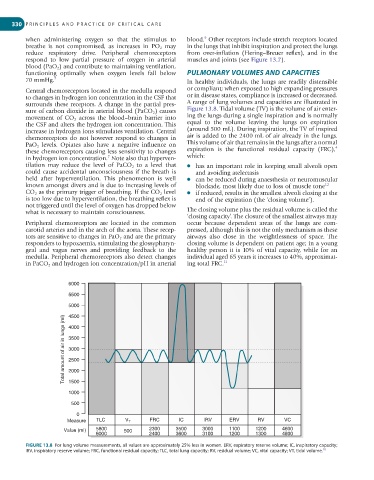
         surrounds these receptors. A change in the partial pres-  A range of lung volumes and capacities are illustrated in
         sure of carbon dioxide in arterial blood (PaCO 2 ) causes   Figure 13.8. Tidal volume (TV) is the volume of air enter-
         movement  of  CO 2   across  the  blood–brain  barrier  into   ing the lungs during a single inspiration and is normally
         the CSF and alters the hydrogen ion concentration. This   equal  to  the  volume  leaving  the  lungs  on  expiration
         increase in hydrogen ions stimulates ventilation. Central   (around 500 mL). During inspiration, the TV of inspired
         chemoreceptors do not however respond to changes in   air is added to the 2400 mL of air already in the lungs.
         PaO 2   levels.  Opiates  also  have  a  negative  influence  on   This volume of air that remains in the lungs after a normal
                                                                                                               4
         these chemoreceptors causing less sensitivity to changes   expiration  is  the  functional  residual  capacity  (FRC),
         in hydrogen ion concentration.  Note also that hyperven-  which:
                                    7
         tilation  may  reduce  the  level  of  PaCO 2  to  a  level  that   ●  has an important role in keeping small alveoli open
         could cause accidental unconsciousness if the breath is   and avoiding atelectasis
         held  after  hyperventilation.  This  phenomenon  is  well   ●  can be reduced during anaesthesia or neuromuscular
         known amongst divers and is due to increasing levels of   blockade, most likely due to loss of muscle tone 12
         CO 2  as the primary trigger of breathing. If the CO 2  level   ●  if reduced, results in the smallest alveoli closing at the
         is too low due to hyperventilation, the breathing reflex is   end of the expiration (the ‘closing volume’).
         not triggered until the level of oxygen has dropped below
         what is necessary to maintain consciousness.         The closing volume plus the residual volume is called the
                                                              ‘closing capacity’. The closure of the smallest airways may
         Peripheral  chemoreceptors  are  located  in  the  common   occur  because  dependent  areas  of  the  lungs  are  com-
         carotid arteries and in the arch of the aorta. These recep-  pressed, although this is not the only mechanism as these
         tors are sensitive to changes in PaO 2  and are the primary   airways  also  close  in  the  weightlessness  of  space.  The
         responders to hypoxaemia, stimulating the glossypharyn-  closing volume is dependent on patient age; in a young
         geal  and  vagus  nerves  and  providing  feedback  to  the   healthy  person  it  is  10%  of  vital  capacity,  while  for  an
         medulla. Peripheral chemoreceptors also detect changes   individual aged 65 years it increases to 40%, approximat-
         in PaCO 2  and hydrogen ion concentration/pH in arterial   ing total FRC. 11


                       6000

                       5500
                       5000
                       4500
                      Total amount of air in lungs (ml)  3500
                       4000


                       3000

                       2500
                       2000
                       1500
                       1000

                        500
                          0
                       Measure  TLC       V T     FRC      IC       IRV     ERV      RV       VC
                      Value (ml)  5800    500     2300     3500    3000     1100     1200    4600
                                6000              2400     3600    3100     1200     1300    4800
         FIGURE 13.8  For lung volume measurements, all values are approximately 25% less in women. ERV, expiratory reserve volume; IC, inspiratory capacity;
                                                                                                           10
         IRV, inspiratory reserve volume; FRC, functional residual capacity; TLC, total lung capacity; RV, residual volume; VC, vital capacity; VT, tidal volume.

