


Page 351 - ACCCN's Critical Care Nursing
P. 351
328  P R I N C I P L E S   A N D   P R A C T I C E   O F   C R I T I C A L   C A R E


                 Inspiration  Expiration
                                Intrapulmonary
                                pressure
              +2
               0
           Pressure relative to atmospheric pressure (mm Hg)  −2  Trans-                             Pulmonary
                                pulmonary
                                                                                                     vein to
                                pressure
              −4
                                                                                                     left heart
              −6
                                 Intrapleural
                                 pressure
                                                                   Pulmonary
              −8
                                                                   artery from
                                                                                                   plexus
                                                                    right heart                    Capillary
                    Volume of breath
             Volume (L)  0                                                                           Alveoli
              0.5
                   5 seconds elapsed
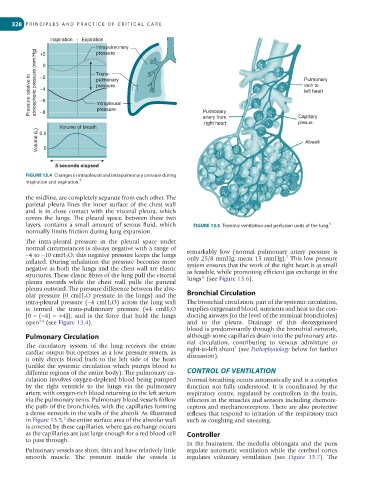
         FIGURE 13.4  Changes in intrapleural and intrapulmonary pressure during
                           4
         inspiration and expiration.

         the midline, are completely separate from each other. The
         parietal pleura lines the inner surface of the chest wall
         and  is  in  close  contact  with  the  visceral  pleura,  which
         covers  the  lungs.  The  pleural  space,  between  these  two
         layers,  contains  a  small  amount  of  serous  fluid,  which   FIGURE 13.5  Terminal ventilation and perfusion units of the lung.   5
         normally limits friction during lung expansion.
         The  intra-pleural  pressure  in  the  pleural  space  under
         normal circumstances is always negative with a range of
         −4 to −10 cmH 2 O; this negative pressure keeps the lungs   remarkably  low  (normal  pulmonary  artery  pressure  is
                                                                                               7
         inflated.  During  inhalation  the  pressure  becomes  more   only 25/8 mmHg; mean 15 mmHg).  This low pressure
         negative as both the lungs and the chest wall are elastic   system ensures that the work of the right heart is as small
         structures. These elastic fibres of the lung pull the visceral   as feasible, while promoting efficient gas exchange in the
                                                                   11
         pleura  inwards  while  the  chest  wall  pulls  the  parietal   lungs  (see Figure 13.6).
         pleura outward. The pressure difference between the alve-
         olar pressure (0 cmH 2 O pressure in the lungs) and the   Bronchial Circulation
         intra-pleural pressure (−4 cmH 2 O) across the lung wall   The bronchial circulation, part of the systemic circulation,
         is  termed  the  trans-pulmonary  pressure  (+4  cmH 2 O   supplies oxygenated blood, nutrients and heat to the con-
         [0  −  (−4)  =  +4]),  and  is  the  force  that  hold  the  lungs   ducting airways (to the level of the terminal bronchioles)
         open  (see Figure 13.4).                             and  to  the  pleura.  Drainage  of  this  deoxygenated
              3,4
                                                              blood is predominantly through the bronchial network,
         Pulmonary Circulation                                although some capillaries drain into the pulmonary arte-
         The  circulatory  system  of  the  lung  receives  the  entire   rial  circulation,  contributing  to  venous  admixture  or
                                                                              7
         cardiac output but operates as a low pressure system, as   right-to-left shunt  (see Pathophysiology below for further
         it  only  directs  blood  back  to  the  left  side  of  the  heart   discussion).
         (unlike the systemic circulation which pumps blood to
         different regions of the entire body). The pulmonary cir-  CONTROL OF VENTILATION
         culation involves oxygen-depleted blood being pumped   Normal breathing occurs automatically and is a complex
         by  the  right  ventricle  to  the  lungs  via  the  pulmonary   function not fully understood. It is coordinated by the
         artery, with oxygen-rich blood returning to the left atrium   respiratory centre, regulated by controllers in the brain,
         via the pulmonary veins. Pulmonary blood vessels follow   effectors in the muscles and sensors including chemore-
         the path of the bronchioles, with the capillaries forming   ceptors and mechanoreceptors. There are also protective
         a dense network in the walls of the alveoli. As illustrated   reflexes that respond to irritation of the respiratory tract
                      5
         in Figure 13.5,  the entire surface area of the alveolar wall   such as coughing and sneezing.
         is covered by these capillaries, where gas exchange occurs
         as the capillaries are just large enough for a red blood cell   Controller
         to pass through.
                                                              In the brainstem, the medulla oblongata and the pons
         Pulmonary vessels are short, thin and have relatively little   regulate automatic ventilation while the cerebral cortex
         smooth  muscle.  The  pressure  inside  the  vessels  is   regulates  voluntary  ventilation  (see  Figure  13.7).  The

