


Page 352 - ACCCN's Critical Care Nursing
P. 352
Respiratory Assessment and Monitoring 329

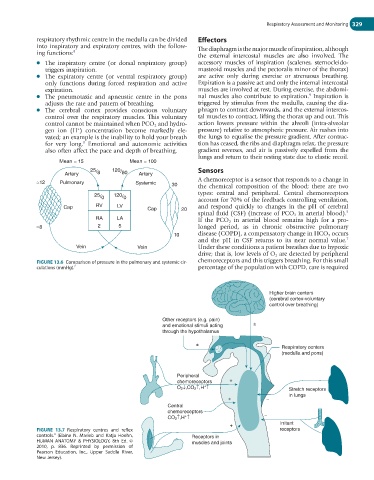
             respiratory rhythmic centre in the medulla can be divided   Effectors
             into inspiratory and expiratory centres, with the follow-  The diaphragm is the major muscle of inspiration, although
             ing functions: 8
                                                                  the  external  intercostal  muscles  are  also  involved.  The
             ●  The  inspiratory  centre  (or  dorsal  respiratory  group)   accessory  muscles  of  inspiration  (scalenes,  sternocleido-
                triggers inspiration.                             masteoid muscles and the pectoralis minor of the thorax)
             ●  The  expiratory  centre  (or  ventral  respiratory  group)   are  active  only  during  exercise  or  strenuous  breathing.
                only  functions  during  forced  respiration  and  active   Expiration is a passive act and only the internal intercostal
                expiration.                                       muscles are involved at rest. During exercise, the abdomi-
                                                                                                      4
             ●  The  pneumotaxic  and  apneustic  centre  in  the  pons   nal muscles also contribute to expiration.  Inspiration is
                adjusts the rate and pattern of breathing.        triggered by stimulus from the medulla, causing the dia-
             ●  The  cerebral  cortex  provides  conscious  voluntary   phragm to contract downwards, and the external intercos-
                control  over  the  respiratory  muscles.  This  voluntary   tal muscles to contract, lifting the thorax up and out. This
                control cannot be maintained when PCO 2  and hydro-  action  lowers  pressure  within  the  alveoli  (intra-alveolar
                gen  ion  (H )  concentration  become  markedly  ele-  pressure) relative to atmospheric pressure. Air rushes into
                          +
                vated; an example is the inability to hold your breath   the lungs to equalise the pressure gradient. After contrac-
                            8
                for  very  long.   Emotional  and  autonomic  activities   tion has ceased, the ribs and diaphragm relax, the pressure
                also often affect the pace and depth of breathing.  gradient  reverses,  and  air  is  passively  expelled  from  the
                                                                  lungs and return to their resting state due to elastic recoil.
                    Mean = 15              Mean = 100
                                                                  Sensors
                               25 / 8  120 / 80
                      Artery                  Artery
                                                                  A chemoreceptor is a sensor that responds to a change in
              12     Pulmonary               Systemic    30       the  chemical  composition  of  the  blood;  there  are  two
                                                                  types:  central  and  peripheral.  Central  chemoreceptors
                                25 / 0  120 / 0
                                                                  account for 70% of the feedback controlling ventilation,
                      Cap       RV     LV        Cap        20    and  respond  quickly  to  changes  in  the  pH  of  cerebral
                                                                                                                  9
                                                                  spinal fluid (CSF) (increase of PCO 2  in arterial blood).
                                RA     LA                         If  the  PCO 2   in  arterial  blood  remains  high  for  a  pro-
              8                  2      5                         longed  period,  as  in  chronic  obstructive  pulmonary
                                                          10      disease (COPD), a compensatory change in HCO 3  occurs
                                                                  and  the  pH  in  CSF  returns  to  its  near  normal  value.
                                                                                                                  7
                          Vein                Vein                Under these conditions a patient breathes due to hypoxic
                                                                  drive; that is, low levels of O 2  are detected by peripheral
             FIGURE 13.6  Comparison of pressure in the pulmonary and systemic cir-  chemoreceptors and this triggers breathing. For this small
                         7
             culations (mmHg).                                    percentage of the population with COPD, care is required


                                                                                         Higher brain centers
                                                                                         (cerebral cortex-voluntary
                                                                                         control over breathing)
                                                      Other receptors (e.g. pain)
                                                      and emotional stimuli acting  ±
                                                      through the hypothalamus

                                                                 ±
                                                                                             Respiratory centers
                                                                                             (medulla and pons)


                                                           Peripheral
                                                           chemoreceptors   +
                                                                    +
                                                           O 2 ↓,CO 2 ↑,H ↑                     Stretch receptors
                                                                                                in lungs
                                                                            +           −
                                                        Central
                                                        chemoreceptors
                                                             +
                                                        CO 2 ↑,H ↑                      −
                                                                            +                Irritant
             FIGURE  13.7  Respiratory  centres  and  reflex                                 receptors
                   4
             controls.   (Elaine  N.  Marieb  and  Katja  Hoehn,   Receptors in
             HUMAN  ANATOMY  &  PHYSIOLOGY,  8th  Ed.  ©        muscles and joints
             2010,  p.  836.  Reprinted  by  permission  of
             Pearson  Education,  Inc.,  Upper  Saddle  River,
             New Jersey).

