


Page 42 - ACCCN's Critical Care Nursing
P. 42
Resourcing Critical Care 19

             Funding  based  on  achieving  positive  patient  outcomes
             would be ideal, as it would ensure that critical care units   TABLE 2.1  Approaches to assessing treatment options 12
             were  using  their  resources  only  for  those  patients  who
             were most likely to achieve positive outcomes in terms of   Approach  Description
             morbidity and mortality, but such an ideal has not devel-
             oped sufficiently to date. Funding based on health out-  Benefit–risk   The benefit of treatment and the inherent
                                                                                     risks to the patient are assessed to inform
                                                                      approach
             comes only does, however, raise the risk of encouraging                 a decision; this approach excludes
             clinicians  to  ‘cherry-pick’  only  the  most  ‘profitable’  or        monetary costs.
             ‘successful’  patient  groups  at  the  expense  of  others.  In   Benefit–cost   Evaluate the benefit and cost of the
             private (for-profit) hospitals or countries with very poor   approach   decision to proceed; this approach
             health  systems,  ‘cherry-picking’  only  those  patients  for          incorporates cost to patient and society.
             whom a successful outcome is guaranteed is likely to be   Implicit approach  The medical practitioner provides the
             more common, whereas in the public hospitals of most                    service and judges its appropriateness.
             Western countries an educated guess/risk is often applied
             to the decision as to whether a patient should enter the
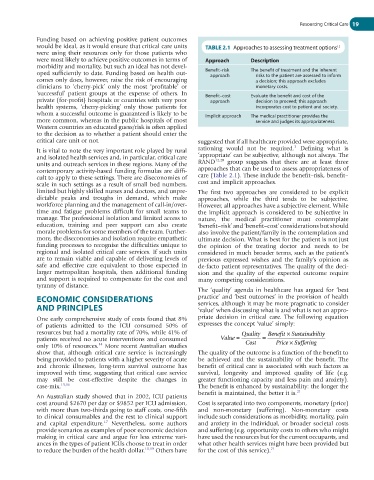
             critical care unit or not.                           suggested that if all healthcare provided were appropriate,
                                                                                                 3
             It is vital to note the very important role played by rural   rationing  would  not  be  required.   Defining  what  is
             and isolated health services and, in particular, critical care   ‘appropriate’ can be subjective, although not always. The
                                                                       12,20
             units and outreach services in these regions. Many of the   RAND    group  suggests  that  there  are  at  least  three
             contemporary activity-based funding formulas are diffi-  approaches that can be used to assess appropriateness of
             cult to apply to these settings. There are diseconomies of   care (Table 2.1). These include the benefit–risk, benefit–
             scale in such settings as a result of small bed numbers,   cost and implicit approaches.
             limited but highly skilled nurses and doctors, and unpre-  The  first  two  approaches  are  considered  to  be  explicit
             dictable  peaks  and  troughs  in  demand,  which  make   approaches,  while  the  third  tends  to  be  subjective.
             workforce planning and the management of call-in/over-  However, all approaches have a subjective element. While
             time  and  fatigue  problems  difficult  for  small  teams  to   the  implicit  approach  is  considered  to  be  subjective  in
             manage. The professional isolation and limited access to   nature,  the  medical  practitioner  must  contemplate
             education,  training  and  peer  support  can  also  create   ‘benefit–risk’ and ‘benefit–cost’ considerations but should
             morale problems for some members of the team. Further-  also involve the patient/family in the contemplation and
             more, the diseconomies and isolation require empathetic   ultimate decision. What is best for the patient is not just
             funding processes to recognise the difficulties unique to   the  opinion  of  the  treating  doctor  and  needs  to  be
             regional and isolated critical care services. If such units   considered in much broader terms, such as the patient’s
             are to remain viable and capable of delivering levels of   previous  expressed  wishes  and  the  family’s  opinion  as
             safe  and  effective  care  equivalent  to  those  expected  in   de-facto patient representatives. The quality of the deci-
             larger  metropolitan  hospitals,  then  additional  funding   sion  and  the  quality  of  the  expected  outcome  require
             and support is required to compensate for the cost and   many competing considerations.
             tyranny of distance.
                                                                  The  ‘quality’  agenda  in  healthcare  has  argued  for  ‘best
             ECONOMIC CONSIDERATIONS                              practice’ and ‘best outcomes’ in the provision of health
                                                                  services, although it may be more pragmatic to consider
             AND PRINCIPLES                                       ‘value’ when discussing what is and what is not an appro-
             One early comprehensive study of costs found that 8%   priate  decision  in  critical  care.  The  following  equation
             of  patients  admitted  to  the  ICU  consumed  50%  of   expresses the concept ‘value’ simply:
             resources but had a mortality rate of 70%, while 41% of            Quality  Benefit ×  Sustainability
             patients received no acute interventions and consumed       Value =       =
                                                                                                ×
             only 10% of resources.  More recent Australian studies              Cost      Price Suffering
                                 14
             show  that,  although  critical  care  service  is  increasingly   The quality of the outcome is a function of the benefit to
             being provided to patients with a higher severity of acute   be  achieved  and  the  sustainability  of  the  benefit.  The
             and  chronic  illnesses,  long-term  survival  outcome  has   benefit of critical care is associated with such factors as
             improved with time, suggesting that critical care service   survival,  longevity  and  improved  quality  of  life  (e.g.
             may  still  be  cost-effective  despite  the  changes  in   greater functioning capacity and less pain and anxiety).
             case-mix. 15,16                                      The benefit is enhanced by sustainability: the longer the
                                                                  benefit is maintained, the better it is. 21
             An Australian study showed that in 2002, ICU patients
             cost around $2670 per day or $9852 per ICU admission,   Cost is separated into two components, monetary (price)
             with more than two-thirds going to staff costs, one-fifth   and  non-monetary  (suffering).  Non-monetary  costs
             to clinical consumables and the rest to clinical support   include such considerations as morbidity, mortality, pain
             and  capital  expenditure.   Nevertheless,  some  authors   and anxiety in the individual, or broader societal costs
                                   17
             provide scenarios as examples of poor economic decision   and suffering (e.g. opportunity costs to others who might
             making  in  critical  care  and  argue  for  less  extreme  vari-  have used the resources but for the current occupants, and
             ances in the types of patient ICUs choose to treat in order   what other health services might have been provided but
             to reduce the burden of the health dollar. 18,19  Others have   for the cost of this service). 21

