


Page 46 - ACCCN's Critical Care Nursing
P. 46
Resourcing Critical Care 23

                                                                  provided  in-house  by  individual  facility  biomedical
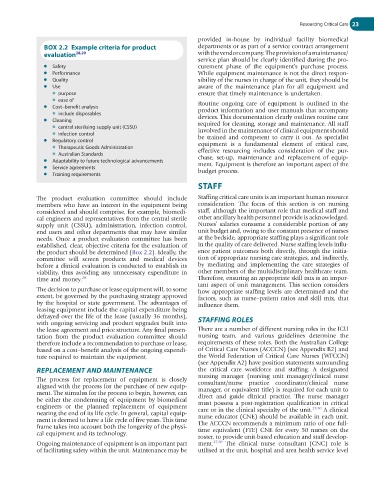
               BOX 2.2  Example criteria for product              departments or as part of a service contract arrangement
               evaluation 28,29                                   with the vendor company. The provision of a maintenance/
                                                                  service plan should be clearly identified during the pro-
               ●  Safety                                          curement  phase  of  the  equipment’s  purchase  process.
               ●  Performance                                     While equipment maintenance is not the direct respon-
               ●  Quality                                         sibility of the nurses in charge of the unit, they should be
               ●  Use                                             aware  of  the  maintenance  plan  for  all  equipment  and
                  ●  purpose                                      ensure that timely maintenance is undertaken.
                  ●  ease of                                      Routine  ongoing  care  of  equipment  is  outlined  in  the
               ●  Cost–benefit analysis                           product information and user manuals that accompany
                  ●  include disposables                          devices. This documentation clearly outlines routine care
               ●  Cleaning                                        required for cleaning, storage and maintenance. All staff
                  ●  central sterilising supply unit (CSSU)       involved in the maintenance of clinical equipment should
                  ●  infection control                            be  trained  and  competent  to  carry  it  out.  As  specialist
               ●  Regulatory control                              equipment  is  a  fundamental  element  of  critical  care,
                  ●  Therapeutic Goods Administration             effective  resourcing  includes  consideration  of  the  pur-
                  ●  Australian Standards                         chase,  set-up,  maintenance  and  replacement  of  equip-
               ●  Adaptability to future technological advancements  ment. Equipment is therefore an important aspect of the
               ●  Service agreements                              budget process.
               ●  Training requirements
                                                                  STAFF

             The  product  evaluation  committee  should  include   Staffing critical care units is an important human resource
             members who have an interest in the equipment being   consideration.  The  focus  of  this  section  is  on  nursing
             considered and should comprise, for example, biomedi-  staff, although the important role that medical staff and
             cal engineers and representatives from the central sterile   other ancillary health personnel provide is acknowledged.
             supply  unit  (CSSU),  administration,  infection  control,   Nurses’ salaries consume a considerable portion of any
             end users and other departments that may have similar   unit budget and, owing to the constant presence of nurses
             needs.  Once  a  product  evaluation  committee  has  been   at the bedside, appropriate staffing plays a significant role
             established, clear, objective criteria for the evaluation of   in the quality of care delivered. Nurse staffing levels influ-
             the product should be determined (Box 2.2). Ideally, the   ence patient outcomes both directly, through the initia-
             committee  will  screen  products  and  medical  devices   tion of appropriate nursing care strategies, and indirectly,
             before a clinical evaluation is conducted to establish its   by  mediating  and  implementing  the  care  strategies  of
             viability,  thus  avoiding  any  unnecessary  expenditure  in   other members of the multidisciplinary healthcare team.
             time and money. 28                                   Therefore, ensuring an appropriate skill mix is an impor-
                                                                  tant aspect of unit management. This section considers
             The decision to purchase or lease equipment will, to some   how appropriate staffing levels are determined and the
             extent, be governed by the purchasing strategy approved   factors, such as nurse–patient ratios and skill mix, that
             by the hospital or state government. The advantages of   influence them.
             leasing equipment include the capital expenditure being
             defrayed over the life of the lease (usually 36 months),
             with ongoing servicing and product upgrades built into   STAFFING ROLES
             the lease agreement and price structure. Any final presen-  There are a number of different nursing roles in the ICU
             tation  from  the  product  evaluation  committee  should   nursing  team,  and  various  guidelines  determine  the
             therefore include a recommendation to purchase or lease,   requirements of these roles. Both the Australian College
             based on a cost–benefit analysis of the ongoing expendi-  of Critical Care Nurses (ACCCN) (see Appendix B2) and
             ture required to maintain the equipment.             the World Federation of Critical Care Nurses (WFCCN)
                                                                  (see Appendix A2) have position statements surrounding
             REPLACEMENT AND MAINTENANCE                          the  critical  care  workforce  and  staffing.  A  designated

             The  process  for  replacement  of  equipment  is  closely   nursing  manager  (nursing  unit  manager/clinical  nurse
             aligned with the process for the purchase of new equip-  consultant/nurse  practice  coordinator/clinical  nurse
             ment. The stimulus for the process to begin, however, can   manager, or equivalent title) is required for each unit to
             be either the condemning of equipment by biomedical   direct  and  guide  clinical  practice.  The  nurse  manager
             engineers  or  the  planned  replacement  of  equipment   must  possess  a  post-registration  qualification  in  critical
                                                                                                       27,30
             nearing the end of its life cycle. In general, capital equip-  care or in the clinical specialty of the unit.   A clinical
             ment is deemed to have a life cycle of five years. This time   nurse educator (CNE) should be available in each unit.
             frame takes into account both the longevity of the physi-  The ACCCN recommends a minimum ratio of one full-
             cal equipment and its technology.                    time  equivalent  (FTE)  CNE  for  every  50  nurses  on  the
                                                                  roster, to provide unit-based education and staff develop-
             Ongoing maintenance of equipment is an important part   ment. 27,30   The  clinical  nurse  consultant  (CNC)  role  is
             of facilitating safety within the unit. Maintenance may be   utilised at the unit, hospital and area health service level

