


Page 45 - ACCCN's Critical Care Nursing
P. 45
22  S C O P E   O F   C R I T I C A L   C A R E


            BOX 2.1  Business case: sample headings              TABLE 2.3  Basic equipment requirements
            Title                                                Monitoring                  Therapeutic
            Purpose
            Background                                           Monitors (including central station)  Ventilators (invasive and
                                                                                              non-invasive)
                                                                 End-tidal CO 2  monitoring
            Key issues                                           Arterial blood gas analyser   Infusion pumps
            Cost–benefit analysis                                 (±electrolytes)            Syringe drivers
            Recommendations                                      Invasive monitoring         CVVHDF
            Risk assessment                                      ●  arterial                 EDD-f
                                                                 ●  central venous pressure  Resuscitators
                                                                 ●  intracranial pressure    Temporary pacemaker
                                                                 ●  PiCCO                    Defibrillator
                                                                 ●  pulmonary artery         Suctioning apparatus
                                                                 Access to image intensifier
         In summary, the business case is an important tool that   Ultrasound
         is increasingly required at all levels of an organisation to   Access to CT/MRI
         clearly define a proposed change or purchase. This docu-
         ment  should  include  clear  goals  and  outcomes,  a  cost-  CT = computerised tomography; CVVHDF = continuous veno-venous
                                                                 haemodiafiltration; EDD-f = extended daily dialysis filtration; MRI =
         benefit  analysis  and  timelines  for  achievement  of  the   magnetic resonance imaging; PiCCO = pulse-induced contour cardiac
         solution.                                               output.
         CRITICAL CARE ENVIRONMENT

         A critical care unit is a distinct unit within a hospital that   non-essential), data points and task lighting sufficient for
         has easy access to the emergency department, operating   use  during  the  performance  of  bedside  procedures.
         theatre and medical imaging. It provides care to patients   Further  detailed  descriptions  are  available  in  various
         with a life-threatening illness or injury and concentrates   health department documents. 26
         the clinical expertise and technological and therapeutic
         resources required.  The College of Intensive Care Medi-  EQUIPMENT
                          26
         cine  (CICM)  defines  three  levels  of  intensive  care  to
         support  the  role  delineation  of  a  particular  hospital,   Since the advent of critical care units, healthcare delivery
         dependent upon staffing expertise, facilities and support   has become increasingly dependent on medical techno-
         services.  Critical care facilities vary in nature and extent   logy to deliver that care. Equipment can be categorised
                27
         between hospitals and are dependent on the operational   into several funding groups: capital expenditure (gener-
         policies  of  each  individual  facility.  In  smaller  facilities,   ally  in  excess  of  $10,000),  equipment  expenditure  (all
         the broad spectrum of critical care may be provided in   equipment less than $10,000), and the disposable prod-
         combined units (intensive care, high-dependency, coro-  ucts  and  devices  required  to  support  the  use  of  equip-
         nary care) to improve flexibility and aid the efficient use   ment. This section examines how to evaluate, procure and
         of available resources. 26                           maintain that equipment.

         ORGANISATIONAL DESIGN                                INITIAL SET-UP REQUIREMENTS
         The functional organisational and unit designs are gov-  Critical care units require baseline equipment that allows
         erned by available finances, an operational brief and the   the unit to deliver safe and effective patient care. The list
         building and design standards of the state or country in   of  specific  equipment  required  by  each  individual  unit
         which the hospital is located. A critical care unit should   will be governed by the scope of that unit’s function. For
         have access to minimum support facilities, which include   example, a unit that provides care to patients after neu-
         staff  station,  clean  utility,  dirty  utility,  store  room(s),    rosurgery will require the ability to monitor intracranial
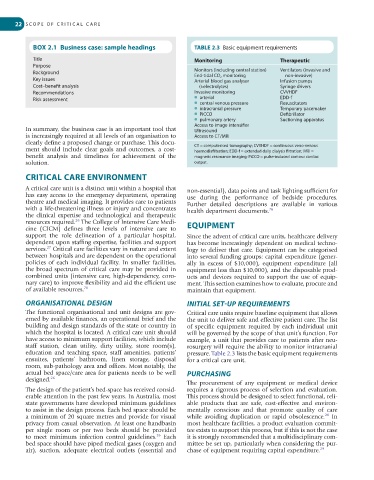
         education  and  teaching  space,  staff  amenities,  patients’   pressure. Table 2.3 lists the basic equipment requirements
         ensuites,  patients’  bathroom,  linen  storage,  disposal   for a critical care unit.
         room, sub-pathology area and offices. Most notably, the
         actual bed space/care area for patients needs to be well   PURCHASING
         designed. 26
                                                              The  procurement  of  any  equipment  or  medical  device
         The design of the patient’s bed-space has received consid-  requires a rigorous process of selection and evaluation.
         erable attention in the past few years. In Australia, most   This process should be designed to select functional, reli-
         state governments have developed minimum guidelines   able  products  that  are  safe,  cost-effective  and  environ-
         to assist in the design process. Each bed space should be   mentally  conscious  and  that  promote  quality  of  care
                                                                                                           28
         a minimum of 20 square metres and provide for visual   while  avoiding  duplication  or  rapid  obsolescence.   In
         privacy from casual observation. At least one handbasin   most healthcare facilities, a product evaluation commit-
         per  single  room  or  per  two  beds  should  be  provided     tee exists to support this process, but if this is not the case
                                                    26
         to  meet  minimum  infection  control  guidelines.   Each   it is strongly recommended that a multidisciplinary com-
         bed space should have piped medical gases (oxygen and   mittee be set up, particularly when considering the pur-
         air),  suction,  adequate  electrical  outlets  (essential  and   chase of equipment requiring capital expenditure. 29

