


Page 428 - ACCCN's Critical Care Nursing
P. 428
Ventilation and Oxygenation Management 405


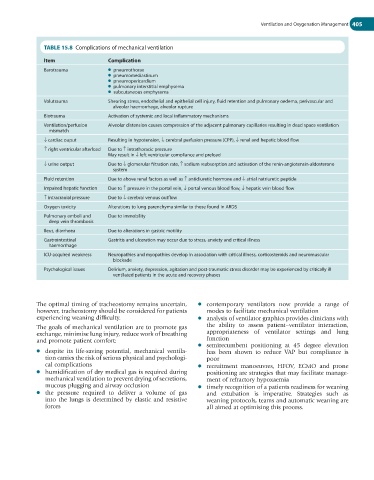
               TABLE 15.8  Complications of mechanical ventilation

               Item                 Complication
               Barotrauma           ●  pneumothorax
                                    ●  pneumomediastinum
                                    ●  pneumopericardium
                                    ●  pulmonary interstitial emphysema
                                    ●  subcutaneous emphysema
               Volutrauma           Shearing stress, endothelial and epithelial cell injury, fluid retention and pulmonary oedema, perivascular and
                                      alveolar haemorrhage, alveolar rupture
               Biotrauma            Activation of systemic and local inflammatory mechanisms
               Ventilation/perfusion   Alveolar distension causes compression of the adjacent pulmonary capillaries resulting in dead space ventilation
                 mismatch
               ↓ cardiac ouput      Resulting in hypotension, ↓ cerebral perfusion pressure (CPP), ↓ renal and hepatic blood flow
               ↑ right ventricular afterload  Due to ↑ intrathoracic pressure
                                    May result in ↓ left ventricular compliance and preload
               ↓ urine output       Due to ↓ glomerular filtration rate, ↑ sodium reabsorption and activation of the renin-angiotensin-aldosterone
                                      system
               Fluid retention      Due to above renal factors as well as ↑ antidiuretic hormone and ↓ atrial natriuretic peptide
               Impaired hepatic function  Due to ↑ pressure in the portal vein, ↓ portal venous blood flow, ↓ hepatic vein blood flow
               ↑ intracranial pressure  Due to ↓ cerebral venous outflow
               Oxygen toxicity      Alterations to lung parenchyma similar to those found in ARDS
               Pulmonary emboli and   Due to immobility
                 deep vein thrombosis
               Ileus, diarrhoea     Due to alterations in gastric motility
               Gastrointestinal     Gastritis and ulceration may occur due to stress, anxiety and critical illness
                 haemorrhage
               ICU-acquired weakness  Neuropathies and myopathies develop in association with critical illness, corticosteroids and neuromuscular
                                      blockade
               Psychological issues  Delirium, anxiety, depression, agitation and post-traumatic stress disorder may be experienced by critically ill
                                      ventilated patients in the acute and recovery phases


             The optimal timing of tracheostomy remains uncertain,   ●  contemporary  ventilators  now  provide  a  range  of
             however, tracheostomy should be considered for patients   modes to facilitate mechanical ventilation
             experiencing weaning difficulty.                     ●  analysis of ventilator graphics provides clinicians with
             The goals of mechanical ventilation are to promote gas   the  ability  to  assess  patient–ventilator  interaction,
             exchange, minimise lung injury, reduce work of breathing   appropriateness  of  ventilator  settings  and  lung
             and promote patient comfort:                            function
                                                                  ●  semirecumbent  positioning  at  45  degree  elevation
             ●  despite  its  life-saving  potential,  mechanical  ventila-  has  been  shown  to  reduce  VAP  but  compliance  is
                tion carries the risk of serious physical and psychologi-  poor
                cal complications                                 ●  recruitment  manoeuvres,  HFOV,  ECMO  and  prone
             ●  humidification of dry medical gas is required during   positioning are strategies that may facilitate manage-
                mechanical ventilation to prevent drying of secretions,   ment of refractory hypoxaemia
                mucous plugging and airway occlusion              ●  timely recognition of a patients readiness for weaning
             ●  the  pressure  required  to  deliver  a  volume  of  gas   and  extubation  is  imperative.  Strategies  such  as
                into  the  lungs  is  determined  by  elastic  and  resistive   weaning protocols, teams and automatic weaning are
                forces                                               all aimed at optimising this process.

