


Page 423 - ACCCN's Critical Care Nursing
P. 423
400  P R I N C I P L E S   A N D   P R A C T I C E   O F   C R I T I C A L   C A R E

            Volume          Volume-oriented                                        Air Trapping


                                                                   Inspiration                            Normal
                                                                                                          patient
                                                     Time
                                                                Flow (L/min)                }
            Flow                                                                                      Time (sec)

                                                                                         Air Trapping
                                                                                         Auto-PEEP
                                                                                 Expiration
                                                     Time
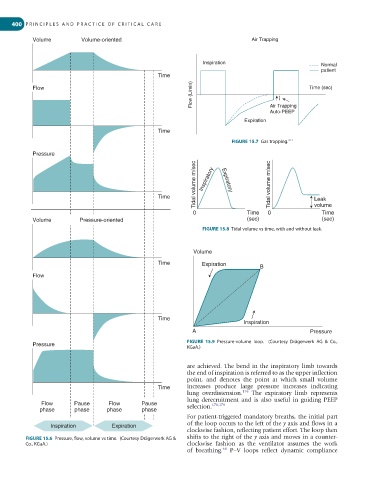
                                                                             FIGURE 15.7  Gas trapping.
                                                                                               271
            Pressure
                                                                 Tidal volume m/sec  Inspiratory  Expiratory  Tidal volume m/sec


                                                     Time                                               Leak


                                                                0                 Time   0              volume
                                                                                                          Time
            Volume         Pressure-oriented                                      (sec)                   (sec)
                                                                   FIGURE 15.8  Tidal volume vs time, with and without leak.


                                                                Volume
                                                     Time          Expiration         B

            Flow


                                                     Time
                                                                                 Inspiration
                                                                A                                     Pressure

            Pressure                                          FIGURE  15.9  Pressure-volume  loop.    (Courtesy  Drägerwerk  AG  &  Co.,
                                                              KGaA.)

                                                              are achieved. The bend in the inspiratory limb towards
                                                              the end of inspiration is referred to as the upper inflection
                                                              point,  and  denotes  the  point  at  which  small  volume
                                                     Time     increases  produce  large  pressure  increases  indicating
                                                              lung  overdistension. 176   The  expiratory  limb  represents
                                                              lung  derecruitment  and  is  also  useful  in  guiding  PEEP
               Flow      Pause       Flow      Pause          selection. 178,179
              phase      phase      phase      phase
                                                              For patient-triggered mandatory breaths, the initial part
                  Inspiration         Expiration              of the loop occurs to the left of the y axis and flows in a
                                                              clockwise fashion, reflecting patient effort. The loop then
         FIGURE 15.6  Pressure, flow, volume vs time.  (Courtesy Drägerwerk AG &   shifts to the right of the y axis and moves in a counter-
         Co., KGaA.)                                          clockwise  fashion  as  the  ventilator  assumes  the  work
                                                                          68
                                                              of  breathing.   P–V  loops  reflect  dynamic  compliance

