


Page 424 - ACCCN's Critical Care Nursing
P. 424
Ventilation and Oxygenation Management 401

                                                                  alveoli  or  failure  to  recruit. 140   Once  the  recruitment
               800                                                manoeuvre  is  terminated,  derecruitment  may  occur
                                                                  rapidly.  Serious  adverse  effects  have  been  noted  during
              Volume (mL)  600                   High Raw         pulmonary  pressures  resulting  in  reductions  in  venous
                                                                  the use of RMs due to increased intrathoracic and intra-
                                                                  return and cardiac output, and cardiac arrest and increased
               400
                                                 (Solid line)
                                                                                   184,188
                                                                  risk of barotrauma.
               200                                                High Frequency Oscillatory Ventilation
                                                                  High frequency oscillatory ventilation (HFOV) requires a
                                                                  specialised ventilator and manipulation of four variables:
                           10      20      30       40      50    mean airway pressure (cmH 2 O), frequency (Hz), inspira-
                                 Pressure (cm H 2 O)              tory  time,  and  amplitude  (or  power  [ΔP]). 189   Alveolar
                                                                  overdistension is limited through the use of sub-deadspace
              *Dashed line depicts normal Raw                     tidal  volumes  whereas  cyclic  collapse  of  alveoli  is  pre-
                                                             129
             FIGURE 15.10  Pressure–volume loop representing resistance changes.    vented  by  maintenance  of  high  end-expiratory  lung
                                                                  pressures. 190,191   High  frequency  (between  3  and  15 Hz)
                                                                  oscillations  at  extremely  fast  rates  (300–420  breaths/
                                                                  min)  create  pressure  waves  enabling  CO 2   elimina-
                                                                  tion. 133,192  Oxygenation is facilitated through application
             between the lungs and the ventilator circuit. Decreased   of a constant mean airway pressure via the bias flow (rate
             compliance requires greater pressure to achieve V T  and is   of  fresh  gas). 192,193   In  adults,  recommendations  for  the
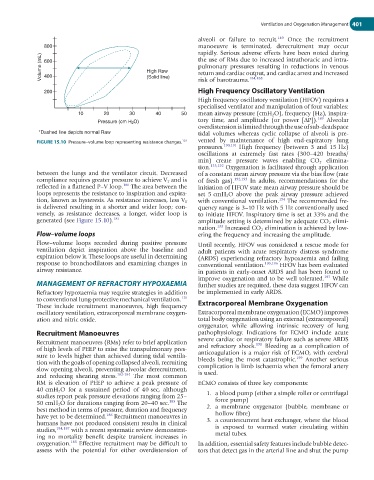
             reflected in a flattened P–V loop. 180  The area between the   initiation of HFOV state mean airway pressure should be
             loops represents the resistance to inspiration and expira-  set  5 cmH 2 O  above  the  peak  airway  pressure  achieved
             tion, known as hysteresis. As resistance increases, less V T    with conventional ventilation. 194  The recommended fre-
             is delivered resulting in a shorter and wider loop; con-  quency range is 3–10 Hz with 5 Hz conventionally used
             versely,  as  resistance  decreases,  a  longer,  wider  loop  is   to initiate HFOV. Inspiratory time is set at 33% and the
             generated (see Figure 15.10). 181                    amplitude setting is determined by adequate CO 2  elimi-
                                                                  nation. 133  Increased CO 2  elimination is achieved by low-
             Flow–volume loops                                    ering the frequency and increasing the amplitude.
             Flow–volume  loops  recorded  during  positive  pressure   Until recently, HFOV was considered a rescue mode for
             ventilation  depict  inspiration  above  the  baseline  and   adult  patients  with  acute  respiratory  distress  syndrome
             expiration below it. These loops are useful in determining   (ARDS) experiencing refractory hypoxaemia and failing
             response to bronchodilators and examining changes in   conventional ventilation. 195,196  HFOV has been evaluated
             airway resistance.                                   in patients in early-onset ARDS and has been found to
                                                                  improve oxygenation and to be well tolerated. 197  While
             MANAGEMENT OF REFRACTORY HYPOXAEMIA                  further studies are required, these data suggest HFOV can
             Refractory hypoxaemia may require strategies in addition   be implemented in early ARDS.
                                                            121
             to conventional lung-protective mechanical ventilation.
             These  include  recruitment  manoeuvres,  high  frequency   Extracorporeal Membrane Oxygenation
             oscillatory ventilation, extracorporeal membrane oxygen-  Extracorporeal membrane oxygenation (ECMO) improves
             ation and nitric oxide.                              total body oxygenation using an external (extracorporeal)
                                                                  oxygenator,  while  allowing  intrinsic  recovery  of  lung
             Recruitment Manoeuvres                               pathophysiology.  Indications  for  ECMO  include  acute
             Recruitment manoeuvres (RMs) refer to brief application   severe cardiac or respiratory failure such as severe ARDS
                                                                                     198
             of high levels of PEEP to raise the transpulmonary pres-  and  refractory  shock.    Bleeding  as  a  complication  of
             sure to levels higher than achieved during tidal ventila-  anticoagulation is a major risk of ECMO, with cerebral
                                                                                                  199
             tion with the goals of opening collapsed alveoli, recruiting   bleeds  being  the  most  catastrophic.    Another  serious
             slow opening alveoli, preventing alveolar derecruitment,   complication is limb ischaemia when the femoral artery
             and  reducing  shearing  stress. 182-184   The  most  common   is used.
             RM  is  elevation  of  PEEP  to  achieve  a  peak  pressure  of   ECMO consists of three key components:
             40 cmH 2 O  for  a  sustained  period  of  40 sec,  although
             studies report peak pressure elevations ranging from 25–  1.  a blood pump (either a simple roller or centrifugal
             50 cmH 2 O for durations ranging from 20–40 sec. 185  The   force pump)
             best method in terms of pressure, duration and frequency   2.  a  membrane  oxygenator  (bubble,  membrane  or
             have yet to be determined. 186  Recruitment manoeuvres in   hollow fibre)
             humans have not produced consistent results in clinical   3.  a countercurrent heat exchanger, where the blood
             studies, 184,187  with a recent systematic review demonstrat-  is  exposed  to  warmed  water  circulating  within
             ing  no  mortality  benefit  despite  transient  increases  in   metal tubes.
             oxygenation. 185  Effective recruitment may be difficult to   In addition, essential safety features include bubble detec-
             assess  with  the  potential  for  either  overdistension  of   tors that detect gas in the arterial line and shut the pump

