


Page 550 - ACCCN's Critical Care Nursing
P. 550
Gastrointestinal, Liver and Nutritional Alterations 527


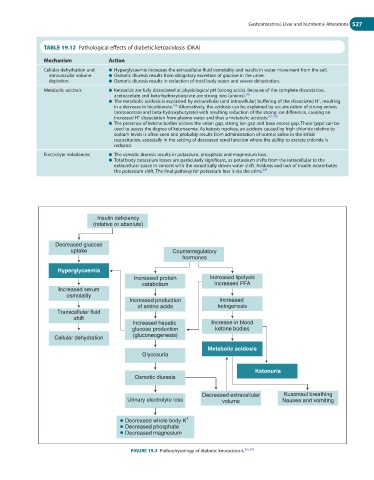
               TABLE 19.12  Pathological effects of diabetic ketoacidosis (DKA)

               Mechanism             Action
               Cellular dehydration and   ●  Hyperglycaemia increases the extracellular fluid osmolality and results in water movement from the cell.
                 intravascular volume   ●  Osmotic diuresis results from obligatory excretion of glucose in the urine.
                 depletion           ●  Osmotic diuresis results in reduction of total body water and severe dehydration.
               Metabolic acidosis    ●  Ketoacids are fully dissociated at physiological pH (strong acids). Because of the complete dissociation,
                                      acetoacetate and beta-hydroxybutyrate are strong ions (anions). 345
                                     ●  The metabolic acidosis is explained by extracellular (and intracellular) buffering of the dissociated H , resulting
                                                                                                         +
                                      in a decrease in bicarbonate.  Alternatively, the acidosis can be explained by accumulation of strong anions
                                                          166
                                      (acetoacetate and beta-hydroxybutyrate) with resulting reduction of the strong ion difference, causing an
                                              +
                                      increased H  dissociation from plasma water and thus a metabolic acidosis. 347,348
                                     ●  The presence of ketone bodies widens the anion gap, strong ion gap and base excess gap. These ‘gaps’ can be
                                      used to assess the degree of ketonaemia. As ketosis resolves, an acidosis caused by high chloride relative to
                                      sodium levels is often seen and probably results from administration of normal saline in the initial
                                      resuscitation, especially in the setting of decreased renal function where the ability to excrete chloride is
                                      reduced.
               Electrolyte imbalances  ●  The osmotic diuresis results in potassium, phosphate and magnesium loss.
                                     ●  Total body potassium losses are particularly significant, as potassium shifts from the intracellular to the
                                      extracellular space in concert with the osmotically driven water shift. Acidosis and lack of insulin exacerbates
                                      the potassium shift. The final pathway for potassium loss is via the urine. 345


                                 Insulin deficiency
                               (relative or absolute)


                   Decreased glucose
                        uptake                           Counterregulatory
                                                             hormones
                    Hyperglycaemia
                                             Increased protein        Increased lipolysis
                                                catabolism             Increased FFA
                    Increased serum
                       osmolality
                                           Increased production          Increased
                                              of amino acids            ketogenesis
                    Transcellular fluid
                         shift
                                            Increased hepatic         Increase in blood
                                            glucose production         ketone bodies
                   Cellular dehydration     (gluconeogenesis)
                                                                     Metabolic acidosis
                                                Glycosuria

                                                                                    Ketonuria
                                             Osmotic diuresis


                                                                   Decreased extracellular    Kussmaul breathing
                                           Urinary electrolyte loss       volume             Nausea and vomiting


                                                              +
                                          Decreased whole body K
                                          Decreased phosphate
                                          Decreased magnesium

                                            FIGURE 19.3  Pathophysiology of diabetic ketoacidosis. 345,349

