


Page 546 - ACCCN's Critical Care Nursing
P. 546
Gastrointestinal, Liver and Nutritional Alterations 523

             Orthotopic Liver Transplantation                     Within the first few months, a split liver will regenerate
             Orthotopic  liver  transplantation  (OLTx)  is  the  replace-  until it is a full-sized liver; in children it also grows and
             ment of the diseased liver. Current surgery times are now   develops at the same rate as the children. This technique
             6–8  hours,  having  previously  been  12–18  hours.  This   has significantly reduced the number of children waiting
             reduction in surgical time and improvement in technique   for liver transplantation, although little impact has been
                                                                                          273,296
             has  led  to  reductions  in  intra-  and  postoperative   made on adult waiting lists.
             complications.
                                                                  Adult Living Donor Liver Transplantation
             Two main techniques are used for OLTx: portal bypass or
             the piggyback technique. Portal bypass occurs where an   Living  donor  liver  transplantation  (LDLT)  is  an  estab-
             internal  temporary  portocaval  shunt  or  external  veno-  lished  option  for  paediatric  patients  with  end-stage
                                                                              297
             venous bypass is used. 289-291  In the piggyback technique,   liver  disease.    This  technique  involves  removal  of
             the  recipient’s  inferior  vena  cava  (IVC)  is  left  and  the   the left lobe from the live donor, usually the recipient’s
             donor IVC is piggybacked onto the recipient’s IVC. The   parent, which is then transplanted into the child. It is a
             advantages  of  this  technique  include  haemodynamic     relatively straightforward procedure, with little risk to the
                                                                        297,298
             stability during the anhepatic phase, reduced operating   donor.
             times  and  reduced  use  of  blood  products,  enabling  a   Adult-to-adult LDLT involves transplantation of the right
                                        292
             shorter length of hospital stay.  The use of T tubes, to   lobe of the liver from a donor to an adult recipient, offer-
             monitor  bile  outflow,  leaks,  stenosis,  and  to  provide   ing hope to patients with end stage liver disease (ESLD).
             direct access to the biliary system to perform controlled   The  operation  has  been  performed  with  some  success,
             cholangiograms  and  interventional  radiographic  proce-  although there are significant risks to the donor, includ-
             dures 293,294  are now not common. It has been shown that   ing death and morbidity. 298
             there  were  fewer  biliary  complications  and  costs  were
             reduced  (there  were  fewer  radiographic  interventions)   POSTOPERATIVE MANAGEMENT
             without insertion of a T tube. 295
                                                                  The  postoperative  management  of  liver  transplant
                                                                  patients  is  not  dissimilar  to  other  critical  care  surgical
             Split-liver Transplantation                          patients  yet  the  combination  of  hepatic-specific
             The disparity between the increasing number of people   issues  and  immunosuppressive  therapy  can  make  the
             on  transplant  waiting  lists  and  the  shortage  of  donor   management challenging.
             livers  available  has  led  to  several  innovative  strategies.
             Split-liver transplantation occurs when the cadaver organ   Initial Nursing Considerations
             is divided for two recipients, with the larger right segment   The initial postoperative care of liver transplant patients
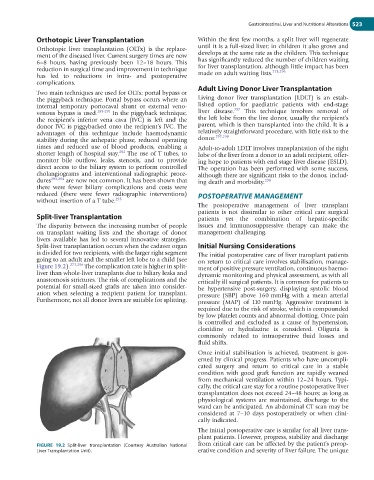
             going to an adult and the smaller left lobe to a child (see   on return to critical care involves stabilisation, manage-
             Figure 19.2). 273,296  The complication rate is higher in split-  ment of positive pressure ventilation, continuous haemo-
             liver than whole-liver transplants due to biliary leaks and   dynamic monitoring and physical assessment, as with all
             anastomosis strictures. The risk of complications and the   critically ill surgical patients. It is common for patients to
             potential for small-sized grafts are taken into consider-  be  hypertensive  post-surgery,  displaying  systolic  blood
             ation  when  selecting  a  recipient  patient  for  transplant.   pressure  (SBP)  above  160 mmHg  with  a  mean  arterial
             Furthermore, not all donor livers are suitable for splitting.   pressure  (MAP)  of  110 mmHg.  Aggressive  treatment  is
                                                                  required due to the risk of stroke, which is compounded
                                                                  by low platelet counts and abnormal clotting. Once pain
                                                                  is  controlled  and  excluded  as  a  cause  of  hypertension,
                                                                  clonidine  or  hydralazine  is  considered.  Oliguria  is
                                                                  commonly  related  to  intraoperative  fluid  losses  and
                                                                  fluid shifts.
                                                                  Once  initial  stabilisation  is  achieved,  treatment  is  gov-
                                                                  erned by clinical progress. Patients who have uncompli-
                                                                  cated  surgery  and  return  to  critical  care  in  a  stable
                                                                  condition  with  good  graft  function  are  rapidly  weaned
                                                                  from mechanical ventilation within 12–24 hours. Typi-
                                                                  cally, the critical care stay for a routine postoperative liver
                                                                  transplantation does not exceed 24–48 hours; as long as
                                                                  physiological  systems  are  maintained,  discharge  to  the
                                                                  ward can be anticipated. An abdominal CT scan may be
                                                                  considered  at  7–10  days  postoperatively  or  when  clini-
                                                                  cally indicated.
                                                                  The initial postoperative care is similar for all liver trans-
                                                                  plant patients. However, progress, stability and discharge
             FIGURE  19.2  Split-liver  transplantation  (Courtesy  Australian  National   from critical care can be affected by the patient’s preop-
             Liver Transplantation Unit).                         erative condition and severity of liver failure. The unique

