


Page 545 - ACCCN's Critical Care Nursing
P. 545
522  P R I N C I P L E S   A N D   P R A C T I C E   O F   C R I T I C A L   C A R E

                                                              reduced overall hospital length of stay. Survival rates of
                                                              all  patients  who  have  undergone  liver  transplantation
                                                              exceed 80% at 5 years, 283  with children having superior
                                                              survival rates to adults. 282
                                                              INDICATIONS FOR TRANSPLANTATION
                oesophageal
                balloon lumen                                 Indications  for  liver  transplantation  are  patients  with
                                                              severe liver disease in whom alternative treatments have
                                                              been exhausted. Categories consist of acute liver failure,
                                                              end-stage  liver  disease,  metabolic  liver  disease  and
               oesophageal and                                primary liver cancer. 284  Timing and patient selection is of
               gastric aspiration                             critical importance, as this has contributed to the success
               lumens                                         of transplantation. Re-transplantation for any disorder is
                                                              considered  only  in  patients  with  acceptable  predicted
               gastric balloon lumen                          survival. 283
                                                              CONTRAINDICATIONS FOR
                     oesophageal balloon
                                                              TRANSPLANTATION
                                                              Generally,  Australian  centres  set  upper  age  limits  of
                                                              around 65 years for liver transplantation, but occasion-
                           gastric balloon                    ally  older  patients  are  considered.  Patients  with  extra-
                                                              hepatic malignancy and uncontrolled systemic infection
                                                              (contraindication  to  high-dose  immunosuppressive
                                                              therapy) are unsuitable for transplantation. In addition,
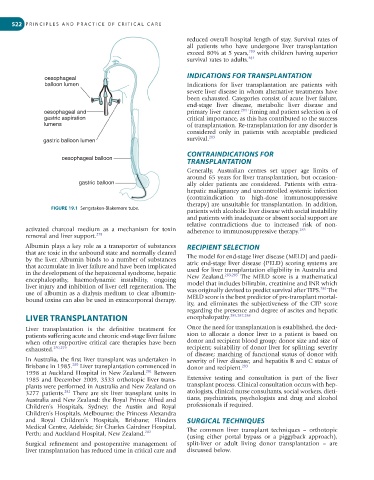
                  FIGURE 19.1  Sengstaken-Blakemore tube.
                                                              patients with alcoholic liver disease with social instability
                                                              and patients with inadequate or absent social support are
                                                              relative  contradictions  due  to  increased  risk  of  non-
         activated  charcoal  medium  as  a  mechanism  for  toxin   adherence to immunosuppressive therapy. 283
         removal and liver support. 278

         Albumin plays a key role as a transporter of substances   RECIPIENT SELECTION
         that are toxic in the unbound state and normally cleared
         by the liver. Albumin binds to a number of substances   The model for end-stage liver disease (MELD) and paedi-
         that accumulate in liver failure and have been implicated   atric end-stage liver disease (PELD) scoring systems are
         in the development of the hepatorenal syndrome, hepatic   used for liver transplantation eligibility in Australia and
                                                                           283,285
         encephalopathy,  haemodynamic  instability,  ongoing   New  Zealand.    The  MELD  score  is  a  mathematical
         liver injury and inhibition of liver cell regeneration. The   model that includes bilirubin, creatinine and INR which
                                                                                                          286
         use of albumin as a dialysis medium to clear albumin-  was originally devised to predict survival after TIPS.  The
         bound toxins can also be used in extracorporeal therapy.  MELD score is the best predictor of pre-transplant mortal-
                                                              ity,  and  eliminates  the  subjectiveness  of  the  CTP  score
                                                              regarding the presence and degree of ascites and hepatic
         LIVER TRANSPLANTATION                                encephalopathy. 285,287,288
         Liver  transplantation  is  the  definitive  treatment  for   Once the need for transplantation is established, the deci-
         patients suffering acute and chronic end-stage liver failure   sion  to  allocate  a  donor  liver  to  a  patient  is  based  on
         when other supportive critical care therapies have been   donor and recipient blood group; donor size and size of
         exhausted. 250,279                                   recipient; suitability of donor liver for splitting; severity
                                                              of disease; matching of functional status of donor with
         In Australia, the first liver transplant was undertaken in   severity of liver disease; and hepatitis B and C status of
         Brisbane in 1985. 280  Liver transplantation commenced in   donor and recipient. 283
                                                 281
         1998 at Auckland Hospital in New Zealand.  Between
         1985 and December 2009, 3533 orthotopic liver trans-  Extensive  testing  and  consultation  is  part  of  the  liver
         plants were performed in Australia and New Zealand on   transplant process. Clinical consultation occurs with hep-
         3277  patients. 282   There  are  six  liver  transplant  units  in   atologists, clinical nurse consultants, social workers, dieti-
         Australia and New Zealand: the Royal Prince Alfred and   tians,  psychiatrists,  psychologists  and  drug  and  alcohol
         Children’s  Hospitals,  Sydney;  the  Austin  and  Royal     professionals if required.
         Children’s Hospitals, Melbourne; the Princess Alexandra
         and  Royal  Children’s  Hospitals,  Brisbane;  Flinders   SURGICAL TECHNIQUES
         Medical Centre, Adelaide; Sir Charles Gairdner Hospital,   The  common  liver  transplant  techniques  –  orthotopic
         Perth; and Auckland Hospital, New Zealand. 282
                                                              (using  either  portal  bypass  or  a  piggyback  approach),
         Surgical  refinement  and  postoperative  management  of   split-liver  or  adult  living  donor  transplantation  –  are
         liver transplantation has reduced time in critical care and   discussed below.

