


Page 572 - ACCCN's Critical Care Nursing
P. 572
Management of Shock 549


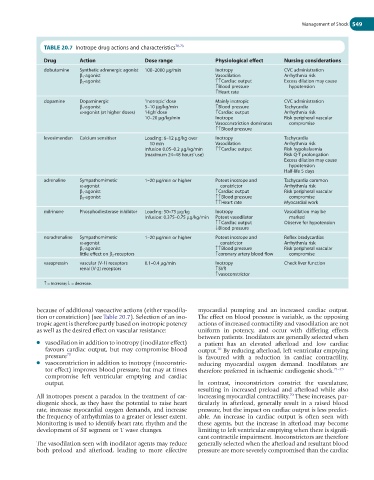
               TABLE 20.7  Inotrope drug actions and characteristics 70-73

               Drug        Action               Dose range             Physiological effect   Nursing considerations
               dobutamine  Synthetic adrenergic agonist  100–2000 µg/min  Inotropy            CVC administration
                           β 1 -agonist                                Vasodilation           Arrhythmia risk
                           β 2 -agonist                                ↑↑Cardiac output       Excess dilation may cause
                                                                       ↑Blood pressure          hypotension
                                                                       ↑Heart rate
               dopamine    Dopaminergic         ‘Inotropic’ dose       Mainly inotropic       CVC administration
                           β 1 -agonist         5–10 µg/kg/min         ↑Blood pressure        Tachycardia
                           α-agonist (at higher doses)  ‘High’ dose    ↑Cardiac output        Arrhythmia risk
                                                10–20 µg/kg/min        Inotrope               Risk peripheral vascular
                                                                       Vasoconstriction dominates  compromise
                                                                       ↑↑Blood pressure
               levosimendan  Calcium sensitiser  Loading: 6–12 µg/kg over   Inotropy          Tachycardia
                                                  10 min                Vasodilation          Arrhythmia risk
                                                Infusion 0.05–0.2 µg/kg/min  ↑↑Cardiac output  Risk hypokalaemia
                                                (maximum 24–48 hours’ use)                    Risk Q-T prolongation
                                                                                              Excess dilation may cause
                                                                                                hypotension
                                                                                              Half-life 5 days
               adrenaline  Sympathomimetic      1–20 µg/min or higher  Potent inotrope and    Tachycardia common
                           α-agonist                                     constrictor          Arrhythmia risk
                           β 1 -agonist                                ↑Cardiac output        Risk peripheral vascular
                           β 2 -agonist                                ↑↑Blood pressure         compromise
                                                                       ↑↑Heart rate           Myocardial work
               milrinone   Phosphodiesterase inhibitor  Loading: 50–75 µg/kg  Inotropy        Vasodilation may be
                                                Infusion: 0.375–0.75 µg/kg/min  Potent vasodilator  marked
                                                                        ↑↑Cardiac output      Observe for hypotension
                                                                        ↓Blood pressure
               noradrenaline  Sympathomimetic   1–20 µg/min or higher  Potent inotrope and    Reflex bradycardias
                           α-agonist                                     constrictor          Arrhythmia risk
                           β 1 -agonist                                ↑↑Blood pressure       Risk peripheral vascular
                           little effect on β 2 -receptors             ↑coronary artery blood flow  compromise
               vasopressin  vascular (V-1) receptors  0.1–0.4 µg/min   Inotropy               Check liver function
                           renal (V-2) receptors                       ↑SVR
                                                                       ↑vasoconstrictor
               ↑ = increase; ↓ = decrease.


             because of additional vasoactive actions (either vasodila-  myocardial  pumping  and  an  increased  cardiac  output.
             tion or constriction) (see Table 20.7). Selection of an ino-  The effect on blood pressure is variable, as the opposing
             tropic agent is therefore partly based on inotropic potency   actions of increased contractility and vasodilation are not
             as well as the desired effect on vascular resistance:  uniform  in  potency,  and  occur  with  differing  effects
                                                                  between patients. Inodilators are generally selected when
             ●  vasodilation in addition to inotropy (inodilator effect)   a  patient  has  an  elevated  afterload  and  low  cardiac
                favours  cardiac  output,  but  may  compromise  blood   output.  By reducing afterload, left ventricular emptying
                                                                        70
                pressure 70                                       is  favoured  with  a  reduction  in  cardiac  contractility,
             ●  vasoconstriction in addition to inotropy (inoconstric-  reducing  myocardial  oxygen  demand.  Inodilators  are
                tor effect) improves blood pressure, but may at times   therefore preferred in ischaemic cardiogenic shock. 71–73
                compromise  left  ventricular  emptying  and  cardiac
                output.                                           In  contrast,  inoconstrictors  constrict  the  vasculature,
                                                                  resulting  in  increased  preload  and  afterload  while  also
                                                                                                70
             All inotropes present a paradox in the treatment of car-  increasing myocardial contractility.  These increases, par-
             diogenic shock, as they have the potential to raise heart   ticularly  in  afterload,  generally  result  in  a  raised  blood
             rate, increase myocardial oxygen demands, and increase   pressure, but the impact on cardiac output is less predict-
             the frequency of arrhythmias to a greater or lesser extent.   able.  An  increase  in  cardiac  output  is  often  seen  with
             Monitoring is used to identify heart rate, rhythm and the   these agents, but the increase in afterload may become
             development of ST segment or T wave changes.         limiting to left ventricular emptying when there is signifi-
                                                                  cant contractile impairment. Inoconstrictors are therefore
             The vasodilation seen with inodilator agents may reduce   generally selected when the afterload and resultant blood
             both  preload  and  afterload,  leading  to  more  effective   pressure are more severely compromised than the cardiac

