


Page 567 - ACCCN's Critical Care Nursing
P. 567
544  P R I N C I P L E S   A N D   P R A C T I C E   O F   C R I T I C A L   C A R E


                                                                          • Trauma
                                                                          • Surgery
                                                Major haemorrhage         • Post partum haemorrhage
                                                                          • GI bleed
                                                                          • Ruptured aortic aneurysm


                                                                          • Mild (750mL)
                                                    Blood loss            • Moderate (750-1500mL)
                                                                          • Severe (1500+)


                                                                          • Massive transfusion
                                                                            protocol (including dose,
                                                    Massive                 timing, ratio of
                                                   transfusion              RBC’s:FFP:Platelets and
                                                     required
                                                                            when to consider
                                                                            factor Vlla)


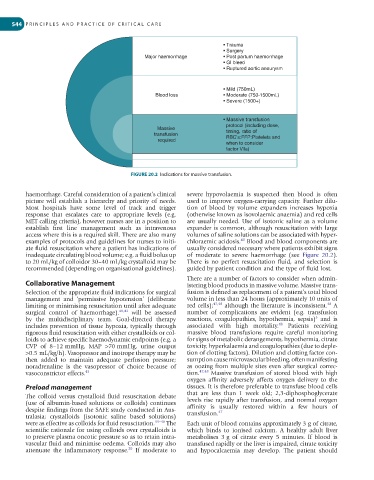
                                            FIGURE 20.2  Indications for massive transfusion.


         haemorrhage. Careful consideration of a patient’s clinical   severe  hypovolaemia  is  suspected  then  blood  is  often
         picture will establish a hierarchy and priority of needs.   used to improve oxygen-carrying capacity. Further dilu-
         Most  hospitals  have  some  level  of  track  and  trigger   tion  of  blood  by  volume  expanders  increases  hypoxia
         response  that  escalates  care  to  appropriate  levels  (e.g.   (otherwise known as isovolaemic anaemia) and red cells
         MET calling criteria), however nurses are in a position to   are  usually  needed.  Use  of  isotonic  saline  as  a  volume
         establish  first  line  management  such  as  intravenous   expander is common, although resuscitation with large
         access where this is a required skill. There are also many   volumes of saline solutions can be associated with hyper-
         examples of protocols and guidelines for nurses to initi-  chloraemic acidosis.  Blood and blood components are
                                                                                40
         ate fluid resuscitation where a patient has indications of   usually considered necessary where patients exhibit signs
         inadequate circulating blood volume; e.g. a fluid bolus up   of  moderate  to  severe  haemorrhage  (see  Figure  20.2).
         to 20 mL/kg of colloidor 30–40 mL/kg crystalloid may be   There  is  no  perfect  resuscitation  fluid,  and  selection  is
         recommended (depending on organisational guidelines).  guided by patient condition and the type of fluid lost.
                                                              There are a number of factors to consider when admin-
         Collaborative Management                             istering blood products in massive volume. Massive trans-
         Selection of the appropriate fluid indications for surgical   fusion is defined as replacement of a patient’s total blood
         management  and  ‘permissive  hypotension’  (deliberate   volume in less than 24 hours (approximately 10 units of
                                                                                                            48
         limiting or minimising resuscitation until after adequate   red cells); 47,48  although the literature is inconsistent.  A
         surgical  control  of  haemorrhage). 40,42   will  be  assessed   number  of  complications  are  evident  (e.g.  transfusion
                                                                                                        3
         by  the  multidisciplinary  team.  Goal-directed  therapy   reactions,  coagulopathies,  hypothermia,  sepsis)   and  is
                                                                                            48
         includes prevention of tissue hypoxia, typically through   associated  with  high  mortality.   Patients  receiving
         rigorous fluid resuscitation with either crystalloids or col-  massive  blood  transfusions  require  careful  monitoring
         loids to achieve specific haemodynamic endpoints (e.g. a   for signs of metabolic derangements, hypothermia, citrate
         CVP  of  8–12 mmHg,  MAP  >70 mmHg,  urine  output   toxicity, hyperkalaemia and coagulopathies (due to deple-
         >0.5 mL/kg/h). Vasopressor and inotrope therapy may be   tion of clotting factors). Dilution and clotting factor con-
         then  added  to  maintain  adequate  perfusion  pressure;   sumption cause microvascular bleeding, often manifesting
         noradrenaline  is  the  vasopressor  of  choice  because  of   as oozing from multiple sites even after surgical correc-
         vasoconstrictor effects. 43                          tion. 47,48  Massive transfusion of stored blood with high
                                                              oxygen  affinity  adversely  affects  oxygen  delivery  to  the
         Preload management                                   tissues. It is therefore preferable to transfuse blood cells
         The  colloid  versus  crystalloid  fluid  resuscitation  debate   that  are  less  than  1  week  old;  2,3-diphosphoglycerate
         (use of albumin-based solutions or colloids) continues   levels rise rapidly after transfusion, and normal oxygen
         despite findings from the SAFE study conducted in Aus-  affinity  is  usually  restored  within  a  few  hours  of
                                                                        47
         tralasia;  crystalloids  (isotonic  saline  based  solutions)   transfusion.
         were as effective as colloids for fluid resuscitation. 44–46  The   Each unit of blood contains approximately 3 g of citrate,
         scientific rationale for using colloids over crystalloids is   which  binds  to  ionised  calcium.  A  healthy  adult  liver
         to preserve plasma oncotic pressure so as to retain intra-  metabolises  3 g  of  citrate  every  5  minutes.  If  blood  is
         vascular fluid and minimise oedema. Colloids may also   transfused rapidly or the liver is impaired, citrate toxicity
                                           20
         attenuate  the  inflammatory  response.   If  moderate  to   and  hypocalcaemia  may  develop.  The  patient  should

