


Page 570 - ACCCN's Critical Care Nursing
P. 570
Management of Shock 547


                                                         Systolic dysfunction
                                                      stroke volume,   ejection fraction


                                        Blood pressure                           Cardiac output


                                                     Sympathoadrenal activation
                                                          (compensation)


                                      Heart rate    Inotropy                      Systemic
                                                                             vascular resistance


                                  Myocardial oxygen demands
                                      (± ischaemia)


                                                           Congestion
                                              left ventricular end-diastolic volume and pressure
                                                           left atrial pressue
                                                     global end-diastolic volume index
                                                    pulmonary capillary wedge pressure
                                                       pulmonary artery pressure
                                                      extravascular lung water index
                                                     intrathoracic blood volume index
                                                 right ventricular systolic/diastolic pressure
                                                          right atrial pressure

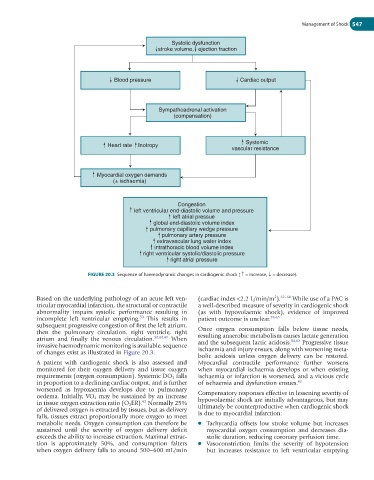
                              FIGURE 20.3  Sequence of haemodynamic changes in cardiogenic shock ( ↑ = increase, ↓ = decrease).


             Based on the underlying pathology of an acute left ven-  (cardiac index <2.2 L/min/m ). 62–64  While use of a PAC is
                                                                                           2
             tricular myocardial infarction, the structural or contractile   a well-described measure of severity in cardiogenic shock
             abnormality  impairs  systolic  performance  resulting  in   (as  with  hypovolaemic  shock),  evidence  of  improved
             incomplete  left  ventricular  emptying.   This  results  in   patient outcome is unclear. 28,65
                                               50
             subsequent progressive congestion of first the left atrium,
             then  the  pulmonary  circulation,  right  ventricle,  right   Once  oxygen  consumption  falls  below  tissue  needs,
             atrium  and  finally  the  venous  circulation. 50,60,61   When   resulting anaerobic metabolism causes lactate generation
                                                                                                50,62
             invasive haemodynamic monitoring is available, sequence   and the subsequent lactic acidosis.   Progressive tissue
             of changes exist as illustrated in Figure 20.3.      ischaemia and injury ensues, along with worsening meta-
                                                                  bolic  acidosis  unless  oxygen  delivery  can  be  restored.
             A  patient  with  cardiogenic  shock  is  also  assessed  and   Myocardial  contractile  performance  further  worsens
             monitored  for  their  oxygen  delivery  and  tissue  oxygen   when  myocardial  ischaemia  develops  or  when  existing
             requirements (oxygen consumption). Systemic DO 2  falls   ischaemia or infarction is worsened, and a vicious cycle
             in proportion to a declining cardiac output, and is further   of ischaemia and dysfunction ensues. 62
             worsened  as  hypoxaemia  develops  due  to  pulmonary   Compensatory responses effective in lessening severity of
             oedema. Initially, VO 2  may be sustained by an increase   hypovolaemic shock are initially advantageous, but may
                                                62
             in tissue oxygen extraction ratio (O 2ER).  Normally 25%   ultimately be counterproductive when cardiogenic shock
             of delivered oxygen is extracted by tissues, but as delivery   is due to myocardial infarction:
             falls, tissues extract proportionally more oxygen to meet
             metabolic needs. Oxygen consumption can therefore be   ●  Tachycardia  offsets  low  stroke  volume  but  increases
             sustained  until  the  severity  of  oxygen  delivery  deficit   myocardial  oxygen  consumption  and  decreases  dia-
             exceeds the ability to increase extraction. Maximal extrac-  stolic duration, reducing coronary perfusion time.
             tion  is  approximately  50%,  and  consumption  falters   ●  Vasoconstriction  limits  the  severity  of  hypotension
             when oxygen delivery falls to around 500–600 mL/min     but  increases  resistance  to  left  ventricular  emptying

