


Page 593 - ACCCN's Critical Care Nursing
P. 593
570  P R I N C I P L E S   A N D   P R A C T I C E   O F   C R I T I C A L   C A R E

         data in post-injury MODS indicates a reduction in mor-  variations  of  SOFA-based  models  have  emerged  in  the
         tality rates to 14–27%. 65,66  This decrease in mortality is   literature, such as single SOFA scores calculated at admis-
         occurring despite increasing patient acuity and may reflect   sion  or  at  a  set  time  after  admission,  sequential  SOFA
         improvements in the delivery of critical care. 6     scores  (mean  SOFA  score),  dynamic  SOFA  scores  and
                                                              scores of separate SOFA components. 69,70  SOFA scores at
                                                              admission are comparable with severity of illness models
         SCORING SYSTEMS                                      such as APACHE or SAPS for predicting mortality.  SOFA
                                                                                                         70
         Organ  dysfunction  can  be  a  consequence  of  a  primary   scoring has the advantage of ease of use, as the clinical
         insult or a secondary insult due to circulating mediators   and laboratory data required are those that are routinely
         (e.g. the patient with ALI from pneumonia that also has   available. As such, the use of dynamic SOFA scoring as a
         renal  dysfunction  or  failure  as  a  consequence).  This  is   means  of  monitoring  patient  response  to  treatments  is
                                                                            69,71
         sometimes  quantified  by  scoring  systems,  traditionally   being explored.
         used  for  predicting  mortality  but  increasingly  being
         explored as clinical management tools. 69-71  These systems   OTHER FACTORS
         are continually being tested and modified, to assess organ   Biomarkers such as lactate and strong ion gap (SIG) are
         dysfunction severity and prognosis in an effort to identify   also being studied as indicators of occult hypoperfusion
         patients who will benefit most from timely clinical inter-  and severity of organ dysfunction. Blood lactate levels are
                 71
         vention.  Scoring systems such as APACHE (acute physio-  associated  with  SOFA  scores,  particularly  in  the  early
         logy  and  chronic  health  evaluation),  SAPS  (simplified   stage of ICU admission, supporting early resuscitation as
         acute physiology score) and MPM (mortality probability   a  management  strategy  to  prevent  organ  dysfunction.
         models)  account  for  information  relating  to  a  24-hour   Serial  lactate  scores  may  therefore  be  appropriate  to
         cycle of patient data (commonly in the first 24 hours of   guiding  optimal  oxygen  delivery  in  early  resuscitation,
         admission), but do not account for the dynamic nature   with  hyperlactataemia  a  sign  of  impending  organ  dys-
         of many of the factors that affect clinical outcomes.  function. Prospective, well-controlled studies are however
                                                              needed to confirm the role of lactate and SIG in MODS
         Specific instruments designed to assess organ dysfunction        74-76
         or  failure  include  the  sepsis-related/sequential  organ   management.
         failure  assessment  (SOFA)  score,  the  multiple  organ     Variations in the human DNA sequences can affect the
         dysfunction  score  and  the  logistic  organ  dysfunction   way  a  person  responds  to  disease.  Researchers  have
         system. 70,72  Traditionally SOFA uses the worst values for   studied the gene code for PAI-1 which is a key element
         six  commonly  measured  clinical  parameters  within  a   in the inhibition of fibrinolysis and is active during acute
         24-hour period: PaO 2 /FiO 2  (P/F ratio), an index that may   inflammation   (the  gene  most  studied  is  found  at  the
                                                                          77
         be  used  to  characterise  acute  respiratory  distress  syn-  4G/5G  insertion/deletion  loci),  finding  that  different
                73
         drome;  platelet count, bilirubin level, blood pressure,   aspects bind as either a repressor (5G) or activator (4G)
         Glasgow Coma Scale score, and urine output or creati-  protein. For example, the 4G allele (position on the gene)
         nine  concentration.  As  the  number  of  dysfunctional   of the 4G/5G gene sequence variation has been associ-
         organ  systems  increases,  there  is  a  rise  in  mortality  as   ated with increased susceptibility to community acquired
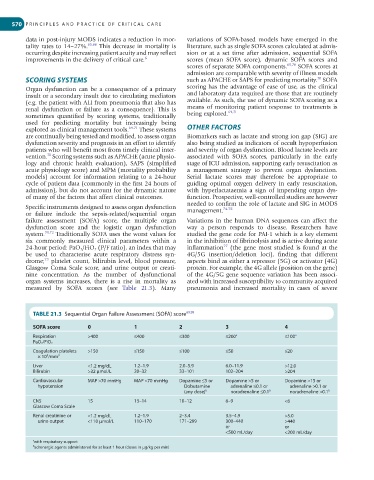
         measured  by  SOFA  scores  (see  Table  21.3).  Many   pneumonia  and  increased  mortality  in  cases  of  severe


            TABLE 21.3  Sequential Organ Failure Assessment (SOFA) score 69,99

            SOFA score        0              1              2              3                  4
            Respiration       >400           ≤400           ≤300           ≤200 a             ≤100 a
            PaO 2 /FiO 2
            Coagulation platelets   >150     ≤150           ≤100           ≤50                ≤20
                3
             × 10 /mm 3
            Liver             <1.2 mg/dL     1.2–1.9        2.0–5.9        6.0–11.9           >12.0
            Bilirubin         >32 µmol/L     20–32          33–101         102–204            >204
            Cardiovascular    MAP >70 mmHg   MAP <70 mmHg   Dopamine ≤5 or   Dopamine >5 or   Dopamine >15 or
             hypotension                                     Dobutamine     adrenaline ≤0.1 or   adrenaline >0.1 or
                                                             (any dose) b   noradrenaline ≤0.1 b  noradrenaline >0.1 b
            CNS               15             13–14          10–12          6–9                <6
            Glascow Coma Scale
            Renal creatinine or   <1.2 mg/dL  1.2–1.9       2–3.4          3.5–4.9            >5.0
             urine output     <110 µmol/L    110–170        171–299        300–440            >440
                                                                           or                 or
                                                                           <500 mL/day        <200 mL/day
            a with respiratory support
            b adrenergic agents administered for at least 1 hour (doses in µg/kg per min)

