


Page 590 - ACCCN's Critical Care Nursing
P. 590
Multiple Organ Dysfunction Syndrome 567

                                                   38
             The alarm reaction (flight-or-fight response)  is initiated
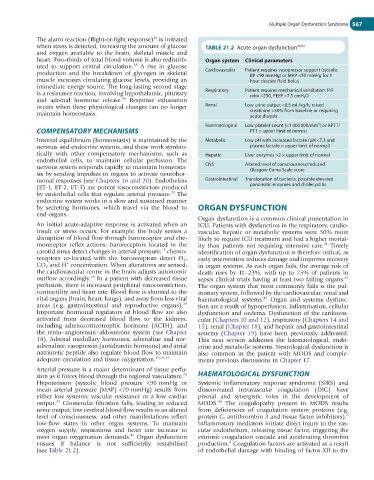
             when stress is detected, increasing the amount of glucose   TABLE 21.2  Acute organ dysfunction 46,98
             and  oxygen  available  to  the  brain,  skeletal  muscle  and
             heart. Two-thirds of total blood volume is also redistrib-  Organ system  Clinical parameters
                                             38
             uted  to  support  central  circulation.   A  rise  in  glucose
             production  and  the  breakdown  of  glycogen  in  skeletal   Cardiovascular  Patient requires vasopressor support (systolic
                                                                                   BP <90 mmHg) or MAP <70 mmHg for 1
             muscle increases circulating glucose levels, providing an             hour despite fluid bolus
             immediate energy source. The long-lasting second stage
             is a resistance reaction, involving hypothalamic, pituitary   Respiratory  Patient requires mechanical ventilation: P/F
                                                                                   ratio <250, PEEP >7.5 cmH 2 O
                                         38
             and  adrenal  hormone  release.   Response  exhaustion
             occurs when these physiological changes can no longer   Renal       Low urine output <0.5 mL/kg/h; raised
             maintain homeostasis.                                                 creatinine >50% from baseline or requiring
                                                                                   acute dialysis
                                                                                                         3
                                                                    Haematological  Low platelet count (<1 000 000/mm ) or APTT/
             COMPENSATORY MECHANISMS                                               PTT > upper limit of normal
             Internal equilibrium (homeostasis) is maintained by the   Metabolic  Low pH with increased lactate (pH <7.3 and
             nervous and endocrine systems, and these work symbio-                 plasma lactate > upper limit of normal)
             tically  with  other  compensatory  mechanisms,  such  as   Hepatic  Liver enzymes >2 × upper limit of normal
             endothelial  cells,  to  maintain  cellular  perfusion.  The
             nervous system responds rapidly to maintain homeosta-  CNS          Altered level of consciousness/reduced
                                                                                   Glasgow Coma Scale score
             sis by sending impulses to organs to activate neurohor-
             monal responses (see Chapters 16 and 20). Endothelins   Gastrointestinal  Translocation of bacteria, possible elevated
             (ET-1, ET-2, ET-3) are potent vasoconstrictors produced               pancreatic enzymes and cholecystitis
                                                         20
             by endothelial cells that regulate arterial pressure.  The
             endocrine system works in a slow and sustained manner
             by  secreting  hormones,  which  travel  via  the  blood  to   ORGAN DYSFUNCTION
             end-organs.
                                                                  Organ dysfunction is a common clinical presentation in
             An initial acute-adaptive response is activated when an   ICU. Patients with dysfunction in the respiratory, cardio-
             insult  or  stress  occurs.  For  example,  the  body  senses  a   vascular,  hepatic  or  metabolic  systems  were  50%  more
             disruption of blood flow through baroreceptor and che-  likely to require ICU treatment and had a higher mortal-
             moreceptor  reflex  actions:  baroreceptors  located  in  the   ity  than  patients  not  requiring  intensive  care.   Timely
                                                                                                           41
                                                      13
             carotid sinus detect changes in arterial pressure;  chemo-  identification of organ dysfunction is therefore critical, as
             receptors  co-located  with  the  baroreceptors  detect  O 2 ,   early intervention reduces damage and improves recovery
                       +
             CO 2  and H  concentration. When alterations are sensed,   in organ systems. As each organ fails, the average risk of
             the cardiovascular centre in the brain adjusts autonomic   death  rises  by  11–23%,  with  up  to  75%  of  patients  in
             outflow accordingly.  In a patient with decreased tissue   sepsis clinical trials having at least two failing organs.
                               38
                                                                                                                  42
             perfusion, there is increased peripheral vasoconstriction,   The organ system that most commonly fails is the pul-
             contractility and heart rate. Blood flow is shunted to the   monary system, followed by the cardiovascular, renal and
             vital organs (brain, heart, lungs), and away from less vital   haematological  systems.   Organ  and  systems  dysfunc-
                                                                                       43
             areas  (e.g.  gastrointestinal  and  reproductive  organs).    tion are a result of hypoperfusion, inflammation, cellular
                                                             39
             Important  hormonal  regulators  of  blood  flow  are  also   dysfunction and oedema. Dysfunction of the cardiovas-
             activated  from  decreased  blood  flow  to  the  kidneys,   cular (Chapters 10 and 12), respiratory (Chapters 14 and
             including  adrenocorticotrophic  hormone  (ACTH),  and   15), renal (Chapter 18), and hepatic and gastrointestinal
             the renin–angiotensin–aldosterone system (see Chapter   systems  (Chapter  19)  have  been  previously  addressed.
             18). Adrenal medullary hormones, adrenaline and nor-  This  next  section  addresses  the  haematological,  endo-
             adrenaline, vasopressin (antidiuretic hormone) and atrial   crine and metabolic systems. Neurological dysfunction is
             natriuretic peptide also regulate blood flow to maintain   also  common  in  the  patient  with  MODS  and  comple-
             adequate circulation and tissue oxygenation. 13,38,39  ments previous discussions in Chapter 17.
             Arterial pressure is a major determinant of tissue perfu-
                                                             20
             sion as it forces blood through the regional vasculature.    HAEMATOLOGICAL DYSFUNCTION
             Hypotension  (systolic  blood  pressure  <90 mmHg  or   Systemic  inflammatory  response  syndrome  (SIRS)  and
             mean  arterial  pressure  [MAP]  <70 mmHg)  results  from   disseminated  intravascular  coagulation  (DIC)  have
             either low systemic vascular resistance or a low cardiac   pivotal  and  synergistic  roles  in  the  development  of
                   20
                                                                        44
             output.  Glomerular filtration falls, leading to reduced   MODS.   The  coagulopathy  present  in  MODS  results
             urine output; low cerebral blood flow results in an altered   from  deficiencies  of  coagulation  system  proteins  (e.g.
                                                                                                                  8
             level  of  consciousness;  and  other  manifestations  reflect   protein C, antithrombin 3 and tissue factor inhibitors).
             low-flow  states  in  other  organ  systems.  To  maintain   Inflammatory mediators initiate direct injury to the vas-
             oxygen  supply,  respirations  and  heart  rate  increase  to   cular endothelium, releasing tissue factor, triggering the
                                            40
             meet organ oxygenation demands.  Organ dysfunction   extrinsic coagulation cascade and accelerating thrombin
                                                                            8
             ensues  if  balance  is  not  sufficiently  restabilised    production.  Coagulation factors are activated as a result
             (see Table 21.2).                                    of endothelial damage with binding of factor XII to the

