


Page 614 - ACCCN's Critical Care Nursing
P. 614
Emergency Presentations 591


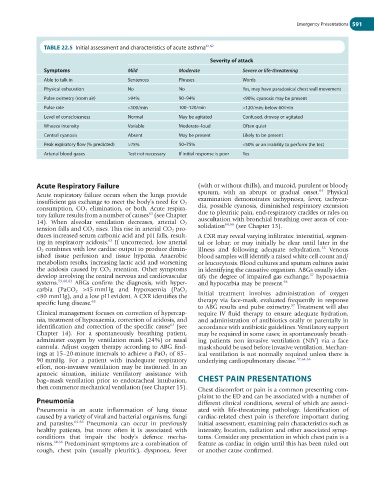
               TABLE 22.5  Initial assessment and characteristics of acute asthma 61,62

                                                                      Severity of attack
               Symptoms                    Mild             Moderate            Severe or life-threatening
               Able to talk in             Sentences        Phrases             Words
               Physical exhaustion         No               No                  Yes, may have paradoxical chest wall movement
               Pulse oximetry (room air)   >94%             90–94%              <90%; cyanosis may be present
               Pulse rate                  <100/min         100–120/min         >120/min; below 60/min
               Level of consciousness      Normal           May be agitated     Confused, drowsy or agitated
               Wheeze intensity            Variable         Moderate–loud       Often quiet
               Central cyanosis            Absent           May be present      Likely to be present
               Peak expiratory flow (% predicted)  >75%     50–75%              <50% or an inability to perform the test
               Arterial blood gases        Test not necessary  If initial response is poor  Yes


             Acute Respiratory Failure                            (with or without chills), and mucoid, purulent or bloody
                                                                                                         64
             Acute respiratory failure occurs when the lungs provide   sputum,  with  an  abrupt  or  gradual  onset.   Physical
             insufficient gas exchange to meet the body’s need for O 2    examination  demonstrates  tachypnoea,  fever,  tachycar-
             consumption,  CO 2   elimination,  or  both.  Acute  respira-  dia, possible cyanosis, diminished respiratory excursion
                                                  63
             tory failure results from a number of causes  (see Chapter   due to pleuritic pain, end-respiratory crackles or rales on
             14).  When  alveolar  ventilation  decreases,  arterial  O 2    auscultation with bronchial breathing over areas of con-
                                                                           64,66
             tension falls and CO 2  rises. This rise in arterial CO 2  pro-  solidation   (see Chapter 13).
             duces increased serum carbonic acid and pH falls, result-  A CXR may reveal varying infiltrates: interstitial, segmen-
             ing in respiratory acidosis.  If uncorrected, low arterial   tal  or  lobar;  or  may  initially  be  clear  until  later  in  the
                                    63
             O 2  combines with low cardiac output to produce dimin-  illness  and  following  adequate  rehydration.   Venous
                                                                                                          55
             ished  tissue  perfusion  and  tissue  hypoxia.  Anaerobic   blood samples will identify a raised white cell count and/
             metabolism results, increasing lactic acid and worsening   or leucocytosis. Blood cultures and sputum cultures assist
             the acidosis caused by CO 2  retention. Other symptoms   in identifying the causative organism. ABGs usually iden-
             develop involving the central nervous and cardiovascular   tify the degree of impaired gas exchange;  hypoxaemia
                                                                                                      57
             systems. 59,60,63   ABGs  confirm  the  diagnosis,  with  hyper-  and hypocarbia may be present. 66
             carbia  (PaCO 2   >45 mmHg  and  hypoxaemia  (PaO 2
             <80 mmHg), and a low pH evident. A CXR identifies the   Initial  treatment  involves  administration  of  oxygen
             specific lung disease. 63                            therapy via face-mask, evaluated frequently in response
                                                                                                57
                                                                  to ABG results and pulse oximetry.  Treatment will also
             Clinical management focuses on correction of hypercap-  require  IV  fluid  therapy  to  ensure  adequate  hydration,
             nia, treatment of hypoxaemia, correction of acidosis, and   and administration of antibiotics orally or parentally in
                                                         63
             identification and correction of the specific cause  (see   accordance with antibiotic guidelines. Ventilatory support
             Chapter  14).  For  a  spontaneously  breathing  patient,   may be required in some cases; in spontaneously breath-
             administer  oxygen  by  ventilation  mask  (24%)  or  nasal   ing  patients  non  invasive  ventilation  (NIV)  via  a  face
             cannula. Adjust oxygen therapy according to ABG find-  mask should be used before invasive ventilation. Mechan-
             ings at 15–20-minute intervals to achieve a PaO 2  of 85–  ical ventilation is not normally required unless there is
             90 mmHg.  For  a  patient  with  inadequate  respiratory   underlying cardiopulmonary disease. 57,64,66
             effort, non-invasive ventilation may be instituted. In an
             apnoeic  situation,  initiate  ventilatory  assistance  with
             bag–mask ventilation prior to endotracheal intubation,   CHEST PAIN PRESENTATIONS
             then commence mechanical ventilation (see Chapter 15).  Chest discomfort or pain is a common presenting com-
                                                                  plaint to the ED and can be associated with a number of
             Pneumonia                                            different clinical conditions, several of which are associ-
             Pneumonia  is  an  acute  inflammation  of  lung  tissue   ated  with  life-threatening  pathology.  Identification  of
             caused by a variety of viral and bacterial organisms, fungi   cardiac-related chest pain is therefore important during
             and  parasites. 64-66   Pneumonia  can  occur  in  previously   initial assessment, examining pain characteristics such as
             healthy  patients,  but  more  often  it  is  associated  with   intensity, location, radiation and other associated symp-
             conditions  that  impair  the  body’s  defence  mecha-  toms. Consider any presentation in which chest pain is a
             nisms. 64,66  Predominant symptoms are a combination of   feature as cardiac in origin until this has been ruled out
             cough,  chest  pain  (usually  pleuritic),  dyspnoea,  fever   or another cause confirmed.

