


Page 617 - ACCCN's Critical Care Nursing
P. 617
594  S P E C I A LT Y   P R A C T I C E   I N   C R I T I C A L   C A R E


                                                 Adult presentations with acute
                                                       abdominal pain


                                       • Take a detailed history
                                       • Perform a rapid physical assessment
                                       • Obtain urine β-HCG from any woman of child-bearing age


                                                        Practice Tip
                                                   Always “suspect the worst”
                                                      and perform serial
                                                   evaluations when needed


                                                      Suspect ruptured
                   Suspect acute                      abdominal aortic                   Suspect ectopic
                   appendicitis 90                           79,88,89                    pregnancy 92
                                                      aneurysm

           • Right lower quadrant pain        • A clinical triad of:             • In any woman of child bearing-age who
           • A clinical triad of:               - Abdominal pain.                  complains of abdominal pain.
             - RLQ pain.                        - Pulsatile mass.                • In the presence of abdominal pain,
             - Abdominal rigidity.              - Hypotension.                     amenorrhoea, and irregular vaginal
             - Migration of the pain from the  • In the presence of the following risk    bleeding.
             periumbilical area.                factors:                         • When the pain is sharp, low
           • History of:                        - Age > 50.                        and laterol.
             - Nausea and vomiting appeared after    - Smoking history.          • In the presence of the
             the pain has started.              - History of hypertension.         following risk factors:
             - Psoas sign.                      - History of atherosclerosis.      - Smoking.
             - Rebound tenderness.              - A positive family history of AAA.     - Infectious disease.
           • Symptoms are less than 2 days.                                        - Maternal exposure to diethylstilboestrol.
           • The condition should be suspected in                                  - Tubal pathology, surgery or sterilisation.
             pregnant women who exhibit new                                        - A previous ectopic pregnancy.
             abdominal pain.                                                       - More than one sexual partner.
                                                                                   - Infertility.
                                                                                   - Previous abdominal or pelvic surgery.


                                                        Practice Tip
                  • Be extremely cautious when assessing female and elderly patients because of high risk of misdiagnosis.
                  • The elderly are at particular risk of critical and severe conditions.
                  • Any patient with acute abdominal pain and abnormal vital signs should be triaged to be seen within 30 minutes or less.

                                                                                          86
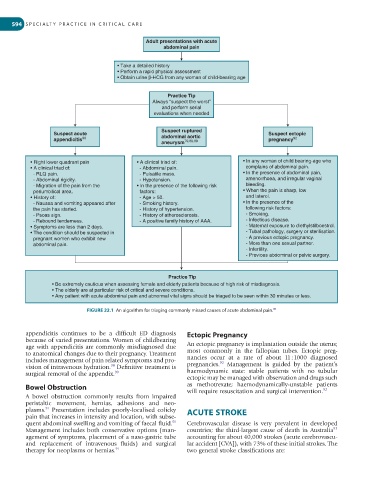
                             FIGURE 22.1  An algorithm for triaging commonly missed causes of acute abdominal pain.

         appendicitis  continues  to  be  a  difficult  ED  diagnosis   Ectopic Pregnancy
         because of varied presentations. Women of childbearing
         age with appendicitis are commonly misdiagnosed due   An ectopic pregnancy is implantation outside the uterus;
         to anatomical changes due to their pregnancy. Treatment   most  commonly  in  the  fallopian  tubes.  Ectopic  preg-
         includes management of pain related symptoms and pro-  nancies  occur  at  a  rate  of  about  11 : 1000  diagnosed
                                                                         92
                                     90
         vision of intravenous hydration.  Definitive treatment is   pregnancies.   Management  is  guided  by  the  patient’s
         surgical removal of the appendix. 90                 haemodynamic  state:  stable  patients  with  no  tubular
                                                              ectopic may be managed with observation and drugs such
         Bowel Obstruction                                    as  methotrexate;  haemodynamically-unstable  patients
                                                              will require resuscitation and surgical intervention.
                                                                                                           92
         A  bowel  obstruction  commonly  results  from  impaired
         peristaltic  movement,  hernias,  adhesions  and  neo-
                91
         plasms.   Presentation  includes  poorly-localised  colicky   ACUTE STROKE
         pain that increases in intensity and location, with subse-
                                                         91
         quent abdominal swelling and vomiting of faecal fluid.    Cerebrovascular  disease  is  very  prevalent  in  developed
                                                                                                              93
         Management includes both conservative options (man-  countries; the third-largest cause of death in Australia
         agement of symptoms, placement of a naso-gastric tube   accounting for about 40,000 strokes (acute cerebrovascu-
         and  replacement  of  intravenous  fluids)  and  surgical   lar accident [CVA]), with 73% of these initial strokes. The
         therapy for neoplasms or hernias. 91                 two general stroke classifications are:

