


Page 632 - ACCCN's Critical Care Nursing
P. 632
Emergency Presentations 609


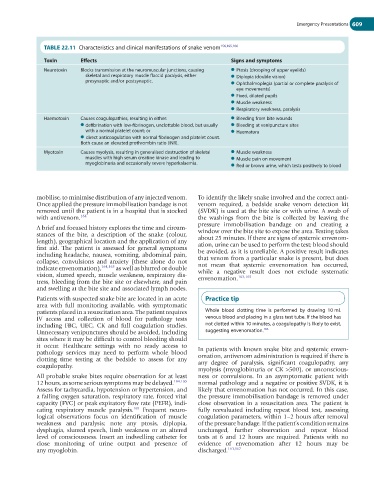
               TABLE 22.11  Characteristics and clinical manifestations of snake venom 156,165,166

               Toxin       Effects                                           Signs and symptoms
               Neurotoxin  Blocks transmission at the neuromuscular junctions, causing   l  Ptosis (drooping of upper eyelids)
                             skeletal and respiratory muscle flaccid paralysis, either   l  Diplopia (double vision)
                             presynaptic and/or postsynaptic.                l  Ophthalmoplegia (partial or complete paralysis of
                                                                              eye movements)
                                                                             l  Fixed, dilated pupils
                                                                             l  Muscle weakness
                                                                             l  Respiratory weakness, paralysis
               Haemotoxin  Causes coagulopathies, resulting in either:       l  Bleeding from bite wounds
                           l defibrination with low-fibrinogen, unclottable blood, but usually   l  Bleeding at venipuncture sites
                             with a normal platelet count; or                l  Haematura
                           l  direct anticoagulation with normal fibrinogen and platelet count.
                           Both cause an elevated prothrombin ratio (INR).
               Myotoxin    Causes myolysis, resulting in generalised destruction of skeletal   l  Muscle weakness
                             muscles with high serum creatine kinase and leading to   l  Muscle pain on movement
                             myoglobinuria and occasionally severe hyperkalaemia.  l  Red or brown urine, which tests positively to blood


             mobilise, to minimise distribution of any injected venom.   To identify the likely snake involved and the correct anti-
             Once applied the pressure immobilisation bandage is not   venom  required,  a  bedside  snake  venom  detection  kit
             removed until the patient is in a hospital that is stocked   (SVDK) is used at the bite site or with urine. A swab of
             with antivenom. 164                                  the  washings  from  the  bite  is  collected  by  leaving  the
                                                                  pressure  immobilisation  bandage  on  and  creating  a
             A brief and focused history explores the time and circum-  window over the bite site to expose the area. Testing takes
             stances  of  the  bite,  a  description  of  the  snake  (colour,   about 25 minutes. If there are signs of systemic envenom-
             length), geographical location and the application of any   ation, urine can be used to perform the test; blood should
             first  aid.  The  patient  is  assessed  for  general  symptoms   be avoided, as it is unreliable. A positive result indicates
             including headache, nausea, vomiting, abdominal pain,   that venom from a particular snake is present, but does
             collapse,  convulsions  and  anxiety  (these  alone  do  not   not  mean  that  systemic  envenomation  has  occurred,
             indicate envenomation), 164,165  as well as blurred or double   while  a  negative  result  does  not  exclude  systematic
             vision, slurred speech, muscle weakness, respiratory dis-  envenomation. 163,165
             tress, bleeding from the bite site or elsewhere, and pain
             and swelling at the bite site and associated lymph nodes.
             Patients with suspected snake bite are located in an acute   Practice tip
             area  with  full  monitoring  available,  with  symptomatic
             patients placed in a resuscitation area. The patient requires   Whole  blood  clotting  time  is  performed  by  drawing  10 mL
             IV  access  and  collection  of  blood  for  pathology  tests   venous blood and placing in a glass test tube. If the blood has
             including  FBC,  UEC,  CK  and  full  coagulation  studies.   not clotted within 10 minutes, a coagulopathy is likely to exist,
             Unnecessary venipunctures should be avoided, including   suggesting envenomation. 166
             sites where it may be difficult to control bleeding should
             it  occur.  Healthcare  settings  with  no  ready  access  to
             pathology  services  may  need  to  perform  whole  blood   In patients with known snake bite and systemic enven-
             clotting  time  testing  at  the  bedside  to  assess  for  any   omation, antivenom administration is required if there is
             coagulopathy.                                        any  degree  of  paralysis,  significant  coagulopathy,  any
                                                                  myolysis (myoglobinuria or CK >500), or unconscious-
             All probable snake bites require observation for at least   ness  or  convulsions.  In  an  asymptomatic  patient  with
             12 hours, as some serious symptoms may be delayed. 164,165    normal pathology and a negative or positive SVDK, it is
             Assess for tachycardia, hypotension or hypertension, and   likely that envenomation has not occurred. In this case,
             a falling oxygen saturation, respiratory rate, forced vital   the pressure immobilisation bandage is removed under
             capacity (FVC) or peak expiratory flow rate (PEFR), indi-  close observation in a resuscitation area. The patient is
             cating  respiratory  muscle  paralysis. 165   Frequent  neuro-  fully  reevaluated  including  repeat  blood  test,  assessing
             logical  observations  focus  on  identification  of  muscle   coagulation parameters, within 1–2 hours after removal
             weakness  and  paralysis;  note  any  ptosis,  diplopia,     of the pressure bandage. If the patient’s condition remains
             dysphagia, slurred speech, limb weakness or an altered   unchanged,  further  observation  and  repeat  blood
             level of consciousness. Insert an indwelling catheter for   tests  at  6  and  12  hours  are  required.  Patients  with  no
             close  monitoring  of  urine  output  and  presence  of     evidence  of  envenomation  after  12  hours  may  be
             any myoglobin.                                       discharged. 163,167

