


Page 637 - ACCCN's Critical Care Nursing
P. 637
614  S P E C I A LT Y   P R A C T I C E   I N   C R I T I C A L   C A R E


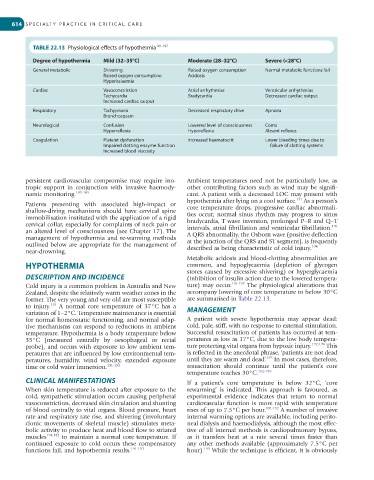
            TABLE 22.13  Physiological effects of hypothermia 191-197

            Degree of hypothermia  Mild (32–35°C)              Moderate (28–32°C)       Severe (<28°C)
            General metabolic      Shivering                   Raised oxygen consumption  Normal metabolic functions fail
                                   Raised oxygen consumption   Acidosis
                                   Hyperkalaemia
            Cardiac                Vasoconstriction            Atrial arrhythmias       Ventricular arrhythmias
                                   Tachycardia                 Bradycardia              Decreased cardiac output
                                   Increased cardiac output
            Respiratory            Tachypnoea                  Decreased respiratory drive  Apnoea
                                   Bronchospasm
            Neurological           Confusion                   Lowered level of consciousness  Coma
                                   Hyperreflexia               Hyporeflexia             Absent reflexes
            Coagulation            Platelet dysfunction        Increased haematocrit    Lower bleeding times due to
                                   Impaired clotting enzyme function                     failure of clotting systems
                                   Increased blood viscosity


         persistent  cardiovascular  compromise  may  require  ino-  Ambient  temperatures  need  not  be  particularly  low,  as
         tropic  support  in  conjunction  with  invasive  haemody-  other contributing factors such as wind may be signifi-
         namic monitoring. 185-189                            cant. A patient with a decreased LOC may present with
                                                                                                  191
                                                              hypothermia after lying on a cool surface.  As a person’s
         Patients  presenting  with  associated  high-impact  or
         shallow-diving  mechanisms  should  have  cervical  spine   core  temperature  drops,  progressive  cardiac  abnormali-
         immobilisation instituted with the application of a rigid   ties  occur;  normal  sinus  rhythm  may  progress  to  sinus
         cervical collar, especially for complaints of neck pain or   bradycardia, T wave inversion, prolonged P–R and Q–T
                                                                                                              191
         an altered level of consciousness (see Chapter 17). The   intervals, atrial fibrillation and ventricular fibrillation.
         management  of  hypothermia  and  re-warming  methods   A QRS abnormality, the Osborn wave (positive deflection
         outlined below are appropriate for the management of   at the junction of the QRS and ST segment), is frequently
                                                                                                       194
         near-drowning.                                       described as being characteristic of cold injury.
                                                              Metabolic acidosis and blood-clotting abnormalities are
         HYPOTHERMIA                                          common,  and  hypoglycaemia  (depletion  of  glycogen
                                                              stores caused by excessive shivering) or hyperglycaemia
         DESCRIPTION AND INCIDENCE                            (inhibition of insulin action due to the lowered tempera-
         Cold injury is a common problem in Australia and New   ture) may occur. 191-197  The physiological alterations that
         Zealand, despite the relatively warm weather zones in the   accompany lowering of core temperature to below 30°C
         former. The very young and very old are most susceptible   are summarised in Table 22.13.
                  191
         to  injury.   A  normal  core  temperature  of  37°C  has  a   MANAGEMENT
         variation of 1–2°C. Temperature maintenance is essential
         for normal homeostatic functioning, and normal adap-  A  patient  with  severe  hypothermia  may  appear  dead:
         tive mechanisms can respond to reductions in ambient   cold, pale, stiff, with no response to external stimulation.
         temperature. Hypothermia is a body temperature below   Successful resuscitation of patients has occurred at tem-
         35°C  (measured  centrally  by  oesophageal  or  rectal   peratures as low as 17°C, due to the low body tempera-
         probe), and occurs with exposure to low ambient tem-  ture protecting vital organs from hypoxic injury. 192-196  This
         peratures that are influenced by low environmental tem-  is reflected in the anecdotal phrase, ‘patients are not dead
         peratures,  humidity,  wind  velocity,  extended  exposure   until they are warm and dead’. 193  In most cases, therefore,
         time or cold water immersion. 191-193                resuscitation  should  continue  until  the  patient’s  core
                                                              temperature reaches 30°C. 192-196
         CLINICAL MANIFESTATIONS                              If  a  patient’s  core  temperature  is  below  32°C,  ‘core
         When skin temperature is reduced after exposure to the   rewarming’  is  indicated.  This  approach  is  favoured,  as
         cold, sympathetic stimulation occurs causing peripheral   experimental  evidence  indicates  that  return  to  normal
         vasoconstriction, decreased skin circulation and shunting   cardiovascular function is more rapid with temperature
         of blood centrally to vital organs. Blood pressure, heart   rises of up to 7.5°C per hour. 191,192  A number of invasive
         rate and respiratory rate rise, and shivering (involuntary   internal warming options are available, including perito-
         clonic  movements  of  skeletal  muscle)  stimulates  meta-  neal dialysis and haemodialysis, although the most effec-
         bolic activity to produce heat and blood flow to striated   tive of all internal methods is cardiopulmonary bypass,
         muscles 191,192  to maintain a normal core temperature. If   as  it  transfers  heat  at  a  rate  several  times  faster  than
         continued  exposure  to  cold  occurs  these  compensatory   any  other  methods  available  (approximately  7.5°C  per
         functions fail, and hypothermia results. 191-193     hour). 195  While the technique is efficient, it is obviously

