


Page 635 - ACCCN's Critical Care Nursing
P. 635
612  S P E C I A LT Y   P R A C T I C E   I N   C R I T I C A L   C A R E


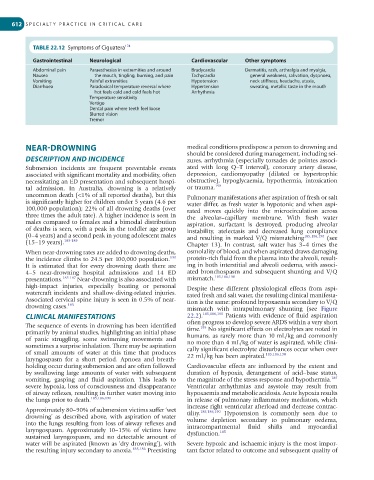
            TABLE 22.12  Symptoms of Ciguatera 174

            Gastrointestinal  Neurological                      Cardiovascular   Other symptoms
            Abdominal pain    Paraesthesias in extremities and around   Bradycardia  Dermatitis, rash, arthralgia and myalgia,
            Nausea              the mouth, tingling, burning, and pain  Tachycardia  general weakness, salivation, dyspnoea,
            Vomiting          Painful extremities               Hypotension        neck stiffness, headache, ataxia,
            Diarrhoea         Paradoxical temperature reversal where   Hypertension  sweating, metallic taste in the mouth
                                hot feels cold and cold feels hot  Arrhythmia
                              Temperature sensitivity
                              Vertigo
                              Dental pain where teeth feel loose
                              Blurred vision
                              Tremor


         NEAR-DROWNING                                        medical conditions predispose a person to drowning and
         DESCRIPTION AND INCIDENCE                            should be considered during management, including sei-
                                                              zures, arrhythmia (especially torsades de pointes associ-
         Submersion  incidents  are  frequent  preventable  events   ated  with  long  Q–T  interval),  coronary  artery  disease,
         associated with significant mortality and morbidity, often   depression,  cardiomyopathy  (dilated  or  hypertrophic
         necessitating an ED presentation and subsequent hospi-  obstructive),  hypoglycaemia,  hypothermia,  intoxication
         tal  admission.  In  Australia,  drowning  is  a  relatively   or trauma. 190
         uncommon death (<1% of all reported deaths), but this   Pulmonary manifestations after aspiration of fresh or salt
         is significantly higher for children under 5 years (4.6 per   water differ, as fresh water is hypotonic and when aspi-
         100,000 population); 22% of all drowning deaths (over   rated  moves  quickly  into  the  microcirculation  across
         three times the adult rate). A higher incidence is seen in   the  alveolar–capillary  membrane.  With  fresh  water
         males compared to females and a bimodal distribution   aspiration,  surfactant  is  destroyed,  producing  alveolar
         of deaths is seen, with a peak in the toddler age group   instability,  atelectasis  and  decreased  lung  compliance
         (0–4 years) and a second peak in young adolescent males   and  resulting  in  marked  V/Q  mismatching 185,186,190   (see
         (15–19 years). 185-189                               Chapter  13).  In  contrast,  salt  water  has  3–4  times  the
         When near-drowning rates are added to drowning deaths,   osmolality of blood, and when aspirated draws damaging
                                                         190
         the incidence climbs to 24.5 per 100,000 population.    protein-rich fluid from the plasma into the alveoli, result-
         It  is  estimated  that  for  every  drowning  death  there  are     ing in both interstitial and alveoli oedema, with associ-
         4–5  near-drowning  hospital  admissions  and  14  ED   ated  bronchospasm  and  subsequent  shunting  and  V/Q
         presentations. 185-187  Near-drowning is also associated with   mismatch. 185,186,190
         high-impact  injuries,  especially  boating  or  personal   Despite  these  different  physiological  effects  from  aspi-
         watercraft  incidents  and  shallow-diving-related  injuries.   rated fresh and salt water, the resulting clinical manifesta-
         Associated cervical spine injury is seen in 0.5% of near-  tion is the same: profound hypoxaemia secondary to V/Q
         drowning cases. 185                                  mismatch  with  intrapulmonary  shunting  (see  Figure
         CLINICAL MANIFESTATIONS                              22.2). 185,186,190  Patients with evidence of fluid aspiration
         The sequence of events in drowning has been identified   often progress to develop severe ARDS within a very short
                                                                   185
         primarily by animal studies, highlighting an initial phase   time.   No significant effects on electrolytes are noted in
         of  panic  struggling,  some  swimming  movements  and   humans, as rarely more than 10 mL/kg and commonly
         sometimes a surprise inhalation. There may be aspiration   no more than 4 mL/kg of water is aspirated, while clini-
         of  small  amounts  of  water  at  this  time  that  produces   cally significant electrolyte disturbances occur when over
                                                                                        185,186,190
         laryngospasm  for  a  short  period.  Apnoea  and  breath-  22 mL/kg has been aspirated.
         holding occur during submersion and are often followed   Cardiovascular  effects  are  influenced  by  the  extent  and
         by swallowing large amounts of water with subsequent   duration  of  hypoxia,  derangement  of  acid–base  status,
         vomiting,  gasping  and  fluid  aspiration.  This  leads  to   the magnitude of the stress response and hypothermia. 185
         severe hypoxia, loss of consciousness and disappearance   Ventricular  arrhythmias  and  asystole  may  result  from
         of airway reflexes, resulting in further water moving into   hypoxaemia and metabolic acidosis. Acute hypoxia results
         the lungs prior to death. 185,186,190                in release of pulmonary inflammatory mediators, which
                                                              increase right ventricular afterload and decrease contrac-
         Approximately 80–90% of submersion victims suffer ‘wet   tility. 185,186,190   Hypotension  is  commonly  seen  due  to
         drowning’  as  described  above,  with  aspiration  of  water   volume  depletion  secondary  to  pulmonary  oedema,
         into the lungs resulting from loss of airway reflexes and   intracompartmental   fluid   shifts   and   myocardial
         laryngospasm.  Approximately  10–15%  of  victims  have   dysfunction. 185
         sustained  laryngospasm,  and  no  detectable  amount  of
         water will be aspirated (known as ‘dry drowning’), with   Severe hypoxic and ischaemic injury is the most impor-
         the resulting injury secondary to anoxia. 185,186  Preexisting   tant factor related to outcome and subsequent quality of

