


Page 636 - ACCCN's Critical Care Nursing
P. 636
Emergency Presentations 613


                                  Aspiration                      may cause a rise in intracranial pressure (ICP). A 12-lead
                  Fresh water                    Salt water       ECG identifies any arrhythmias (resulting from acidosis
                                                                  and  hypoxia  rather  than  electrolyte  abnormalities)  and
                                                                  the  patient  is  managed  conventionally  (see  Chapter
                                Bronchospasm          Alveolar    11). 187   All  patients  require  serial  chest  X-rays,  as  lung
             Surfactant
                              Acute emphysema         oedema      fields  often  worsen  in  the  first  few  hours.  In  clinically
                                                                  significant  submersions,  the  chest  X-ray  will  typically
                                                                  show  bilateral  infiltrates  undifferentiated  from  other
                                V/Q-mismatch                      causes of pulmonary oedema.
                                 Atelectasis
                                 Compliance        WOB            MANAGEMENT

                                                                  The condition of the patient, the environment and the
                                                                  skill of the attending rescue personnel will influence pre-
                                                                  hospital management of the postsubmersion patient, and
                                  Hypoxia                         the adequacy of initial basic life support at the scene is
                                  Acidosis                        the  most  important  determinant  of  outcome. 188   The
                                                                  Heimlich  manoeuvre  should  not  be  performed  in  an
            V/Q-mismatch, ventilation/perfusion mismatch; WOB, work of breathing.
                                                                  attempt  to  remove  aspirated  water,  as  it  is  ineffective
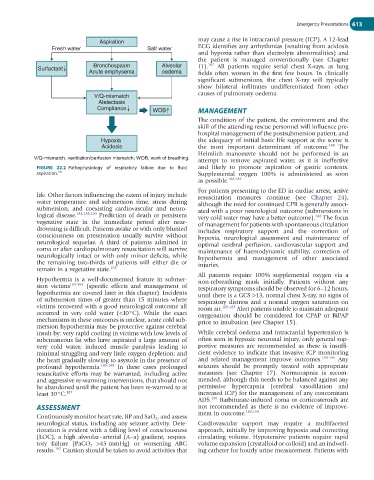
             FIGURE  22.2  Pathophysiology  of  respiratory  failure  due  to  fluid   and  likely  to  promote  aspiration  of  gastric  contents.
                    185
             aspiration.                                          Supplemental  oxygen  100%  is  administered  as  soon
                                                                  as possible. 188,189
                                                                  For patients presenting to the ED in cardiac arrest, active
             life. Other factors influencing the extent of injury include   resuscitation  measures  continue  (see  Chapter  24),
             water  temperature  and  submersion  time,  stress  during   although the need for continued CPR is generally associ-
             submersion,  and  coexisting  cardiovascular  and  neuro-  ated with a poor neurological outcome (submersions in
             logical disease. 185,186,190  Prediction of death or persistent   very cold water may have a better outcome). 188  The focus
             vegetative  state  in  the  immediate  period  after  near-  of management for patients with spontaneous circulation
             drowning is difficult. Patients awake or with only blunted   includes  respiratory  support  and  the  correction  of
             consciousness  on  presentation  usually  survive  without   hypoxia,  neurological  assessment  and  maintenance  of
             neurological  sequelae.  A  third  of  patients  admitted  in   optimal  cerebral  perfusion,  cardiovascular  support  and
             coma or after cardiopulmonary resuscitation will survive   maintenance  of  haemodynamic  stability,  correction  of
             neurologically intact or with only minor deficits, while   hypothermia  and  management  of  other  associated
             the  remaining  two-thirds  of  patients  will  either  die  or   injuries.
             remain in a vegetative state. 185
                                                                  All  patients  require  100%  supplemental  oxygen  via  a
             Hypothermia  is  a  well-documented  feature  in  submer-  non-rebreathing  mask  initially.  Patients  without  any
             sion  victims 185-189   (specific  effects  and  management  of   respiratory symptoms should be observed for 6–12 hours,
             hypothermia are covered later in this chapter). Incidents   until there is a GCS >13, normal chest X-ray, no signs of
             of submersion times of greater than 15 minutes where   respiratory  distress  and  a  normal  oxygen  saturation  on
             victims recovered with a good neurological outcome all   room air. 185-187  Alert patients unable to maintain adequate
             occurred  in  very  cold  water  (<10°C).  While  the  exact   oxygenation  should  be  considered  for  CPAP  or  BiPAP
             mechanisms in these outcomes is unclear, acute cold sub-  prior to intubation (see Chapter 15).
             mersion hypothermia may be protective against cerebral
             insult by: very rapid cooling in victims with low levels of   While cerebral oedema and intracranial hypertension is
             subcutaneous fat who have aspirated a large amount of   often seen in hypoxic neuronal injury, only general sup-
             very  cold  water;  induced  muscle  paralysis  leading  to   portive  measures  are  recommended  as  there  is  insuffi-
             minimal struggling and very little oxygen depletion; and   cient evidence to indicate that invasive ICP monitoring
             the heart gradually slowing to asystole in the presence of   and  related  management  improve  outcomes. 185-189   Any
             profound  hypothermia. 185-188   In  these  cases  prolonged   seizures  should  be  promptly  treated  with  appropriate
             resuscitative  efforts  may  be  warranted,  including  active   measures  (see  Chapter  17).  Normocapnia  is  recom-
             and aggressive re-warming interventions, that should not   mended, although this needs to be balanced against any
             be abandoned until the patient has been re-warmed to at   permissive  hypercapnia  (cerebral  vasodilation  and
             least 30°C. 187                                      increased ICP) for the management of any concomitant
                                                                  ADS.  Barbiturate-induced coma or corticosteroids are
                                                                      190
             ASSESSMENT                                           not  recommended  as  there  is  no  evidence  of  improve-
                                                                                 189,190
             Continuously monitor heart rate, BP and SaO 2 , and assess   ment in outcome.
             neurological status, including any seizure activity. Dete-  Cardiovascular  support  may  require  a  multifaceted
             rioration is evident with a falling level of consciousness   approach, initially by improving hypoxia and correcting
             (LOC),  a  high  alveolar–arterial  (A–a)  gradient,  respira-  circulating  volume.  Hypotensive  patients  require  rapid
             tory  failure  (PaCO 2  >45 mmHg)  or  worsening  ABG   volume expansion (crystalloid or colloid) and an indwell-
             results. 187  Caution should be taken to avoid activities that   ing catheter for hourly urine measurement. Patients with

