


Page 649 - ACCCN's Critical Care Nursing
P. 649
626  S P E C I A LT Y   P R A C T I C E   I N   C R I T I C A L   C A R E

                                                              of  other  injuries,  for  example  neurological  trauma  or
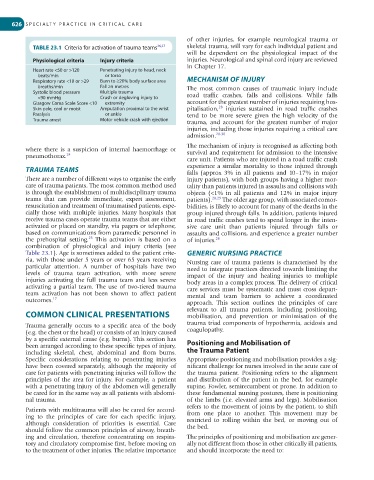
            TABLE 23.1  Criteria for activation of trauma teams 26,27  skeletal trauma, will vary for each individual patient and
                                                              will  be  dependent  on  the  physiological  impact  of  the
            Physiological criteria  Injury criteria           injuries. Neurological and spinal cord injury are reviewed
                                                              in Chapter 17.
            Heart rate <50 or >120   Penetrating injury to head, neck
             beats/min             or torso
            Respiratory rate <10 or >29   Burn to ≥20% body surface area  MECHANISM OF INJURY
             breaths/min          Fall ≥5 metres              The  most  common  causes  of  traumatic  injury  include
            Systolic blood pressure   Multiple trauma
             <90 mmHg             Crush or degloving injury to   road  traffic  crashes,  falls  and  collisions.  While  falls
            Glasgow Coma Scale Score <10  extremity           account for the greatest number of injuries requiring hos-
                                                                         28
            Skin pale, cool or moist  Amputation proximal to the wrist   pitalisation,   injuries  sustained  in  road  traffic  crashes
            Paralysis              or ankle                   tend  to  be  more  severe  given  the  high  velocity  of  the
            Trauma arrest         Motor vehicle crash with ejection  trauma,  and  account  for  the  greatest  number  of  major
                                                              injuries, including those injuries requiring a critical care
                                                              admission. 28-30
                                                              The mechanism of injury is recognised as affecting both
         where  there  is  a  suspicion  of  internal  haemorrhage  or   survival and requirement for admission to the intensive
         pneumothorax. 24
                                                              care unit. Patients who are injured in a road traffic crash
         TRAUMA TEAMS                                         experience a similar mortality to those injured through
                                                              falls  (approx  3%  in  all  patients  and  10–17%  in  major
         There are a number of different ways to organise the early   injury patients), with both groups having a higher mor-
         care of trauma patients. The most common method used   tality than patients injured in assaults and collisions with
         is through the establishment of multidisciplinary trauma   objects  (<1%  in  all  patients  and  12%  in  major  injury
         teams  that  can  provide  immediate,  expert  assessment,   patients). 28,29  The older age group, with associated comor-
         resuscitation and treatment of traumatised patients, espe-  bidities, is likely to account for many of the deaths in the
         cially those with multiple injuries. Many hospitals that   group injured through falls. In addition, patients injured
         receive trauma cases operate trauma teams that are either   in road traffic crashes tend to spend longer in the inten-
         activated or placed on standby, via pagers or telephone,   sive  care  unit  than  patients  injured  through  falls  or
         based on communications from paramedic personnel in   assaults and collisions, and experience a greater number
                              25
         the  prehospital  setting.   This  activation  is  based  on  a   of injuries. 28
         combination  of  physiological  and  injury  criteria  (see
         Table 23.1). Age is sometimes added to the patient crite-  GENERIC NURSING PRACTICE
         ria, with those under 5 years or over 65 years receiving   Nursing  care  of  trauma  patients  is  characterised  by  the
         particular  attention.  A  number  of  hospitals  have  two   need to integrate practices directed towards limiting the
         levels  of  trauma  team  activation,  with  more  severe     impact  of  the  injury  and  healing  injuries  to  multiple
         injuries  activating  the  full  trauma  team  and  less  severe   body areas in a complex process. The delivery of critical
         activating  a  partial  team.  The  use  of  two-tiered  trauma   care services must be systematic and must cross depart-
         team  activation  has  not  been  shown  to  affect  patient   mental  and  team  barriers  to  achieve  a  coordinated
         outcomes. 17                                         approach.  This  section  outlines  the  principles  of  care
                                                              relevant  to  all  trauma  patients,  including  positioning,
         COMMON CLINICAL PRESENTATIONS                        mobilisation,  and  prevention  or  minimisation  of  the

         Trauma  generally  occurs  to  a  specific  area  of  the  body   trauma triad components of hypothermia, acidosis and
         (e.g. the chest or the head) or consists of an injury caused   coagulopathy.
         by a specific external cause (e.g. burns). This section has
         been arranged according to these specific types of injury,   Positioning and Mobilisation of
         including  skeletal,  chest,  abdominal  and  from  burns.   the Trauma Patient
         Specific  considerations  relating  to  penetrating  injuries   Appropriate positioning and mobilisation provides a sig-
         have  been  covered  separately,  although  the  majority  of   nificant challenge for nurses involved in the acute care of
         care for patients with penetrating injuries will follow the   the  trauma  patient.  Positioning  refers  to  the  alignment
         principles of the area for injury. For example, a patient   and distribution of the patient in the bed, for example
         with a penetrating injury of the abdomen will generally   supine, Fowler, semirecumbent or prone. In addition to
         be cared for in the same way as all patients with abdomi-  these fundamental nursing postures, there is positioning
         nal trauma.                                          of the limbs (i.e. elevated arms and legs). Mobilisation
                                                              refers to the movement of joints by the patient, to shift
         Patients with multitrauma will also be cared for accord-  from  one  place  to  another.  This  movement  may  be
         ing  to  the  principles  of  care  for  each  specific  injury,   restricted  to  rolling  within  the  bed,  or  moving  out  of
         although  consideration  of  priorities  is  essential.  Care   the bed.
         should follow the common principles of airway, breath-
         ing  and  circulation,  therefore  concentrating  on  respira-  The principles of positioning and mobilisation are gener-
         tory and circulatory compromise first, before moving on   ally not different from those in other critically ill patients,
         to the treatment of other injuries. The relative importance   and should incorporate the need to:

