


Page 651 - ACCCN's Critical Care Nursing
P. 651
628  S P E C I A LT Y   P R A C T I C E   I N   C R I T I C A L   C A R E


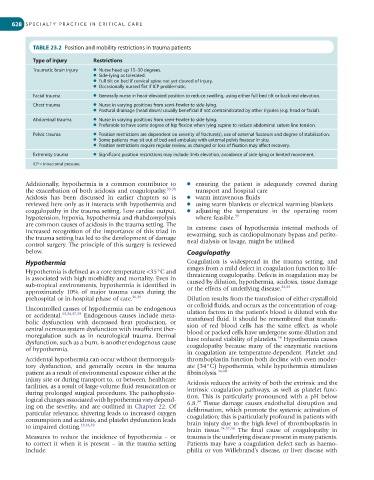
            TABLE 23.2  Position and mobility restrictions in trauma patients

            Type of injury      Restrictions
            Traumatic brain injury  l  Nurse head up 15–30 degrees.
                                l  Side-lying as tolerated.
                                l  Full tilt on bed if cervical spine not yet cleared of injury.
                                l  Occasionally nursed flat if ICP problematic.
            Facial trauma       l  Generally nurse in head-elevated position to reduce swelling, using either full bed tilt or back rest elevation.
            Chest trauma        l  Nurse in varying positions from semi-Fowler to side-lying.
                                l  Postural drainage (head down) usually beneficial if not contraindicated by other injuries (e.g. head or facial).
            Abdominal trauma    l  Nurse in varying positions from semi-Fowler to side-lying.
                                l  Preferable to have some degree of hip flexion when lying supine to reduce abdominal suture line tension.
            Pelvic trauma       l  Position restrictions are dependent on severity of fracture(s), use of external fixateurs and degree of stabilisation.
                                l  Some patients may sit out of bed and ambulate with external pelvis fixateur in situ.
                                l  Position restrictions require regular review, as changed or loss of fixation may affect recovery.
            Extremity trauma    l  Significant position restrictions may include limb elevation, avoidance of side-lying or limited movement.
            ICP = intracranial pressure.


         Additionally,  hypothermia  is  a  common  contributor  to   l  ensuring  the  patient  is  adequately  covered  during
         the exacerbation of both acidosis and coagulopathy. 33-38    transport and hospital care
         Acidosis  has  been  discussed  in  earlier  chapters  so  is   l  warm intravenous fluids
         reviewed here only as it interacts with hypothermia and   l  using warm blankets or electrical warming blankets
         coagulopathy in the trauma setting. Low cardiac output,   l  adjusting  the  temperature  in  the  operating  room
         hypotension, hypoxia, hypothermia and rhabdomyolysis    where feasible. 39
         are common causes of acidosis in the trauma setting. The
         increased recognition of the importance of this triad in   In  extreme  cases  of  hypothermia  internal  methods  of
         the trauma setting has led to the development of damage   rewarming, such as cardiopulmonary bypass and perito-
         control surgery. The principle of this surgery is reviewed   neal dialysis or lavage, might be utilised.
         below.                                               Coagulopathy

         Hypothermia                                          Coagulation  is  widespread  in  the  trauma  setting,  and
         Hypothermia is defined as a core temperature <35°C and   ranges from a mild defect in coagulation function to life-
         is associated with high morbidity and mortality. Even in   threatening coagulopathy. Defects in coagulation may be
         sub-tropical environments, hypothermia is identified in   caused by dilution, hypothermia, acidosis, tissue damage
                                                                                             34,35
         approximately  10%  of  major  trauma  cases  during  the   or the effects of underlying disease.
         prehospital or in-hospital phase of care. 36,39      Dilution results from the transfusion of either crystalloid
                                                              or colloid fluids, and occurs as the concentration of coag-
         Uncontrolled causes of hypothermia can be endogenous   ulation factors in the patient’s blood is diluted with the
         or  accidental. 33,34,37,39   Endogenous  causes  include  meta-  transfused fluid. It should be remembered that transfu-
         bolic  dysfunction  with  decreased  heat  production,  or   sion  of  red  blood  cells  has  the  same  effect,  as  whole
         central nervous system dysfunction with insufficient ther-  blood or packed cells have undergone some dilution and
         moregulation  such  as  in  neurological  trauma.  Dermal   have reduced viability of platelets.  Hypothermia causes
                                                                                            38
         dysfunction, such as a burn, is another endogenous cause   coagulopathy because many of the enzymatic reactions
         of hypothermia.
                                                              in  coagulation  are  temperature-dependent.  Platelet  and
         Accidental hypothermia can occur without thermoregula-  thromboplastin function both decline with even moder-
         tory  dysfunction,  and  generally  occurs  in  the  trauma   ate (34°C) hypothermia, while hypothermia stimulates
         patient as a result of environmental exposure either at the   fibrinolysis. 34,40
         injury site or during transport to, or between, healthcare
         facilities, as a result of large-volume fluid resuscitation or   Acidosis reduces the activity of both the extrinsic and the
         during prolonged surgical procedures. The pathophysio-  intrinsic coagulation pathways, as well as platelet func-
         logical changes associated with hypothermia vary depend-  tion.  This  is  particularly  pronounced  with  a  pH  below
                                                                 34
         ing on the severity, and are outlined in Chapter 22. Of   6.8.  Tissue damage causes endothelial disruption and
         particular relevance, shivering leads to increased oxygen   defibrination, which promote the systemic activation of
         consumption and acidosis, and platelet dysfunction leads   coagulation; this is particularly profound in patients with
         to impaired clotting. 33,36,39                       brain injury due to the high level of thromboplastin in
                                                              brain  tissue. 34,37,38   The  final  cause  of  coagulopathy  in
         Measures  to  reduce  the  incidence  of  hypothermia  –  or    trauma is the underlying disease present in many patients.
         to  correct  it  when  it  is  present  –  in  the  trauma  setting   Patients may have a coagulation defect such as haemo-
         include:                                             philia or von Willebrand’s disease, or liver disease with

