


Page 654 - ACCCN's Critical Care Nursing
P. 654
Trauma Management 631

                infection  risk  and  require  surgical  treatment  within     l  Fractures of the pelvis. The pelvis is the largest com-
                8 hours. 50,51                                       bined bony structure in the body and serves to provide
             l  Traumatic amputation. Amputation refers to an avul-  an  essential  supporting  framework  for  ambulation
                sion in which the affected limb or body appendage is   and protection of pelvic organs. Major blood vessels
                completely separated from the body. This can occur   and  nerves  traverse  the  pelvic  bones,  supplying  the
                when  a  digit  or  extremity  is  sheared  off  by  either   lower  limbs  and  pelvic  organs.  Therefore,  injury  to
                mechanical  or  severing  forces,  for  example  amputa-  any part of the pelvis is serious. The three bones that
                tion of a thumb by a bandsaw. Traumatic amputations   comprise  the  pelvic  ring  are  the  two  innominate
                vary  in  severity  and  ongoing  compromise,  with  a   bones (ilium and pubic rami) and the sacrum. Due
                cleancut  amputation  more  likely  to  be  successfully   to  its  reinforced  structure,  the  amount  of  force
                reattached  than  a  crushed  extremity.  Criteria  that   required to fracture the pelvis is substantial. Fractures
                inform the surgical decision-making process include   of the pelvis can affect one or both sides of the pelvis,
                the amount of tissue loss, location on the body at the   and be stable or unstable. A variety of classification
                connection site, damage to underlying and surround-  systems  exist  to  describe  the  severity  of  pelvic  frac-
                ing  tissues,  bones,  nerves,  tendons/muscles  and   tures, the most common being the Tile classification
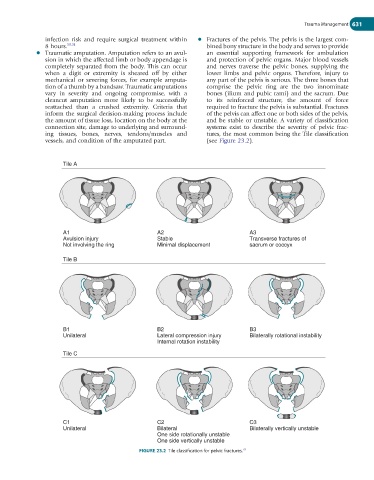
                vessels, and condition of the amputated part.        (see Figure 23.2).


                      Tile A


                      A1                            A2                             A3
                      Avulsion injury               Stable                         Transverse fractures of
                      Not involving the ring        Minimal displacement           sacrum or coccyx

                      Tile B


                      B1                            B2                             B3
                      Unilateral                    Lateral compression injury     Bilaterally rotational instability
                                                    Internal rotation instability
                      Tile C


                      C1                            C2                             C3
                      Unilateral                    Bilateral                      Bilaterally vertically unstable
                                                    One side rotationally unstable
                                                    One side vertically unstable
                                               FIGURE 23.2  Tile classification for pelvic fractures.
                                                                                79

