


Page 668 - ACCCN's Critical Care Nursing
P. 668
Trauma Management 645


               BOX 23.1  Criteria for treatment in a                TABLE 23.11  Systemic changes that occur with
               specialised burn centre 77                           burn injuries 71

               l  Burns greater than 10% of total body surface area (TBSA)  System affected  Pathophysiological change
               l  Burns to special areas: face, hands, feet, genitalia, perineum,
                  major joints                                      Cardiovascular system  l  Increased capillary permeability
                                                                                       leading to capillary leak of
               l  Full-thickness burns greater than 5% of TBSA                         intravascular proteins and fluids to
               l  Electrical burns                                                     interstitial compartment
               l  Chemical burns                                                      l  Peripheral and splanchnic
                                                                                       vasoconstriction
               l  Burns with an associated inhalation injury                          l  Reduced myocardial contractility
               l  Circumferential burns of the limbs or chest                         l  Systemic hypovolaemia due to
               l  Burns in the very young or very old                                  above, plus fluid loss from burn
               l  Burns  in  people  with  preexisting  medical  disorders  that   Respiratory system  l  Bronchoconstriction
                  could  complicate  management,  prolong  recovery  or               l  Adult respiratory distress syndrome
                  increase mortality
               l  Burns with associated trauma                      Metabolic system  l  Increased basal metabolic rate (up to
                                                                                       3 times normal)
               l  The possibility of non-accidental injury in children                l  Above, plus splanchnic
                                                                                       vasoconstriction, will lead to
                                                                                       catabolism if patient not fed early
                                                                                       and aggressively

                     Zone of                      Zone of           Immunological system  l  Downregulation of immune response
                     coagulation                  stasis
                                                  Zone of
                     Epidermis                    hyperaemia
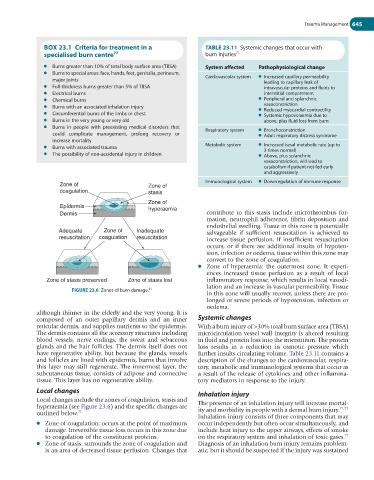
                     Dermis                                          contribute to this stasis include microthrombus for-
                                                                     mation, neutrophil adherence, fibrin deposition and
                                                                     endothelial swelling. Tissue in this zone is potentially
                    Adequate       Zone of    Inadequate             salvageable  if  sufficient  resuscitation  is  achieved  to
                    resuscitation  coagulation  resuscitation        increase tissue perfusion. If insufficient resuscitation
                                                                     occurs, or if there are additional insults of hypoten-
                                                                     sion, infection or oedema, tissue within this zone may
                                                                     convert to the zone of coagulation.
                                                                  l  Zone  of  hyperaemia:  the  outermost  zone.  It  experi-
                                                                     ences  increased  tissue  perfusion  as  a  result  of  local
                Zone of stasis preserved   Zone of stasis lost       inflammatory response, which results in local vasodi-
                                                                     lation and an increase in vascular permeability. Tissue
                         FIGURE 23.6  Zones of burn damage.
                                                  81
                                                                     in this zone will usually recover, unless there are pro-
                                                                     longed or severe periods of hypotension, infection or
                                                                     oedema.
             although thinner in the elderly and the very young. It is
             composed  of  an  outer  papillary  dermis  and  an  inner   Systemic changes
             reticular dermis, and supplies nutrients to the epidermis.   With a burn injury of >30% total burn surface area (TBSA)
             The dermis contains all the accessory structures including   microcirculation vessel wall integrity is altered resulting
             blood  vessels,  nerve  endings,  the  sweat  and  sebaceous   in fluid and protein loss into the interstitium. The protein
             glands and the hair follicles. The dermis itself does not   loss  results  in  a  reduction  in  osmotic  pressure  which
             have regenerative ability, but because the glands, vessels   further insults circulating volume. Table 23.11 contains a
             and follicles are lined with epidermis, burns that involve   description of the changes to the cardiovascular, respira-
             this layer may still regenerate. The innermost layer, the   tory, metabolic and immunological systems that occur as
             subcutaneous tissue, consists of adipose and connective   a result of the release of cytokines and other inflamma-
             tissue. This layer has no regenerative ability.      tory mediators in response to the injury.
             Local changes                                        Inhalation injury
             Local changes include the zones of coagulation, stasis and
             hyperaemia (see Figure 23.6) and the specific changes are   The presence of an inhalation injury will increase mortal-
                                                                                                                71,72
             outlined below. 71                                   ity and morbidity in people with a dermal burn injury.
                                                                  Inhalation injury consists of three components that may
             l  Zone of coagulation: occurs at the point of maximum   occur independently but often occur simultaneously, and
                damage. Irreversible tissue loss occurs in this zone due   include heat injury to the upper airways, effects of smoke
                                                                                                                  71
                to coagulation of the constituent proteins.       on the respiratory system and inhalation of toxic gases.
             l  Zone of stasis: surrounds the zone of coagulation and   Diagnosis of an inhalation burn injury remains problem-
                is an area of decreased tissue perfusion. Changes that   atic, but it should be suspected if the injury was sustained

